📲 Join our WhatsApp for Daily Fully Funded Scholarship Alerts
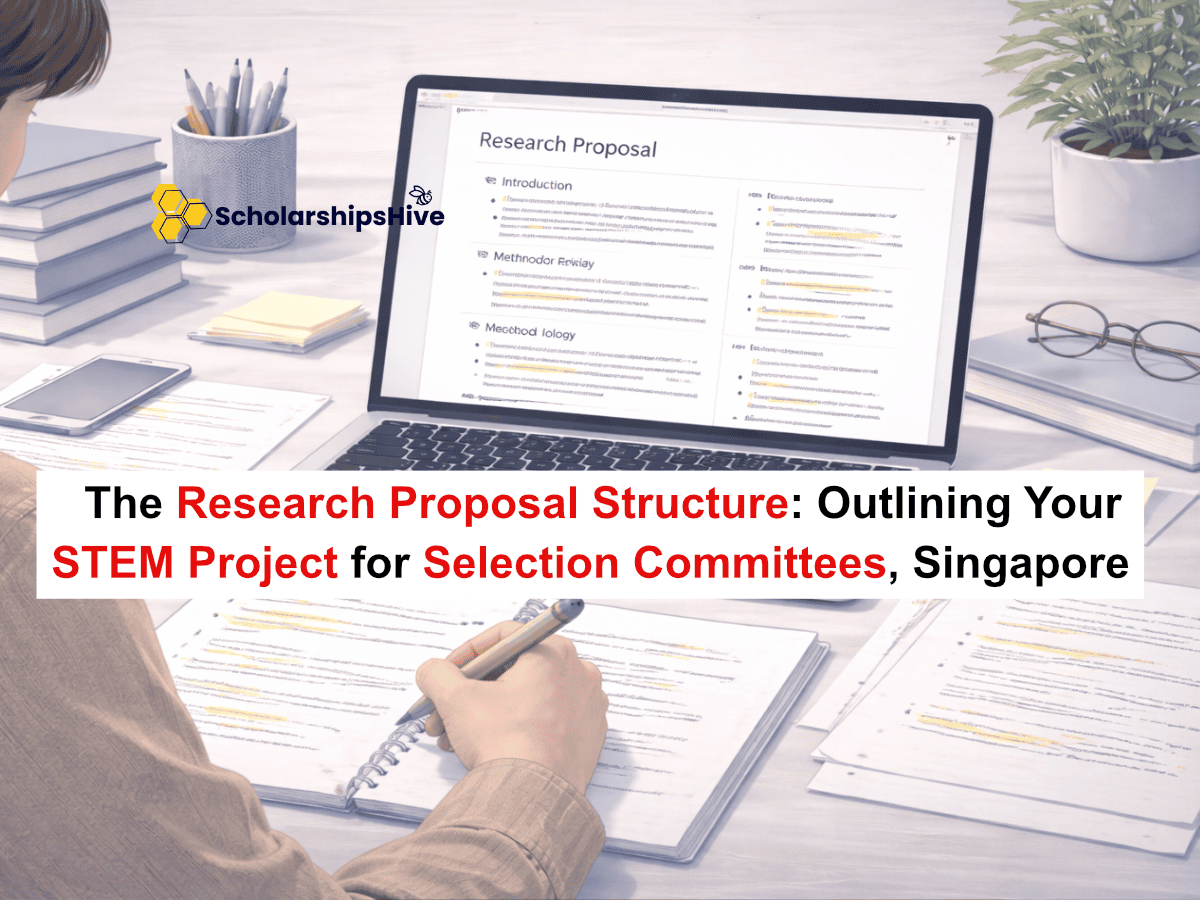
When applying for elite international doctoral fellowships like the Singapore International Graduate Award (SINGA), your academic transcripts and GPA prove your past performance, but your research proposal structure proves your future potential. Co-funded by the Agency for Science, Technology and Research (A*STAR), NUS, NTU, SUTD, SMU, and SIT, SINGA selection committees evaluate thousands of global applicants. The single document that separates shortlisted candidates from immediate rejection is a rigorously structured, scientifically sound research proposal outline.
Because SINGA candidates select pre-approved projects from the official A*STAR portal rather than inventing a completely novel dissertation from scratch, your proposal outline must demonstrate that you deeply understand the selected project’s technical scope, experimental methodology, and industrial or clinical implications.
This exhaustive blueprint breaks down the psychological drivers of the A*STAR selection committees, the precise structural anatomy of a winning STEM research proposal, and a step-by-step framework to draft your project outline for the 2026 cohort.
1. Understanding What the A*STAR Selection Committee Looks For
Before writing a single sentence, you must understand who is reading your proposal. The selection panel typically consists of senior A*STAR principal investigators, research institute directors, and senior university faculty members across biomedical sciences, computing, engineering, and physical sciences.
- Scientific Rigor & Feasibility: They want to see whether you understand the core bottlenecks of the chosen project and whether your proposed experimental roadmap is realistic within a 4-year doctoral window.
- Methodological Alignment: They look for clear proof that your past laboratory techniques, coding experience, or engineering background match the specific demands of the project abstract.
- Translational Potential: A*STAR places heavy emphasis on research that bridges fundamental science with real-world, commercial, or public-sector applications in Singapore and globally.
2. The Anatomy of a Winning Research Proposal Structure
When submitting your supporting documentation and statement of intent for your chosen project codes, structure your technical breakdown using these five core sections:
Section 1: The Context and Scientific Background (The “Why”)
- The Global Research Gap: Begin by introducing the broader scientific domain (e.g., mRNA vaccine delivery, neuromorphic computing, or nanomaterial catalysts). Clearly state what current limitations, inefficiencies, or knowledge gaps exist in existing literature.
- Relevance to Singapore’s R&D Ecosystem: Briefly explain why solving this specific problem matters. Connect your research goals to industrial or technological advancements prioritized in Singapore’s research hubs.
Section 2: Hypotheses and Core Research Objectives (The “What”)
- Primary Research Question: State your central working hypothesis in 1 to 2 precise, testable sentences. Avoid vague or overly broad statements.
- Specific Objectives: Break down the project into 3 distinct milestones (e.g., Phase 1: Synthesis and characterization; Phase 2: In-vitro testing or algorithmic modeling; Phase 3: Validation and scale-up optimization).
Section 3: Methodological Framework and Experimental Design (The “How”)
- Detailed Techniques: Outline the exact laboratory protocols, computational frameworks, or engineering equipment you plan to utilize. Mention specific tools (e.g., Python/PyTorch for AI models, CRISPR-Cas9 for gene editing, or cleanroom photolithography for microelectronics).
- Controls and Troubleshooting: Demonstrate scientific maturity by acknowledging potential technical hurdles (e.g., signal-to-noise ratio issues, cell toxicity, or material degradation) and outlining pre-planned fallback strategies.
Section 4: Expected Deliverables and Impact Metrics
- Tangible Outputs: Define what success looks like by the end of your 4-year candidature—such as publishing 2 to 3 papers in high-impact peer-reviewed journals, filing a joint patent with A*STAR, or developing a functional software prototype.
Section 5: Timeline and Milestone Roadmap (4-Year Horizon)
- Year 1: Core coursework completion, literature review deep-dive, baseline lab setup, and Qualifying Examination (QE) preparation.
- Year 2: Primary data generation, milestone execution, and passing the QE to secure the S$3,200 stipend increase.
- Year 3: Advanced experimentation, scaling trials, and drafting initial manuscripts for journal submission.
- Year 4: Finalizing data validation, writing the doctoral dissertation, and defending your thesis.
You may also like this: Medical Fitness Reports: The Specific Laboratory Checks Required for Saudi University Clearance, Saudi Arabia
3. Step-by-Step Roadmap to Drafting Your Proposal
Step 1: Dissect Your Chosen Portal Project Abstract
Pull the exact project abstract you selected from the SINGA portal. Highlight the principal investigator’s key publications cited in the description and read at least two of them thoroughly.
Step 2: Map Your Skills to the Project Requirements
Explicitly connect your undergraduate or Master’s thesis techniques to the proposed A*STAR project. Show the committee that you are not starting from zero, but rather building directly upon proven laboratory competence.
Step 3: Keep the Language Precise and Concise
Avoid excessive filler words or flowery academic prose. STEM selection committees value technical clarity, quantitative precision, and logical flow above all else.
Check this out: The Foreign Police Clearance Certificate: Formatting Your Local Non-Criminal Background Check in Saudi Arabia
Official Scholarship Links & Resources
- Official SINGA Portal & Guidelines: A*STAR SINGA Application Portal
- A*STAR Research Institutes Directory: A*STAR Research & Facilities Directory
- National University of Singapore Graduate School: NUS Graduate Education Portal
- Join our WhatsApp Channel for the latest updates on international scholarships and deadlines.
Frequently Asked Questions
Am I supposed to invent an entirely original research project for SINGA?
No. SINGA applicants select from a curated list of pre-approved projects posted by A*STAR scientists and university professors on the official portal. Your proposal outline should focus on demonstrating how you plan to execute, troubleshoot, and advance that specific pre-approved project.
How long should the research proposal summary be in the application package?
While requirements can vary slightly depending on portal fields, most application sections allocate space for a 500-to-1000-word statement of purpose or project alignment summary. Keep it concise, punchy, and structurally divided with clear headings.
Can I modify my research proposal after submitting it to the A*STAR portal?
No. Once your application is formally submitted, your project choices and uploaded documents are locked for administrative review. Ensure your proposal is proofread and polished well before hitting the final submit button.
Final thoughts and advice from scholarshipshive
Crafting a compelling research proposal structure for your SINGA application is your golden opportunity to demonstrate intellectual maturity, methodological rigor, and scientific passion. By grounding your outline in the realities of your chosen A*STAR project, detailing clear experimental milestones, and anticipating potential technical bottlenecks, you signal to the selection committee that you are ready to thrive as a doctoral researcher in Singapore’s premier innovation ecosystem. Refine your proposal meticulously, align your skills with precision, and step forward with absolute confidence toward your academic future!