
Medical Fitness Reports: The Specific Laboratory Checks Required for Saudi University Clearance, Saudi Arabia 2026
In this article
- 1. The Purpose and Regulatory Framework of Saudi Student Medical Checks
- 2. Detailed Breakdown of Mandatory Laboratory Checks and Screenings
- 3. Vaccination Requirements Accompanying the Medical Report
- 4. Step-by-Step Procedure for Completing Your Medical Screening
- 5. Common Pitfalls to Avoid During Medical Processing
- Official Scholarship Links & Resources
- Frequently Asked Questions
- Final thoughts and advice from scholarshipshive
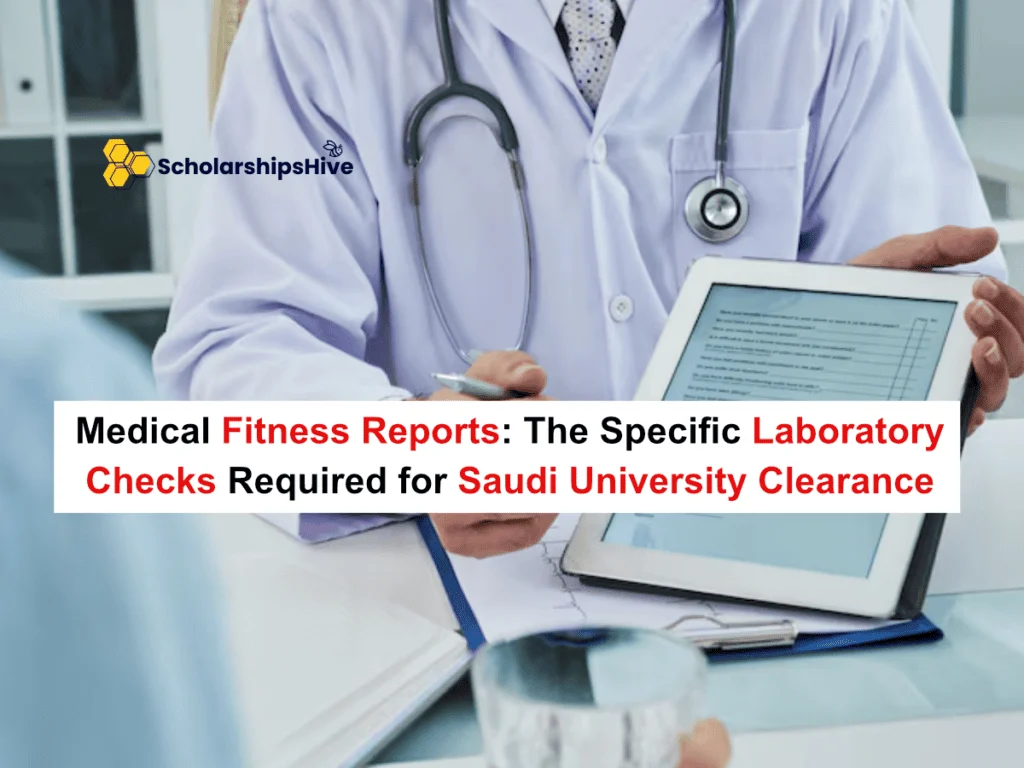
Securing admission and a fully funded scholarship at an elite research institution or public university in the Kingdom of Saudi Arabia—such as King Abdullah University of Science and Technology (KAUST), King Fahd University of Petroleum and Minerals (KFUPM), King Saud University, or the Islamic University of Madinah—is a prestigious accomplishment. However, before an international student can step foot on campus or receive final visa stamping from the Royal Embassy of Saudi Arabia, they must successfully clear one final, non-negotiable administrative hurdle: The Official Medical Fitness Report.
Unlike standard university admission essays or academic transcripts, the medical fitness examination is a sovereign health screening enforced by the Saudi Ministry of Health (MOH) and the Ministry of Foreign Affairs (MOFA). Its purpose is absolute: to ensure that all incoming international students are free from communicable diseases, chronic debilitating conditions, and public health risks. A single failed blood marker or unverified vaccination record can result in immediate visa denial.
This comprehensive guide breaks down the legal framework of Saudi student medical clearances, the specific laboratory tests required, authorized medical centers, and actionable steps to ensure your health screening passes without complication.
1. The Purpose and Regulatory Framework of Saudi Student Medical Checks
The requirement for a standardized Medical Fitness Report is embedded within Saudi immigration law and international student sponsorship bylaws.
- Public Health Safeguards: The Kingdom hosts millions of residents and international pilgrims annually. Consequently, public health security is paramount. The medical screening acts as an epidemiological firewall, ensuring that incoming students do not introduce severe infectious diseases into campus communities or the broader public.
- The Authorized Medical Channel: You cannot simply visit any local clinic and get a checkup. Medical fitness examinations must be conducted at approved, accredited hospitals or authorized medical centers (such as GAMCA / Wafid-approved medical centers in many regions) that are digitally linked to Saudi consular health systems or authorized to issue attested medical certificates.
- Mandatory Submission Stage: While universities issue initial or conditional acceptance letters based on your academic dossier, final visa sponsorship and the generation of your student visa (Ta’asheerah) require the upload and verification of an attested Medical Fitness Report.
2. Detailed Breakdown of Mandatory Laboratory Checks and Screenings
The medical examination is divided into two primary categories: pathology/laboratory diagnostics and clinical physical evaluations. Every candidate must undergo a rigorous battery of tests:
A. Infectious Disease Blood Panels (Serology)
The most critical component of the laboratory screening involves testing for blood-borne and communicable infectious diseases. A positive result for any of the following triggers an automatic, unappealable visa rejection:
- HIV / AIDS Test: Screening via ELISA or Western Blot tests to confirm the absence of Human Immunodeficiency Virus.
- Hepatitis B Surface Antigen (HBsAg): Testing for acute or chronic Hepatitis B infection.
- Hepatitis C Antibody (Anti-HCV): Screening for Hepatitis C virus antibodies.
- Syphilis Screening: Venereal Disease Research Laboratory (VDRL) or Treponema Pallidum Hemagglutination Assay (TPHA) testing to rule out active syphilis infection.
B. Diagnostic Imaging: Chest X-Ray (Tuberculosis Screening)
- Pulmonary Health: Every applicant must undergo a standard digital Chest X-Ray to evaluate lung clarity.
- Exclusion Criteria: The radiologist and reviewing medical officer examine the film specifically for signs of active pulmonary tuberculosis (TB), scarring, calcifications, or other respiratory abnormalities. Any active or latent tubercular lesions result in immediate suspension of medical clearance pending further specialist review or treatment.
C. General Pathology and Urinalysis
- Complete Blood Count (CBC): Evaluates hemoglobin levels, white blood cell (WBC) counts, and platelet distribution to assess overall systemic health and rule out severe blood disorders.
- Renal Function Tests: Blood urea nitrogen (BUN) and serum creatinine levels to evaluate kidney function.
- Random or Fasting Blood Glucose: Screening for uncontrolled diabetes or metabolic abnormalities.
- Routine Urinalysis: Checks for protein, sugar, microscopic hematuria, and urinary tract infections.
D. Physical and Sensory Examinations
In addition to laboratory samples, attending physicians conduct a physical assessment:
- Visual Acuity and Audiometry: Basic eye examinations (checking correctable vision) and hearing evaluations.
- Vital Signs: Recording blood pressure, resting heart rate, height, weight, and Body Mass Index (BMI).
- Physical Disability & Chronic Illness Assessment: Evaluation of neurological, cardiovascular, and musculoskeletal health to ensure the student can endure rigorous academic study without requiring continuous emergency medical intervention.
3. Vaccination Requirements Accompanying the Medical Report
Beyond the diagnostic laboratory tests, Saudi health regulations mandate proof of specific immunizations, which must be documented on your official vaccination card (often requiring the International Certificate of Vaccination or Prophylaxis – ICVP):
- Meningococcal Meningitis (ACWY): Mandatory for all international travelers entering Saudi Arabia. The vaccination must be administered no more than 3 years and no less than 10 days prior to arrival in the Kingdom.
- Polio Vaccination (IPV/OPV): Particularly required for travelers arriving from countries with active polio transmission vectors.
- Routine Adult Boosters: Up-to-date documentation for Tetanus, Diphtheria, Measles, Mumps, Rubella (MMR), and seasonal influenza where applicable.
You may also like this: King Faisal University (KFU) Scholarships: Agricultural and Biological Research Grants in Al-Ahsa, Saudi Arabia | Fully Funded
4. Step-by-Step Procedure for Completing Your Medical Screening
To ensure your medical report is fully accepted by Saudi consulates and VFS Tasheer / visa processing offices, follow this precise workflow:
- Wait for Official Consular Instructions: Do not rush to complete your medical check before receiving official guidance from your admitting university or the Saudi Cultural Attaché. Ensure you know the exact authorized medical centers designated for Saudi visa processing in your home country.
- Schedule Your Appointment: Book your appointment at an authorized medical testing center, bringing your passport, passport-sized photographs, university acceptance letter, and required medical fees.
- Undergo Pathology and Imaging: Complete your blood draws, urine sample collection, chest X-ray, and physical examination in a single visit.
- Review and Attest: Once results are processed (typically taking 3 to 7 working days), the medical center issues the official Medical Fitness Report. Depending on your country, the report may require counter-attestation by your national Ministry of Foreign Affairs (MOFA) before submission to the Saudi embassy.
5. Common Pitfalls to Avoid During Medical Processing
- Using Unauthorized Clinics: Submitting a medical certificate issued by a private, unaccredited local clinic will result in immediate rejection by the Saudi consulate. Always use official, approved medical panels.
- Failing to Check Expiration Windows: Medical fitness reports have a strict validity window (usually 30 to 90 days from the date of issuance to the date of visa stamping). Do your medical check too early, and it will expire before your visa interview; do it too late, and you risk missing university enrollment deadlines.
- Concealing Pre-Existing Chronic Conditions: Attempting to hide severe medical conditions or falsify lab reports is a serious legal offense that leads to permanent blacklisting and deportation if discovered upon arrival at Saudi airports.
Check this out: Jazan University Scholarships: Coastal Research Infrastructure and Student Living Stipends, Saudi Arabia | Fully Funded
Official Scholarship Links & Resources
- Unified Government Scholarship Platform: Study in Saudi Arabia Portal
- Saudi Ministry of Foreign Affairs (MOFA): Visa & Consular Services Portal
- KAUST Admissions Portal: King Abdullah University of Science and Technology
- Join our WhatsApp Channel for the latest updates on international scholarships and deadlines.
Frequently Asked Questions
What happens if my medical report shows a positive result for an infectious disease?
If a medical screening detects active infectious diseases such as HIV, Hepatitis B/C, or Tuberculosis, Saudi immigration and health regulations strictly prohibit the issuance of a residency or student visa. The visa application will be refused, and the applicant cannot appeal the health screening results.
Can I complete my medical fitness test inside Saudi Arabia after arriving on a student visa?
No. International students must complete their mandatory medical fitness screenings and obtain certified reports in their home countries through authorized medical centers before their student visas are stamped by the Saudi embassy. Upon arrival in the Kingdom, universities conduct routine local residency medical checks (Iqama medicals), but initial visa issuance is strictly contingent on home-country clearance.
How long is a Saudi student visa medical report valid?
A medical fitness report is generally valid for 90 days from the date of issue. You must complete your visa stamping process within this window to avoid having to retake the examinations.
Final thoughts and advice from scholarshipshive
Passing your Medical Fitness Report is the final, vital checkpoint in transitioning from an admitted candidate to an officially enrolled international student in Saudi Arabia. By utilizing authorized medical centers, ensuring all mandatory blood tests and chest X-rays meet stringent health standards, and keeping strict track of validity windows, you secure a smooth, stress-free visa stamping process. Complete your health screenings with absolute precision, prepare your vaccination records, and step forward with confidence toward your fully funded academic future in the Kingdom.
Never miss a deadline
Get new fully funded scholarships every day. Follow Scholarships Hive on your favourite app.
Keep reading

Scholarships you can apply for
 Prince Mohammad bin Fahd University (PMU) Scholarships: Global Partnership Options and Fee Waivers 2026, Saudi Arabia | Partially Funded
 King Faisal University (KFU) Scholarships: Agricultural and Biological Research Grants in Al-Ahsa 2026, Saudi Arabia | Fully Funded
 Jazan University Scholarships: Coastal Research Infrastructure and Student Living Stipends 2026, Saudi Arabia | Fully Funded