
Ireland vs UK for Pakistani Students: Cost, Visa and Scholarship Comparison 2026
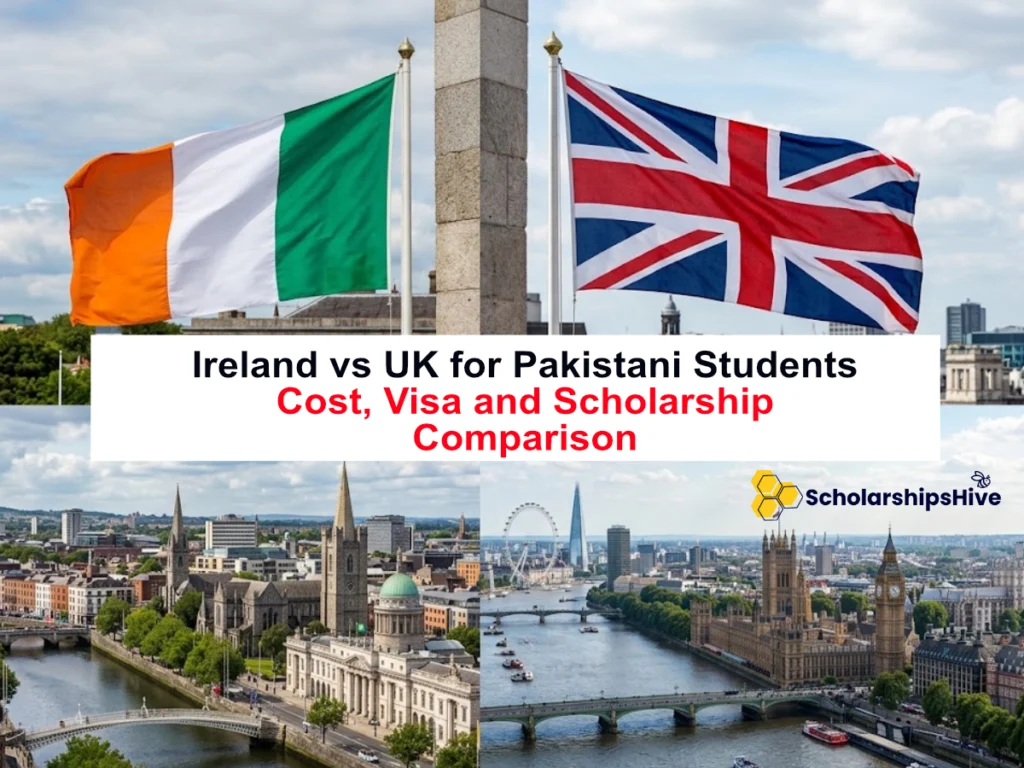
Pakistani families researching study-abroad options tend to mentally file Ireland under “the UK, basically” — same English-speaking environment, similar distance from home, similar-sounding degree structures. The reality is that Ireland and the UK differ meaningfully at almost every layer that actually affects your budget and timeline: tuition, visa cost, financial-proof rules, IELTS thresholds, and post-study work rights. This comparison is for anyone still deciding between the two, not just students who’ve already picked Ireland.
Tuition: Ireland Is Usually Cheaper, But Programme Length Changes the Math
On paper, both countries have broadly overlapping tuition ranges — roughly €10,000–€35,000 a year in Ireland versus £11,000–£38,000 a year in the UK. Ireland comes out cheaper per year in most direct comparisons, and the stronger pound plus the UK’s mandatory health surcharge (covered below) widens that gap further once you look at total cost rather than the headline tuition figure alone.
The detail that changes this calculation is programme length. Most UK taught Master’s programmes run one year; many Irish Master’s programmes run two years. A one-year UK Master’s with a higher annual fee can end up costing less in total than a two-year Irish Master’s with a lower annual fee — so don’t compare annual tuition figures directly without checking your specific programme’s duration in each country.
Visa Cost and Financial Proof: Two Genuinely Different Systems
This is where the countries diverge sharply, and it’s rarely covered clearly for Pakistani applicants specifically.
| Detail | Ireland | UK |
|---|---|---|
| Visa application fee | Roughly €60 | Roughly £524 |
| Mandatory health charge | None | Immigration Health Surcharge (IHS): £776/year for most courses |
| Minimum financial proof | €10,000, shown over roughly 6 months of account history | £12,006 (London) or £9,207 (outside London) for 9 months, shown as a 28-day closing balance |
| Financial evidence style | Ireland wants to see funds sitting in the account for months, not deposited recently | UK wants a stable closing balance held for 28 consecutive days before applying |
The financial-proof difference matters practically, not just numerically. If your family’s savings are in fixed deposits or came from a recent property sale or loan disbursement, the UK’s 28-day rule is more forgiving — you can apply relatively soon after the funds clear. If your family’s savings have been sitting in a standard account for a long time already, Ireland’s 6-month history requirement works in your favor without needing to restructure anything.
For a one-year Master’s, once you add the UK’s visa fee and IHS on top of otherwise similar tuition, Ireland typically comes out a few thousand pounds cheaper at the visa-and-fees layer alone — separate from any tuition difference.
IELTS Requirements: Ireland’s Bar Is Slightly Lower
Both countries require IELTS (or an equivalent test) for visa and admission purposes, but the typical bands differ:
- UK: commonly 6.5–7.5, depending on the course and university
- Ireland: commonly 6.0–7.0, generally a half-band to a full band lower for comparable programme types
If your IELTS score sits in the 6.0–6.5 range, this difference can genuinely widen or narrow your realistic university list between the two countries — it’s worth checking your target programmes in both before assuming your score rules out one destination.
You may also like:
- Fully Funded Government of Ireland Postgraduate Scholarship Programme
- Government of Ireland (GOI-IES) Scholarship (Fully Funded Scholarship for International Students)
- Erasmus Mundus Joint Masters Scholarship (Fully Funded Masters in Europe)
Post-Study Work Rights: The Gap Just Got Bigger
This is the single biggest recent shift affecting the Ireland-vs-UK decision, and it’s dated, so pay attention to when you’d actually be applying.
Ireland’s Stamp 1G (Third Level Graduate Programme) gives Honours Bachelor’s (Level 8) graduates 12 months to find graduate-level work, and Master’s or PhD (Level 9/10) graduates up to 24 months, without needing a job offer in advance.
The UK’s Graduate Route currently offers 24 months for Bachelor’s and Master’s graduates, and 3 years for PhD graduates — but this is changing. Under Statement of Changes HC 1691, anyone applying for the Graduate Route on or after January 1, 2027 will receive only 18 months for Bachelor’s and Master’s graduates (PhDs remain unaffected at 3 years). If you start a UK Master’s in September 2026, you’ll typically graduate around September 2027 and file your Graduate Route application after the January 1 cutoff — meaning you’d receive 18 months, not the 24 months many students still assume based on older information.
Once this change takes effect, Ireland’s 24-month Stamp 1G for Master’s graduates actually matches or exceeds the UK’s reduced 18-month window — a meaningful reversal of the assumption that the UK’s post-study route is automatically stronger. Ireland’s Stamp 1G fee (roughly €300) is also lower than the UK’s Graduate Route visa fee and IHS combined.
Which Country Actually Fits You?
- Choose Ireland if: lower total tuition and visa cost matter most to you, your IELTS score sits below 6.5, you’re targeting pharma, tech or a smaller city environment, or your Master’s programme is one year (checking Irish one-year options specifically, since two-year programmes erode the cost advantage).
- Choose the UK if: you’re targeting a one-year Master’s with strong brand recognition, you can meet the UK’s 28-day financial-proof rule more easily than Ireland’s 6-month history requirement, or your field has significantly stronger UK-specific industry placement even after the Graduate Route reduction.
Neither country is universally better — the right answer depends on your specific programme length, IELTS score, financial documentation situation, and how much weight you put on post-study work duration under the UK’s new rules.
For official comparison data, see UKCISA’s international student fee guidance and Citizens Information’s non-EEA student page. If you’re weighing a specific programme in each country, share both options in our WhatsApp channel and we’ll help you run the real cost comparison.
FAQs
Is Ireland cheaper than the UK for Pakistani students?
Generally yes, at both the tuition and visa layer — Ireland’s visa fee (~€60) and lack of a mandatory health surcharge undercut the UK’s £524 visa fee plus £776/year IHS. However, if your Irish Master’s runs two years versus a one-year UK equivalent, the total cost gap narrows or can reverse, so always compare total programme cost, not annual fees alone.
Which country has easier post-study work rights after graduating in 2027?
For Master’s graduates specifically, Ireland’s Stamp 1G (24 months) now matches or exceeds the UK’s Graduate Route, which drops to 18 months for applications made on or after January 1, 2027 under recent UK immigration changes. PhD graduates still get 3 years under the UK’s Graduate Route, unaffected by this change.
Do Ireland and the UK have the same IELTS requirements?
No, Ireland’s typical requirement (6.0–7.0) tends to run about half a band to a full band lower than the UK’s typical requirement (6.5–7.5) for comparable programmes. This can matter if your score is borderline for UK admission but comfortably clears Ireland’s threshold.
Final Thoughts and Advice by ScholarshipsHive
The students who make the wrong call here usually aren’t comparing badly — they’re comparing outdated assumptions, especially around the UK’s post-study work length, which just shrank for anyone applying from January 2027 onward. If you’re weighing a specific Ireland vs UK offer, share both programme details and your IELTS score in our WhatsApp channel and we’ll help you run the actual numbers.
Explore similar scholarships
Never miss a deadline
Get new fully funded scholarships every day. Follow Scholarships Hive on your favourite app.
Similar scholarships
 Trinity College Dublin & UCD Scholarships 2027 Ireland: The Funding Tier Between “Government Scholarship” and “No Scholarship”
 Erasmus Mundus Joint Masters Scholarship 2026 (Fully Funded Masters in Europe)
 Fully Funded Government of Ireland Postgraduate Scholarship Programme 2026
 Government of Ireland (GOI-IES) Scholarship 2026 (Fully Funded Scholarship for International Students)
 Ireland Fully Funded Scholarships 2026-2027: GOI-IES & Global Excellence Guide
 AFEPA Master’s Scholarship 2026-2027 | Fully Funded European Program in Agricultural & Environmental Policy