
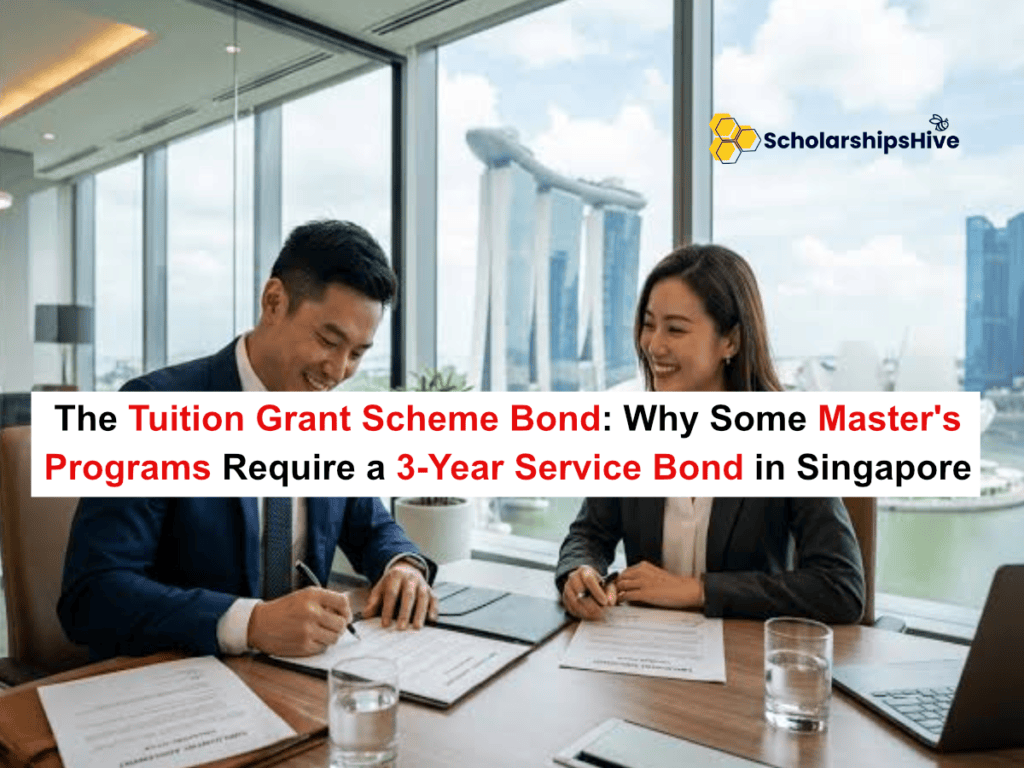
The Tuition Grant Scheme Bond: Why Some Master’s Programs Require a 3-Year Service Bond in Singapore 2026
Key facts
- Country
- Singapore
- Funding
- Fully Funded, Partial Funding
For international students and Singapore Permanent Residents planning to pursue a master’s degree at an autonomous university in Singapore—such as the National University of Singapore (NUS), Nanyang Technological University (NTU), or Singapore Management University (SMU)—the financial architecture of higher education can present unexpected conditions.
While published international tuition fees can look steep, the Singapore Ministry of Education (MOE) offers the Tuition Grant Scheme, which substantially cuts tuition costs. However, taking up this government subsidy is not a free lunch; for non-citizens, it triggers a mandatory 3-year post-graduation service bond.
1. Decoding the MOE Tuition Grant: Subsidy vs. Scholarship
A common misconception among incoming graduate applicants is treating the MOE Tuition Grant as a merit-based scholarship or a standard student loan.
- What It Actually Is: The Tuition Grant is a direct financial subsidy funded by the Singapore government through MOE. It bridges the massive gap between the baseline cost of education at public institutes and what students pay out of pocket.
- The Trade-Off for Non-Citizens: While Singapore Citizens who take up the grant incur no mandatory post-graduation work obligation, international students and Permanent Residents who opt for the subsidy must legally sign a Tuition Grant Agreement. This contract binds them to work for a Singapore-registered company for three years immediately following graduation.
Check this: INSEAD Singapore Campus MBA Scholarships: Elite Private Sector Funding Options in Singapore
2. Why Does Singapore Require a 3-Year Service Bond?
The rationale behind tying a master’s level tuition subsidy to a mandatory employment bond stems from Singapore’s national strategic economic planning.
- Talent Retention and Economic Alignment: Singapore operates as a knowledge-based hub with a hyper-focused labor market. By subsidizing advanced graduate education—particularly in specialized tech, engineering, biomedical, and financial sectors—the government ensures that global talent trained within its public institutions contributes directly to the local workforce and Gross Domestic Product (GDP).
- Balancing Public Funds: Taxpayer-funded subventions are finite resources. Requiring a 3-year service commitment guarantees that the state receives a return on its educational investment by integrating skilled post-graduates into local enterprises, multinational corporations, or research institutions registered in Singapore.
You may also like this: Singapore Institute of Technology (SIT) EngD Scholarship: Industrial and Systems Management Awards in Singapore
3. Financial Impact: Subsidized vs. Non-Subsidized Master’s Tuition
Choosing whether to accept the Tuition Grant involves a direct mathematical trade-off between immediate cash flow and post-graduation mobility.
| Tuition Grant Status | Typical Master’s Fee Impact | Post-Graduation Restriction |
| With MOE Tuition Grant (Subsidized) | Significantly reduced tuition (often 40% to 70% lower than base international rates, depending on the specific faculty and MOE policy). | 3-Year Work Bond: Must be fulfilled by working full-time for a Singapore-registered entity. |
| Without MOE Tuition Grant (Full Fee) | Full International Rate: Billed at unsubsidized commercial cost, running into tens of thousands of dollars more per academic year. | Total Freedom: Zero service obligation; you are legally free to leave Singapore or work anywhere worldwide immediately upon graduation. |
4. Fulfilling the Bond: Employer Rules and Global Options
Serving the 3-year bond does not strictly lock you into a single local employer for the entire duration, but it does carry distinct geographical and corporate parameters.
- Qualifying Employment: The bond requires you to be employed on a full-time basis by a Singapore-registered company. This can range from major multinational tech firms and financial institutions to local SMEs and statutory boards.
- Overseas Postings: MOE guidelines historically permit portions of the bond to be fulfilled overseas if you are deployed abroad by a Singapore-registered parent company or subsidiary, provided prior approval and documentation are successfully coordinated through the Tuition Grant & Scholarships (TG&S) Portal.
- Consequences of Defaulting: Breaking the bond without official deferment or approval results in liquidated damages (LD). MOE calculates these damages based on the total financial subsidy received plus compounding interest, which can amount to a substantial lump-sum debt enforceable through legal channels.
Check this out: Dr. Goh Keng Swee (GKS) Scholarship: Elite Private-Sector Backed Undergraduate Programs in Singapore
Official Links & Resources
- Official MOE Tuition Grant Portal: Singapore Ministry of Education TG&S Portal
- Autonomous University Financial Guides: Check individual admissions portals for NUS, NTU, and SMU graduate division fee schedules.
- Join our WhatsApp Channel for the latest updates on international scholarships and deadlines.
Frequently Asked Questions
Are all master’s programs in Singapore eligible for the MOE Tuition Grant?
No. While many research master’s (MSc by Research, PhDs) and select MOE-supported coursework master’s programs qualify for the Tuition Grant, a large majority of self-funded, specialized professional master’s degrees (such as certain executive MBAs or niche professional conversion programs) are entirely excluded from the scheme and charge flat unsubsidized rates to all students.
Can I buy out my 3-year service bond if I get a job offer in another country?
Yes. If your career trajectory shifts and you wish to relocate overseas immediately after graduation, you can choose to buy out the remaining duration of your bond by paying the calculated liquidated damages and interest to the Singapore government. However, this financial penalty is often steep and should be calculated carefully before accepting the grant.
Does the service bond time run concurrently if I change jobs within Singapore?
Yes. You are not bound to a single employer for all three years. If you switch jobs during your 3-year bond period, as long as your next employer is a valid Singapore-registered corporate entity and you experience no major unapproved employment gaps, your accumulated months of service continue to count toward fulfilling your total 36-month obligation.
Final thoughts and advice from scholarshipshive
Navigating the MOE Tuition Grant Scheme requires looking beyond immediate tuition savings to evaluate your long-term career trajectory. If your goal is to immerse yourself in Singapore’s vibrant corporate and technological ecosystem after graduation, taking the grant is a practical financial accelerator. However, if you require absolute geographic mobility from day one, budgeting for the full unsubsidized fee may be the wiser strategic choice.
Similar scholarships
 The Singapore Digital Arrival Card (SGAC): The Mandatory Submission Rule Before Clearing Changi Airport 2026
 Bringing Dependents: Can a PhD Scholar Bring a Spouse or Child on a Long-Term Visit Pass (LTVP) in Singapore 2026?
 The Employment Pass (EP) Transition: Moving From a Student Pass to a High-Paying Corporate Salary in Singapore 2026
 The Post-Study Work Trap: How to Secure a Long-Term Visit Pass (LTVP) to Look for a Tech Job in Singapore 2026
 The Part-Time Work Rule: Understanding the Legal 16-Hour-Per-Week Student Limit Under ICA in Singapore 2026
 Cost of Living in Singapore: Food Courts, EZ-Link Transportation Cards, and Rent Bills 2026