
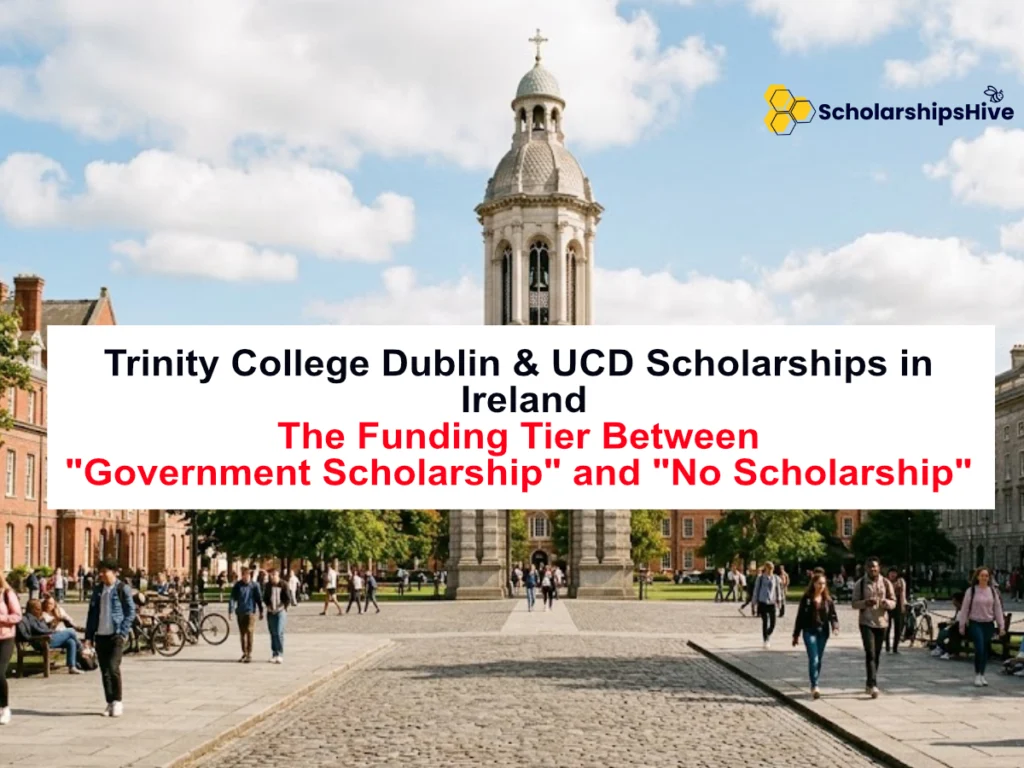
Trinity College Dublin & UCD Scholarships 2027 Ireland: The Funding Tier Between “Government Scholarship” and “No Scholarship”
Key facts
- Country
- Ireland
- Degree level
- Masters, PhD, Undergraduate
- Funding
- Fully Funded, Partially Funded
Most Ireland scholarship guides point international students toward two options: the Government of Ireland International Education Scholarship (GOI-IES) for postgraduates, or nothing. That leaves out a real middle tier — university-run scholarships at Trinity College Dublin and UCD that don’t require the near-impossible competitiveness of a national government award, but still meaningfully reduce tuition for students who don’t make the GOI-IES cut.
If you didn’t get shortlisted for GOI-IES or the GOI Postgraduate Scholarship, these university-level awards are the next place to look before assuming you’re paying full non-EU tuition.
Trinity College Dublin: Two Merit-Based Routes by Degree Level
Global Excellence Undergraduate Scholarships
This scholarship apply as a reduction of €2,000 to €5,000 against your first-year tuition, for students who’ve received a course offer for a full-time undergraduate degree. The catch is that medicine, dentistry, acting, engineering, natural sciences, and computer science and statistics courses are excluded from this specific scheme — check your programme against the eligible list before assuming it applies. Deadlines are region-specific rather than universal: Africa (May 1), Central/North/South America (April 1), South East Asia and Oceania (July 15), and all other regions (June 15). Students from China aren’t eligible for this scholarship and should instead apply for Trinity’s separate Claddagh Undergraduate Scholarship.
Global Excellence Postgraduate Scholarships
This scholarship works the same way for taught Master’s applicants — €2,000 to €5,000 off your first-year tuition, applied as a one-time deduction rather than a recurring award. This route is for full-time taught Master’s programmes only; research Master’s, PhD and part-time study have separate funding routes entirely. Even with the maximum €5,000 award, expect tuition alone to still run roughly €13,000–€23,000 depending on your programme, so treat this as a partial reduction, not a full-ride replacement.
Both Trinity awards require a non-EU fee status and a genuine course offer before you can apply — you can’t apply for the scholarship independently of your admission application.
UCD: One Scholarship You Apply For, One You Don’t
UCD runs its funding differently, splitting it into two distinct mechanisms:
Global Excellence Scholarship
It covers either 50% or 100% of tuition fees for outstanding non-EU applicants to eligible undergraduate and graduate taught programmes — a genuinely larger award than Trinity’s flat euro amounts, but correspondingly more competitive. Deadlines are regional and staggered: undergraduate and graduate taught applicants from the Middle East, Africa and Pakistan, plus graduate taught applicants from South Asia, face an earlier deadline (typically late February) than applicants from all other regions (typically end of March). Online, part-time, clinical, January-start and International Foundation Year Pathway programmes are excluded. Results are announced roughly seven weeks after your regional deadline via SISWeb.
International Student Scholarship (ISS)
This scholarship is the detail most competitor coverage misses entirely: there’s no separate application. Every non-EU applicant to an eligible programme is automatically assessed for ISS eligibility at the point of their admission offer — UCD Global determines both eligibility and award amount based on the academic strength shown in your programme application itself. If you’re awarded both a Global Excellence Scholarship and an ISS, the higher-value award applies rather than both stacking together. One condition worth knowing if you’re offered this award: it isn’t automatically guaranteed for every year of a multi-year programme — continued eligibility depends on maintaining a minimum GPA each stage (recent terms reference 3.08), and a scholarship suspended for falling below that threshold can potentially be reinstated in a later stage if you bring your GPA back up.
Why This Matters for Students Who Don’t Qualify for GOI-IES
GOI-IES and the GOI Postgraduate Scholarship are genuinely excellent when you get them — but they’re restricted to a specific list of eligible countries and a narrow set of eligible courses, and only a small number are awarded across all of Ireland each cycle. If you don’t meet those specific country or course restrictions, or simply aren’t shortlisted in a highly competitive national pool, these university-level awards are the realistic next step rather than resigning yourself to full tuition. Trinity’s and UCD’s awards use their own institutional eligibility criteria, separate from GOI-IES’s rules entirely, so being ineligible for one doesn’t disqualify you from the other.
You may also like:
- Fully Funded Government of Ireland Postgraduate Scholarship Programme
- Government of Ireland (GOI-IES) Scholarship (Fully Funded Scholarship for International Students)
- Erasmus Mundus Joint Masters Scholarship (Fully Funded Masters in Europe)
How to Apply — Step by Step
- Apply for and receive an offer (or conditional offer) for an eligible undergraduate or graduate taught programme at Trinity or UCD — scholarship applications only open after you have a course application in progress or an offer.
- Confirm your programme isn’t on the excluded list for your target scholarship (medicine, dentistry, clinical, online, part-time, or January-intake programmes are commonly excluded across both universities).
- For Trinity’s Global Excellence awards: submit the separate scholarship application by your region-specific deadline, since these are not automatic.
- For UCD’s Global Excellence Scholarship: apply via SISWeb after receiving your offer, checking your region-specific deadline carefully — Middle East, Africa, Pakistan and South Asia graduate applicants face an earlier cutoff than other regions.
- For UCD’s ISS: do nothing extra — eligibility is assessed automatically once you have an offer, and you’ll be notified via SISWeb if awarded.
- If awarded a scholarship, accept your offer and, for UCD, respond to the scholarship offer within two weeks — no response is treated as a decline.
Full current details are on Trinity’s international scholarships page and UCD Global’s scholarships page. If you’re unsure which of these routes fits your course, region and fee status, ask in our WhatsApp channel.
FAQs
What’s the difference between Trinity’s Global Excellence Scholarship and UCD’s International Student Scholarship?
Trinity’s Global Excellence awards require a separate application and offer a fixed €2,000–€5,000 tuition reduction. UCD’s International Student Scholarship (ISS) requires no application at all — it’s assessed automatically at the point of your admission offer, with the award amount determined by UCD based on your academic profile.
Can I apply for a Trinity or UCD scholarship if I wasn’t shortlisted for GOI-IES?
Yes. These university-level scholarships use entirely separate eligibility criteria from the Government of Ireland International Education Scholarship. Missing GOI-IES eligibility or shortlisting doesn’t affect your eligibility for Trinity’s or UCD’s own institutional awards.
Do these scholarships cover full tuition?
Sometimes, but not always. UCD’s Global Excellence Scholarship can cover up to 100% of tuition for the most competitive candidates, but more commonly awards 50%. Trinity’s Global Excellence awards are fixed at €2,000–€5,000, which typically covers only a portion of total tuition — plan your budget assuming a partial reduction unless you’re confirmed for a full award.
Final Thoughts and Advice by ScholarshipsHive
The students who miss out on funding here usually aren’t the ones who lack strong academic records — they’re the ones who assume GOI-IES rejection means no scholarship is available at all, and never check UCD’s automatic ISS or Trinity’s regional Global Excellence deadlines. If you’re unsure which university-level award fits your course and region, share your target programme and nationality in our WhatsApp channel and we’ll help you map out the right one.
Explore similar scholarships
Never miss a deadline
Get new fully funded scholarships every day. Follow Scholarships Hive on your favourite app.
Similar scholarships
 Ireland vs UK for Pakistani Students: Cost, Visa and Scholarship Comparison 2026
 Erasmus Mundus Joint Masters Scholarship 2026 (Fully Funded Masters in Europe)
 Fully Funded Government of Ireland Postgraduate Scholarship Programme 2026
 Government of Ireland (GOI-IES) Scholarship 2026 (Fully Funded Scholarship for International Students)
 Ireland Fully Funded Scholarships 2026-2027: GOI-IES & Global Excellence Guide
 AFEPA Master’s Scholarship 2026-2027 | Fully Funded European Program in Agricultural & Environmental Policy