
The “Istanbul Cliché” Red Flag: What NOT to Say During Your Panel Interview in Turkey 2026
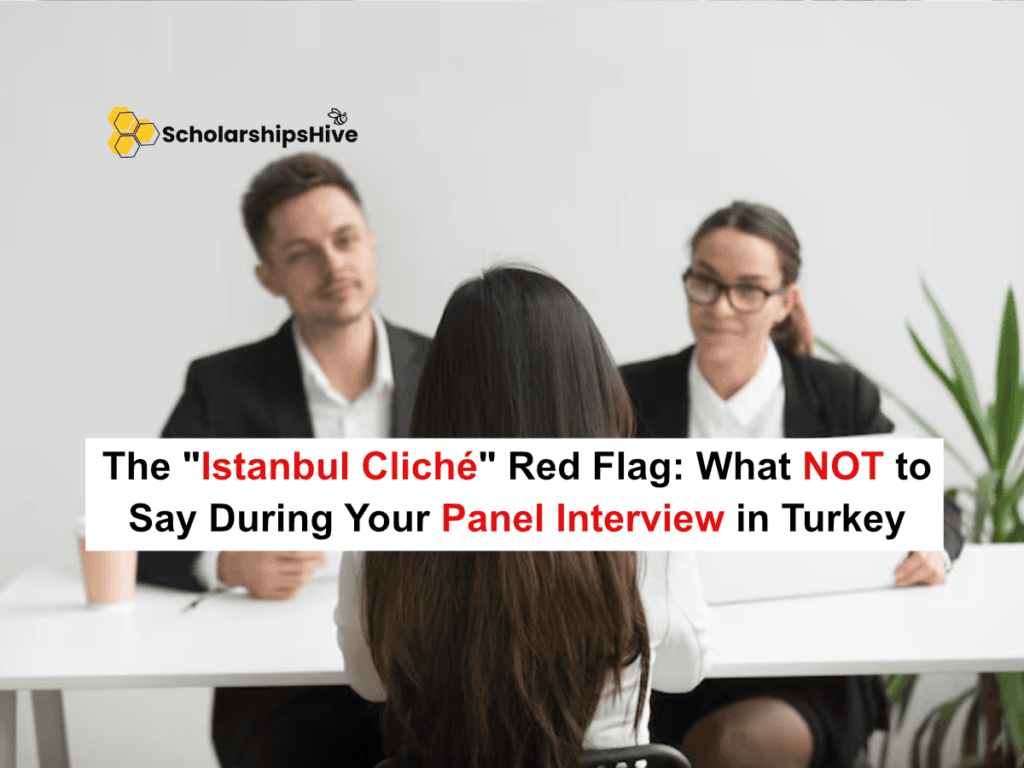
Securing an invitation to the physical or online panel interview for elite institutional programs like the Türkiye Scholarships (TBBS) framework represents a massive milestone. You have successfully cleared the initial academic filtering stage, and your written dossier has caught the attention of the evaluation committee. However, the 15-to-30-minute panel interview is where selection committees separate truly analytical candidates from those who simply memorized generic internet talking points.
Across panel sessions in Ankara and Istanbul, interviewers deal with thousands of applicants who lean heavily on rehearsed, overly romanticized phrasing. Dropping a predictable geopolitical buzzword can instantly trigger a negative reaction from the board, signaling a lack of original thought.
This comprehensive guide breaks down the dangers of the famous “Istanbul Cliché,” highlights other verbal red flags to avoid, and provides actionable communication strategies for 2026 and 2027.
1. Anatomy of the “Istanbul Cliché” and Why It Fails
The single most documented verbal trap in Turkish scholarship interviews revolves how candidates describe the country’s geographic and cultural identity:
- The Forbidden Phrase: “I want to study in Turkey because Istanbul is a bridge between the East and the West.”
- Why Committee Members Hate It: Selection boards—often composed of senior academics, diplomats, and state representatives—hear this exact sentence hundreds of times during an interview cycle. It requires zero critical insight, reflects no personal academic alignment, and reduces a complex, modern nation of 85 million people down to a tired travel-brochure slogan.
- The Better Alternative: Instead of relying on geographical clichés, ground your motivation in specific structural realities. Talk about Turkey’s advanced research clusters in your specific discipline, its unique bilateral trade partnerships with your home country, or the specific faculty labs at your chosen university.
Check this: Dokuz Eylül University: Business, Maritime and Tech Scholarship Tracks, Turkey | Partially Funded
2. Additional Red Flags That Derail Scholarship Interviews
Beyond overused geographic metaphors, panel evaluators actively penalize several behavioral and verbal missteps:
- Stating an Intention to Stay Permanently: Türkiye Scholarships operate primarily as a soft-power diplomatic and international development tool. Committee members want to hear how you will leverage your degree back in your home country or within international networks. Telling a panel that you plan to abandon your home country to live permanently in Turkey invalidates the primary objective of the grant.
- Showing Reluctance Toward Mandatory Language Training: Even if your university degree program is taught entirely in English, all scholarship recipients must complete the mandatory TÖMER Turkish language year. Complaining about learning a new language or asking if you can skip it is an immediate deal-breaker.
- Contradicting Your Own Written Motivation Letter: Panelists keep a printed copy of your submitted application and motivation letter directly on the desk in front of them. If your spoken answers contradict your written claims regarding your career trajectory or research focus, trust evaporates instantly.
You may also like this: Boğaziçi University Scholarship: English Proficiency Rules and Academic Admission Criteria, Turkey | Partially Funded
3. Core Facts Every Candidate Must Get Right
Panelists frequently test basic geopolitical and historical awareness to see if candidates have done genuine homework. Avoid these elementary errors:
- Confusing the Capital City: Thinking that Istanbul is the capital of Turkey instead of Ankara displays a fundamental lack of basic research.
- Historical Blind Spots: Not knowing foundational historical milestones, such as the establishment of the modern Republic by Mustafa Kemal Atatürk in 1923.
- Excessive Sycophancy: Excessive, ungrounded flattery feels disingenuous. Maintain professional respect rather than over-the-top praise.
4. Strategic Preparation Timeline for 2027 Applicants
To ensure your panel performance is authentic, articulate, and completely cliché-free, follow a structured preparation timeline:
- Audit Your Motivation Letter (Spring 2026): Highlight every core claim you made in your application essays and ensure you can defend them smoothly under questioning.
- Conduct Mock Panel Sessions (Summer 2026): Practice answering tough behavioral questions with peers or mentors, explicitly filtering out generic buzzwords.
- Refine Your Return Plan: Build a clear, realistic explanation of how your specific degree from Turkey will be implemented in your home society upon graduation.
Check this out: Middle East Technical University (METU) Scholarship: Campus Guide and Scholarship Rules, Turkey | Partially Funded
Official Portals and Resources
- Official Scholarship Assessment Guidelines: Türkiye Scholarships Interview Portal
- Higher Education Academic Standards: YÖK Official Framework
- Join our WhatsApp Channel for the latest updates on international scholarships and deadlines.
FAQs
Why is calling Istanbul a “bridge between East and West” considered a red flag?
It is considered an overused, unoriginal cliché that offers no substantive insight into your academic goals, showing the panel that you rely on memorized travel slogans rather than critical thought.
Should I say I want to live in Turkey permanently after graduation?
No. Scholarship committees look for candidates who intend to return to their home countries or contribute to international diplomatic and professional bridges, rather than those seeking permanent migration.
Is learning Turkish mandatory even for English-taught degree programs?
Yes. All scholarship recipients are required to complete a preparatory year of Turkish language training through TÖMER, and showing reluctance toward this requirement is viewed negatively by interviewers.
Final thoughts and advice From ScholarshipsHive
Mastering the Türkiye Scholarships panel interview requires dropping generic internet talking points and speaking with authentic, well-researched precision. By eliminating the “Istanbul Cliché,” anchoring your academic goals to concrete realities, respecting language learning requirements, and executing your preparations strategically during 2026 for 2027 entry, you can project the confidence and originality that panels reward with an acceptance letter.
Similar scholarships
 Alumni Network (TÜMED): How the Scholarship Keeps You Connected to Turkish Trade After Graduation, Turkey 2026
 Bringing Your Family: Can a Spouse Join You on a Turkish Student Visa Dependent Path? 2026
 Post-Graduation Careers: Finding a Corporate Job or Continuing to a PhD in Turkey 2026
 Opening a Ziraat Bank Account: Managing Your Monthly Scholarship Payments in Turkey 2026
 Part-Time Work Restrictions: Navigating the Legal Work Limits for Foreign Students in Turkey 2026
 Cost of Living in Turkey: Istanbul and Ankara vs. Affordable Cities Like Konya or Erzurum 2026