
Bringing Dependents: The Process for Bringing a Spouse or Children Along on a Saudi Research Fellowship Visa in Saudi Arabia 2026
In this article
- 1. The Foundations of Family Sponsorship for Research Scholars
- 2. Step-by-Step Sovereign Application Workflow
- 3. Arrival, Medical Testing, and Issuing Dependent Iqamas
- 4. Financial Obligations: Government Fees and the Dependent Levy
- Official Scholarship Links & Resources
- Frequently Asked Questions
- Final thoughts and advice from scholarshipshive
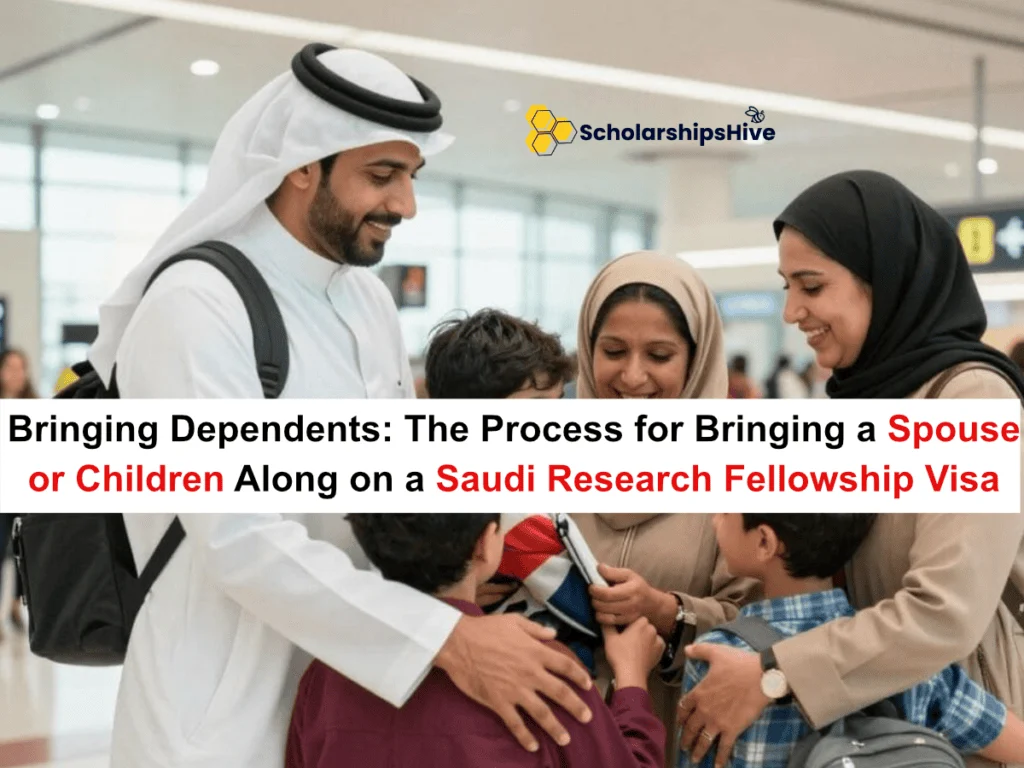
When international scholars, graduate researchers, and postdoctoral fellows accept fully funded positions at premier academic and scientific institutions in the Kingdom of Saudi Arabia—such as King Abdullah University of Science and Technology (KAUST), King Abdulaziz University (KAU), King Fahd University of Petroleum and Minerals (KFUPM), and King Saud University (KSU)—one of the most important milestones is relocating with family. Moving across international borders with a spouse and children introduces a major life transition, making it essential to understand the legal, administrative, and logistical pathways governing family reunification in the Kingdom.
Unlike short-term tourist or business entries, bringing family members on an official research fellowship involves a structured, multi-phase immigration process. Governed by the Ministry of Interior, the Ministry of Foreign Affairs (MOFA), and the Council of Cooperative Health Insurance (CCHI), the system ensures that accompanying dependents receive legal residency (Iqamas), comprehensive healthcare, schooling access, and social integration support.
This comprehensive guide breaks down the legal eligibility criteria, document attestation chains, digital workflows via Absher and Nafath, financial obligations, health insurance mandates, and practical steps for successfully bringing your spouse and children to Saudi Arabia in 2026.
1. The Foundations of Family Sponsorship for Research Scholars
Under Saudi immigration law, international researchers holding valid institutional residency permits (Iqamas) and sponsored by accredited universities possess the legal right to sponsor their immediate family members. However, approval is strictly governed by institutional status and regulatory compliance:
- Eligible Dependents: Sponsorship is legally restricted to immediate family members—specifically, a legal spouse and unmarried children under the designated age limit (typically sons under 25 and unmarried daughters).
- University Sponsorship Coordination: For scholars on fully funded graduate and research fellowships (such as those at KAUST or KFUPM), the university’s international student office or government relations department frequently assists with documentation guidelines, housing clearance letters, and dependent paperwork processing.
- The Housing Requirement: To qualify for family visa authorization, the sponsor must demonstrate suitable, approved family accommodation. For campus-based scholars, university-provided family villas or townhouses automatically satisfy this requirement, whereas off-campus researchers must present a registered lease agreement (Ejari) and municipal housing utility records.
2. Step-by-Step Sovereign Application Workflow
The process of securing a family residency visa (frequently referred to as a dependent or Isteqdam visa) follows a strict digital sequence managed through official government portals:
Phase A: Prerequisite Digital Setup and Eligibility Verification
- Activate Nafath and Absher: Ensure your personal Absher account is fully active and your Nafath digital identity application is biometrically verified. Nafath authentication is mandatory for all digital transactions, fee payments, and sponsorship tracking.
- Verify Profession and Salary Criterias: Your university-issued Iqama must reflect an approved professional or technical title (such as Researcher, Scientist, Engineer, or Lecturer) rather than a basic labor classification, and your monthly stipend or salary must meet or exceed the official sponsorship thresholds.
Phase B: Document Authentication and Attestation Chain
Before initiating the online request, you must gather and authenticate foundational civil documents. This step must be executed flawlessly to prevent application rejection:
- Marriage Certificate: Required for sponsoring a spouse, bearing full attestation.
- Children’s Birth Certificates: Required for each child, displaying full parental details.
- The Strict Attestation Chain: Documents issued outside Saudi Arabia must clear a multi-step verification sequence:
- Notarization and certification by the relevant ministry in your home country (e.g., Ministry of Foreign Affairs or Department of State).
- Stamping and legalisation by the Royal Embassy or Consulate of Saudi Arabia in your home country.
- Final local attestation by the Saudi Ministry of Foreign Affairs (MOFA) upon arrival or via electronic integration.
- Certified legal translation into Arabic for all non-Arabic certificates.
Phase C: Electronic Visa Authorization (The “Yellow Slip”)
- Log into your Absher Individual or corporate government portal and navigate to the Family Visas application section.
- Input your dependent passport details, relationship classifications, and attested certificate reference numbers.
- Pay the requisite government processing fees (such as the Isteqdam fee) via the secure SADAD payment system.
- Upon successful review by the Ministry of Interior, a digital visa authorization (historically known as a “Yellow Slip”) is issued, permitting visa stamping at the designated Saudi consulate abroad.
Phase D: Embassy Stamping and Travel
- Submit the family passports, photos, medical fitness certificates (where applicable), and the approved visa authorization to the local Saudi visa application center or embassy in your home country.
- Ensure that CCHI-compliant health insurance policies for each dependent are active, as consular sections verify insurance linkage before stamping entry visas.
- Book flights and travel to the Kingdom within the validity window indicated on the entry visas.
You may also like this: Medical Fitness Reports: The Specific Laboratory Checks Required for Saudi University Clearance, Saudi Arabia
3. Arrival, Medical Testing, and Issuing Dependent Iqamas
Once your family members land in Saudi Arabia, the final phase converts their entry visas into permanent legal residencies:
- Port of Entry Processing: Immigration officers at Saudi international airports scan dependent passports, capture initial entry records, and link them to your primary sponsor file.
- Medical Fitness Screening: Dependents aged 18 and above must complete a medical fitness examination at an approved local health center (testing for communicable diseases such as tuberculosis and hepatitis).
- Biometric Enrollment: Dependents over the age limit must visit an authorized Ministry of Interior service center to record fingerprints and facial biometrics.
- Issuance of Plastic Iqama Cards: Once medical clearances and biometric data clear through Absher, the official dependent residency cards (Iqamas) are printed, granting full legal residence rights for the duration of your fellowship.
4. Financial Obligations: Government Fees and the Dependent Levy
Relocating family members involves specific recurring and one-time financial contributions that scholars must budget for:
- Visa Application Fees: Initial processing and issuance fees apply during the electronic visa application phase.
- The Monthly Dependent Levy: Under national fiscal regulations, sponsors are required to pay a monthly government levy for each accompanying dependent residing in the Kingdom. This fee (collected annually or semi-annually in advance via SADAD during Iqama renewals) must be factored into your financial planning.
- Mandatory Health Insurance Premiums: Every dependent must be covered under an approved CCHI health insurance policy. For scholars on fully funded institutional fellowships, check with your university’s human resources or student affairs office, as many premier research institutions fully subsidize or directly provide dependent health insurance coverage as part of the scholarship grant.
Check this out: The Foreign Police Clearance Certificate: Formatting Your Local Non-Criminal Background Check in Saudi Arabia
Official Scholarship Links & Resources
- Unified Government Scholarship Platform: Study in Saudi Arabia Portal
- Council of Cooperative Health Insurance (CCHI): Official CCHI Portal & Insurance Regulations
- Saudi Ministry of Foreign Affairs: MOFA Visa Services & Attestation Portal
- Join our WhatsApp Channel for the latest updates on international scholarships and deadlines.
Frequently Asked Questions
Can I bring my family to Saudi Arabia on a tourist visa first and convert it to a residency visa?
No. Saudi immigration regulations strictly prohibit converting tourist visas, commercial visit visas, or short-term entry permits into permanent family residency (Iqama) visas from within the country. Dependents must enter the Kingdom using properly stamped family residency visas obtained through the official consular process abroad.
Are children of research scholars eligible to attend local schools?
Yes. Once your children receive their official dependent Iqamas, they become fully eligible to enroll in local public schools, international community schools, or specialized campus-affiliated academies (such as those operating inside research cities like KAUST).
What happens to my family’s residency if my research fellowship concludes?
Dependent residency permits are legally tethered to the primary sponsor’s Iqama validity. When a fellowship concludes or your contract is successfully transitioned, dependent visas are updated, renewed, or wound down in accordance with your institutional clearance and exit procedures.
Final thoughts and advice from scholarshipshive
Bringing your spouse and children along on a Saudi research fellowship is a rewarding journey that blends world-class academic advancement with rich family experiences abroad. By securing your document attestations early, navigating the Absher and Nafath digital workflows with precision, and coordinating closely with your university’s international student office, you can ensure a seamless relocation. Plan your timeline proactively, maintain compliance with CCHI insurance and dependent levy schedules, and step forward with absolute confidence toward your academic and family success in the Kingdom!
Never miss a deadline
Get new fully funded scholarships every day. Follow Scholarships Hive on your favourite app.
Keep reading
Scholarships you can apply for
 Prince Mohammad bin Fahd University (PMU) Scholarships: Global Partnership Options and Fee Waivers 2026, Saudi Arabia | Partially Funded
 King Faisal University (KFU) Scholarships: Agricultural and Biological Research Grants in Al-Ahsa 2026, Saudi Arabia | Fully Funded
 Jazan University Scholarships: Coastal Research Infrastructure and Student Living Stipends 2026, Saudi Arabia | Fully Funded