📲 Join our WhatsApp for Daily Fully Funded Scholarship Alerts
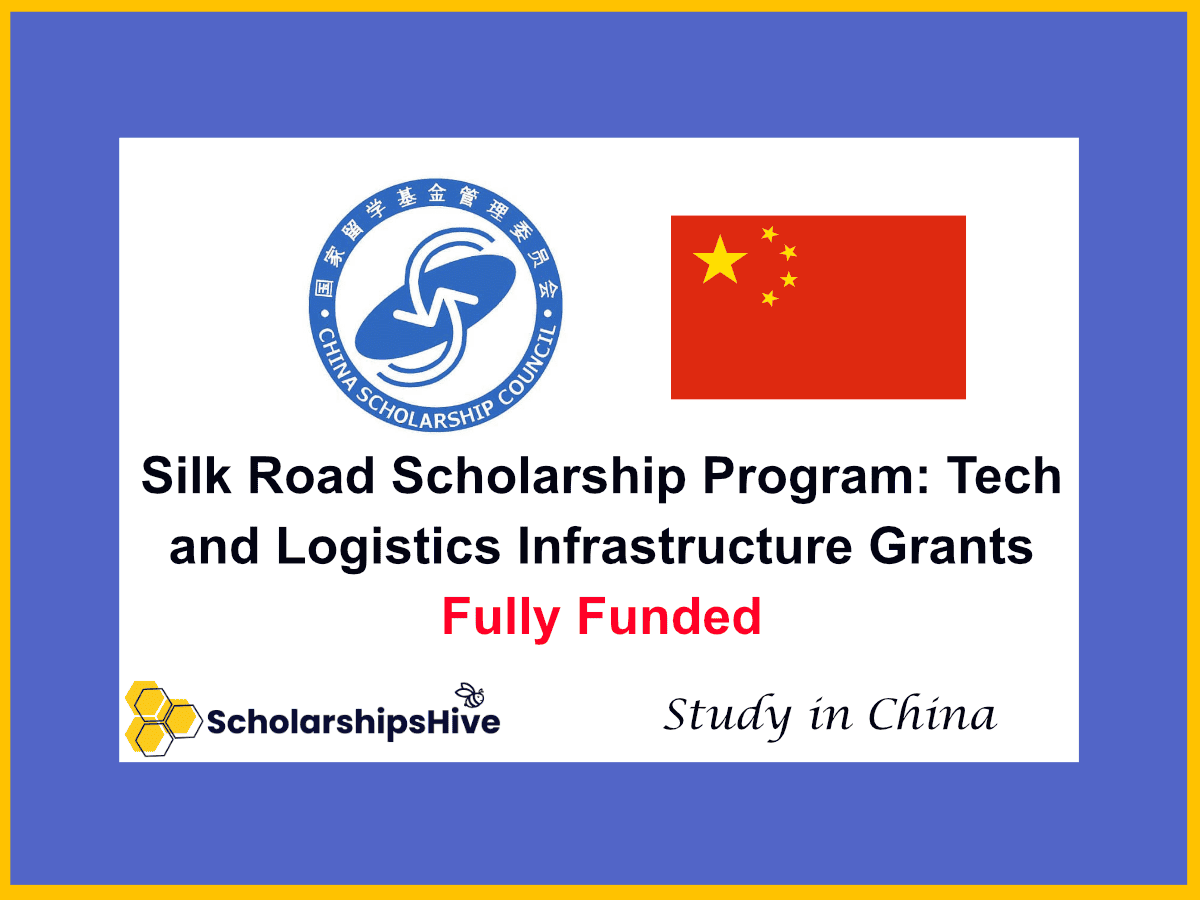
China’s Belt and Road Initiative has catalyzed some of the world’s most advanced supply chain ecosystems, automated ports, and cross-border tech networks. To fuel this global expansion, the Chinese Ministry of Education funds the specialized Chinese Government Scholarship (CSC) – Silk Road Program. This elite academic fund targets outstanding international tech talent eager to specialize in next-generation transportation networks, industrial automation, and smart logistics management systems.
For digital infrastructure planners and engineers mapping out their portfolios for the upcoming 2026 and 2027 cycles, this fully funded pathway offers complete financial liberation while training inside global engineering powerhouses.
Funding Type: Fully Funded Industry Leadership Endowments
The Silk Road Program operates under a strict Fully Funded merit framework. Administered primarily as a specialized CSC Type B scheme through designated Chinese universities, it provides comprehensive coverage designed to remove all major financial barriers.
| Benefit Category | Coverage Scope |
|---|---|
| Tuition Costs | 100% registration, laboratory, and operational course fee waiver |
| Campus Lodging | Free dedicated room placement inside the international student dormitory wings |
| Health Protection | Comprehensive Medical Insurance plan for international students in China |
| Undergraduate Monthly Allowance | 2,500 RMB per month |
| Master’s Track Monthly Allowance | 3,000 RMB per month |
| Doctoral Track Monthly Allowance | 3,500 RMB per month |
Check this: Need-Blind US Universities: For International Students Financial Aid List, USA | Fully Funded
Top Chinese Elite Universities for Smart Infrastructure & Supply Chains
The universities chosen for the Silk Road cohort host China’s premier state key laboratories in automation, civil systems, and information technology.
Central South University (CSU)
Located in Changsha, CSU is a dominant global force in transportation engineering and rail network design. Its Silk Road tracks focus heavily on computer science, mining logistics, and railway infrastructure.
Tianjin University (TJU)
As one of China’s oldest engineering institutions, TJU drives cutting-edge research in smart city tech, industrial engineering, and automated maritime logistics architectures.
Nanjing University of Science and Technology (NJUST)
NJUST excels in autonomous systems, control engineering, and intelligent manufacturing frameworks, directly matching the needs of modern smart factories and automated warehouses.
Southwest Jiaotong University
The undisputed academic heart of China’s high-speed rail engineering, this institution focuses on massive overland transportation networks and cross-border transit logistics.
You may also like this: US Universities with Automatic Merit Scholarships: For International Students, USA | Partially Funded
The Silk Road Dual-Portal Admission Sequence
Securing this grant requires a flawless, dual-system submission. Missing either portal registration typically results in immediate disqualification.
1.University Portal Registration & Supervisor Sourcing:November to February.
Create an account on the international application portal of your chosen university (e.g., Central South University or Tianjin University). Upload your academic history and secure a provisional Supervisor Acceptance Letter if required by the department.
2.CSC National Portal Submission:January to April.
Log into the central Chinese Government Scholarship Information System (cgsis.campuschina.org). Choose Category Type B, select your target university as your sole choice, and input that university’s specific Agency Code.
3.Document Verification & Fee Settlement:February to May.
Pay any mandatory institutional application processing fees via your university account. Track your portal status to ensure all notarized transcripts, physical exam charts, and police clearances pass initial verification.
4.Technical Review & CSC Final Confirmation:May to July.
Shortlisted applicants complete technical, panel, or math-centric online interviews administered by engineering faculty boards. Approved nominations are forwarded to the CSC central committee for final visa dispatch.
Check this out: University of Rochester Dean’s Scholarship: Undergraduate International Students, USA | Partially Funded
Crucial Technical Target Document Requirements
- Customized 1,000-Word Strategic Research Plan: Selection panels for the Silk Road Program look for specialized operational proposals. Your study plan must target real-world infrastructure issues, such as blockchain integrations for supply chains, AI-driven port routing, or high-speed rail track durability.
- Dual Professional Recommendation Letters: You must submit two original letters signed by professors or associate professors detailing your quantitative competencies and research innovations.
- Language Benchmark Credentials: For English-taught tracks, a certified IELTS (minimum 6.0 to 6.5) or a formal English Medium of Instruction (MOI) document from your graduating university is required. For Chinese-taught pathways, an HSK Level 4 or 5 certificate is mandatory.
Official Application Channels & Links
- Central Government Portal: www.campuschina.org — The primary technical registration site for all Type B zero-tuition university awards.
- Central South Academic Link: intl.csu.edu.cn — System registry and specialized program catalog for Central South University admissions.
- Tianjin Portal Registry: sie.tju.edu.cn — Main dashboard for processing international engineering student applications at TJU.
- Join our WhatsApp Channel for the latest updates on international scholarships and deadlines.
Frequently Asked Questions (FAQs)
Is the Silk Road Scholarship distinct from the standard CSC Type B award?
It falls under the CSC Type B umbrella but operates as a targeted corporate-academic partnership project. While generic Type B slots accept any major, the Silk Road track is strictly ring-fenced for industrial engineering, digital infrastructure, logistics, and renewable energy fields that support cross-border commerce networks.
Do undergraduate applicants need to take special entrance examinations?
Yes. Under the latest state protocols, undergraduate candidates targeting bachelor’s level tracks under this program must sit for the China Scholastic Competency Assessment (CSCA). This standardized test evaluates competency layers across core subjects, including mathematics and physics, before university nomination lists are certified.
What happens if my program is taught in Chinese but my language skills are insufficient?
If you are selected for a Chinese-medium logistics or tech track but hold an HSK Level 4 rather than an elite Level 5, the scholarship accommodates this by granting one full year of foundational Chinese language prep. This preparatory phase is fully funded under your existing stipend framework before your primary degree track launches.
Final Thoughts & Advice by Scholarships Hive
The secret to winning a Silk Road Scholarship is proving that your home country shares an active infrastructural link with the Belt and Road framework. The selection boards look specifically for candidates whose careers will directly bridge the logistical or technological gap between China and their home regions. When writing your personal statements and formatting your CV, don’t focus entirely on abstract academic theories. Instead, highlight your hands-on experience with technical tools like Python, MATLAB, or supply chain modeling suites, and clearly explain how your research will streamline international trade corridors or advance automated systems locally. Showing that you understand the industrial utility of your degree is exactly what sets a winning application apart.