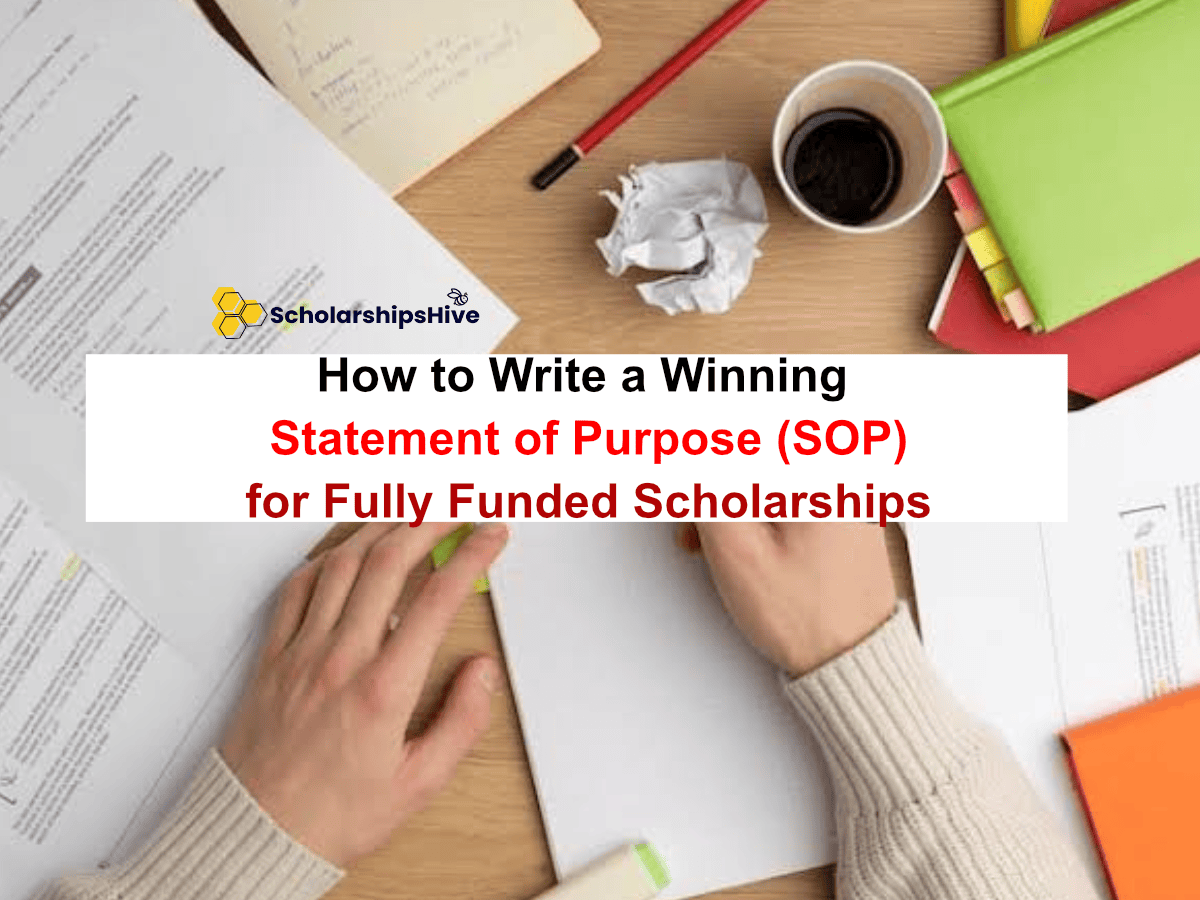
A Statement of Purpose (SOP) is one of the most critical components of your application for any fully funded international scholarship—such as Chevening, Erasmus Mundus, MEXT, Fulbright, or Commonwealth. While your academic transcripts prove what you have accomplished in the past, your SOP tells selection committees who you are, what drives you, and how you intend to create a tangible impact in your field and home country.
A winning SOP bridges the gap between your academic background, your future career ambitions, and the specific goals of the scholarship foundation. This comprehensive guide outlines the optimal structure, essential elements, common pitfalls to avoid, and expert strategies to make your essay stand out.
MUST READ:
- University of Tokyo MEXT University-Recommended Track Japan: Complete Step-by-Step Guide
- KTH Royal Institute of Technology Scholarship Sweden: Complete Application Guide
- Single Entry Visa (SEV): Turning Your eVAL into an Official Entry Stamp via the eVISA Portal in Malaysia
1. Core Elements of a Winning SOP
Selection committees review thousands of essays every application cycle. To earn a top evaluation score, your SOP must address four core dimensions:
- Academic & Professional Alignment: Demonstrating that your educational background and past projects naturally lead to your target Master’s or PhD program.
- Clear Problem Statement: Identifying a specific issue, research gap, or developmental challenge in your field or home country that your studies will address.
- Institutional & Program Fit: Explaining why the specific university, faculty, curriculum, or research laboratories are essential to your goals.
- Long-Term Vision & ROI (Return on Investment): Demonstrating how fully funding your studies will yield measurable societal, economic, or scientific benefits upon graduation.
2. Standard 5-Paragraph SOP Structure
A clear, logical structure ensures your essay remains engaging and scannable for review panels. Below is a tested framework used by successful scholarship recipients:
[Paragraph 1: The Hook & Core Purpose]
                     │
                     ▼
[Paragraph 2: Academic & Professional Background]
                     │
                     ▼
[Paragraph 3: Why This Program & University?]
                     │
                     ▼
[Paragraph 4: Career Goals & Developmental Impact]
                     │
                     ▼
[Paragraph 5: Conclusion & Scholarship Value]
Paragraph 1: The Hook & Core Purpose
- Avoid generic quotes or overly dramatic childhood anecdotes.
- State your academic focus immediately and introduce the core challenge or research question that drives your work.
- Briefly summarize your primary goal in pursuing this specific program.
Paragraph 2: Academic & Professional Foundation
- Highlight key undergraduate milestones, research projects, publications, or thesis achievements.
- Mention relevant professional experience, internships, or volunteer work.
- Emphasize outcomes and skills gained (e.g., methodologies learned, data analyzed, or leadership roles held) rather than just listing duties.
Paragraph 3: Why This Specific Program and University?
- Name specific courses, professors, laboratories, or research modules offered at the host institution.
- Explain why these unique features are unavailable or underrepresented in your home country.
- Show that you have thoroughly researched the university’s curriculum and academic community.
Paragraph 4: Future Career Goals & Impact
- Divide your goals into short-term (1–3 years post-graduation) and long-term (5–10 years) objectives.
- Detail how returning to your home country or industry will contribute to local development, policy improvement, or technological advancement.
- Align your vision with international frameworks (e.g., United Nations Sustainable Development Goals) where applicable.
Paragraph 5: Conclusion & Value Proposition
- Reiterate your commitment to excellence and leadership.
- Summarize how receiving the scholarship will serve as the catalyst for your vision.
- End with a strong, confident concluding statement.
3. Key Differences: General University SOP vs. Scholarship SOP
Many applicants make the mistake of using a standard university motivation letter for a scholarship board. Understand these crucial distinctions:
| Feature | General University SOP | Fully Funded Scholarship SOP |
| Primary Focus | Academic aptitude & research capability | Leadership potential, societal impact & ROI |
| Key Audience | University admissions committee | Scholarship panel / Ministry officials |
| Core Question | “Can you succeed in our curriculum?” | “Why should we invest thousands of dollars in you?” |
| Key Element | Academic fit & course interest | Development goals & plan to return/contribute |
4. Common Mistakes That Lead to Rejection
Avoid these frequent writing pitfalls that weaken scholarship essays:
- Restating Your Resume: Avoid listing every job or grade chronologically. Instead, curate a cohesive narrative that highlights your growth.
- Vague / Generic Claims: Statements like “I want to study engineering because I am passionate about technology” carry no weight. Be specific about the exact sub-field, method, or issue.
- Flattery Over Substance: Spending half a paragraph praising the university’s ranking adds no value. Focus on how specific resources align with your goals.
- Ignoring Word Limits: Exceeding or falling significantly short of specified word or character counts signals a lack of attention to detail.
- Unclear Post-Graduation Plans: Scholarship boards rarely fund students who cannot articulate a concrete, actionable plan following graduation.
YOU MAY ALSO LIKE:
- University of Helsinki Grant Scheme Finland: Complete Application Guide
- The Malaysia Digital Arrival Card (MDAC): The Mandatory Form You Must Submit 3 Days Before Landing in Malaysia
- Part-Time Work Limits: Navigating the Legal 20-Hour Holiday and Semester Break Restrictions in Malaysia
5. Expert Tips to Strengthen Your Essay
- Use the STAR Method for Key Achievements: When describing a major project, outline the Situation, Task, Action, and Result.
- Quantify Your Impact: Whenever possible, include metrics (e.g., “Led a research team of 4 members,” “Analyzed datasets covering 5,000+ respondents,” or “Improved process efficiency by 20%”).
- Seek Multi-Stage Proofreading: Have your draft reviewed by academic mentors, current scholarship alumni, or native English speakers to refine clarity, tone, and grammar.
FAQs
How long should a Statement of Purpose be for a fully funded scholarship?
Unless specified otherwise by the application guidelines, a standard SOP should be between 800 and 1,200 words (typically 1 to 2 single-spaced pages). Always adhere strictly to the word or character limits set by the scholarship board.
Should I mention specific professors in my SOP?
Yes, particularly for research-focused Master’s or PhD applications. Referencing 1–2 faculty members whose ongoing research aligns directly with your intended thesis demonstrates strong preparation and institutional fit.
Can I use artificial intelligence (AI) to write my scholarship SOP?
While AI tools can assist with brainstorming, structuring, or checking grammar, selection committees actively use AI detection tools and value authentic personal voice. Write your essay yourself to ensure your genuine motivation and experiences come through clearly.
Final Tip From ScholarshipsHive
The strongest Statements of Purpose read like a compelling bridge: one side anchored in your proven past achievements, and the other anchored in your clear vision for the future. Treat the scholarship foundation not as a source of free tuition, but as a strategic investor funding your capacity to solve real-world challenges.
Join our WhatsApp Channel for the latest updates on international scholarships and deadlines: WhatsApp Channel