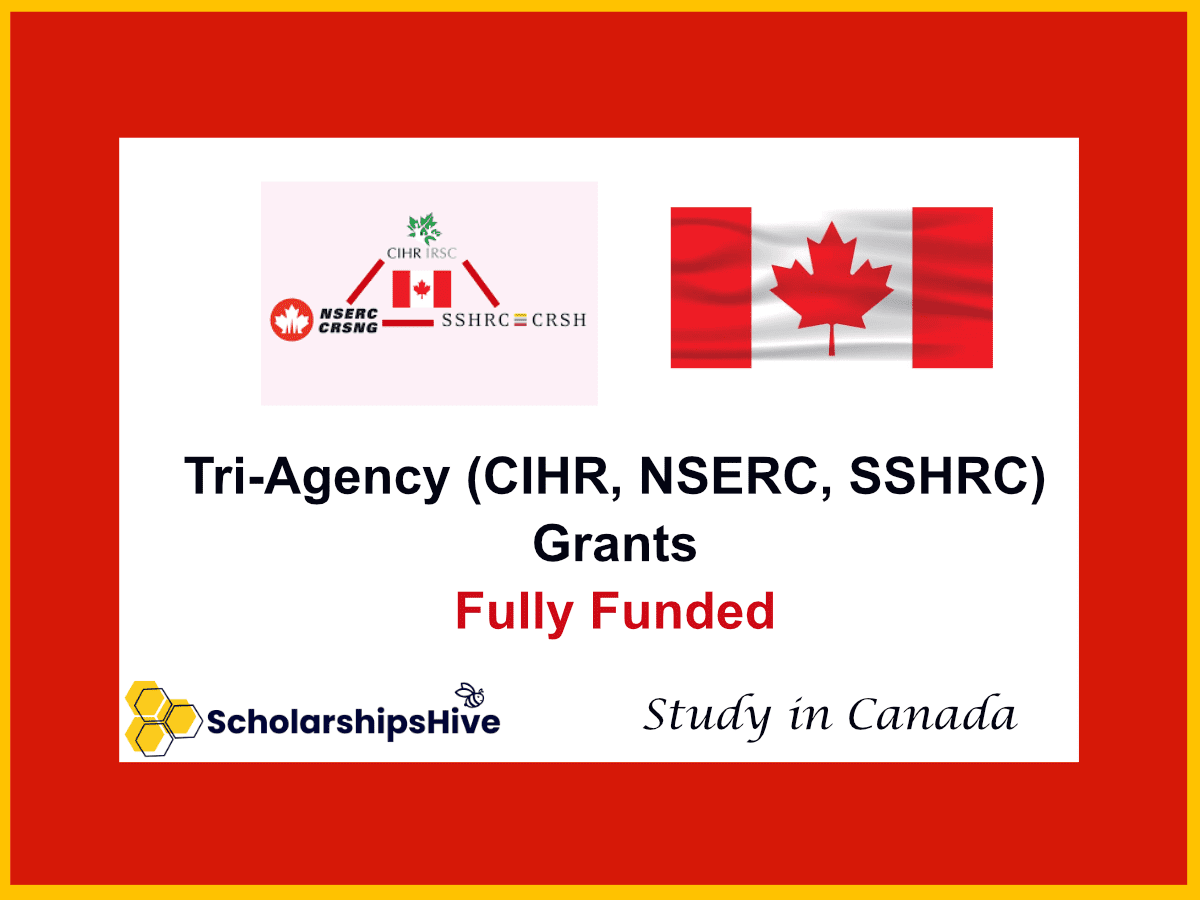
For doctoral students in Canada, the “Tri-Agency” represents the gold standard of research funding. Comprising the Canadian Institutes of Health Research (CIHR), the Natural Sciences and Engineering Research Council (NSERC), and the Social Sciences and Humanities Research Council (SSHRC), these federal agencies provide the financial backbone for the nation’s top research talent.
If you are pursuing a PhD, understanding how to navigate the Canada Graduate Research Scholarships – Doctoral (CGRS-D) program—a prestigious, fully funded award—is essential for securing your academic future.
1. Understanding the Tri-Agency Landscape
The Tri-Agencies are the primary federal bodies that fund research and research training. While they work in tandem, they each focus on distinct disciplines:
- CIHR: Funds health-related research, including biomedical, clinical, health systems, and population health.
- NSERC: Supports natural sciences and engineering research, from biology and physics to civil and software engineering.
- SSHRC: Invests in social sciences and humanities, covering everything from economics and sociology to history and the arts.
Check this: Bank Accounts: Commonwealth Bank vs. ANZ for International Students in Australia
2. The CGRS-D Award: At a Glance
The Canada Graduate Research Scholarships (CGRS-D) program is the flagship fully funded opportunity for doctoral candidates.
- Award Value: $40,000 per year for three years (Total $120,000).
- Funding Type: Direct fellowship support (Stipend).
- Purpose: To support high-caliber scholars engaged in doctoral programs, fostering innovation and impact both within and beyond the academic environment.
- Eligibility: International students are now eligible to apply, provided they are enrolled in a doctoral program at an eligible Canadian institution. The eligibility window has also been extended, allowing students with up to 36 months of full-time equivalent study in their program to apply.
3. The Application Process: How to Apply 2026
Applying for a Tri-Agency grant is a strategic process. Your application pathway depends on your current registration status.
Step 1: Determine Where to Submit
- If you are currently registered at a Canadian university: You must apply through your institution. Universities are assigned a “quota” of applications they can forward to the national competition. Check your university’s internal deadlines, which are often weeks ahead of the federal agency’s date.
- If you are not currently registered: You may be required to apply directly to the appropriate agency. Always refer to the specific agency’s portal (ResearchNet for CIHR) to confirm your status.
You may also like this: Part-Time Work: Essential Rules for International Students in Australia
Step 2: Prepare Your Application Package
A successful application typically requires:
- Research Proposal: A clear, feasible, and innovative outline of your project.
- Academic Record: Official transcripts for all undergraduate and graduate studies.
- Letters of Appraisal: Two academic references who can speak to your research ability and potential.
- Contributions Statement: A detailed summary of your research experience, publications, and leadership activities.
Check this out: Post-Study Work Visa: How to Stay 3–5 Years After Graduation in Australia
Step 3: Internal Review
If applying through a university, your application will undergo an internal selection process. Committees evaluate applications based on academic excellence, research potential, and personal leadership. Only those who pass this internal hurdle are nominated for the national competition.
4. Eligibility and Equity
The Tri-Agencies are deeply committed to Equity, Diversity, and Inclusion (EDI). They have implemented measures to ensure that the research enterprise reflects the diversity of Canada:
- Targeted Funding: Some programs now include specific funds for Black student researchers.
- Lived Experience: Applications now encourage candidates to discuss “relevant experience” obtained beyond academia, such as community engagement, mentorship, and traditional teachings.
Official Resources & Links
- CIHR Application Portal (ResearchNet): Use this for all health-related research applications.
- NSERC Doctoral Funding: Access guidelines and instructions for science and engineering awards.
- SSHRC Doctoral Fellowships: Information for social sciences and humanities applicants.
Join our WhatsApp Channel for the latest updates on international scholarships and research funding deadlines.
Frequently Asked Questions
Can I apply for more than one agency?
No. You can only submit one application per year across the three agencies. You must select the agency that best aligns with your research topic.
What if my research is interdisciplinary?
The Tri-Agencies have a specific Tri-Agency Interdisciplinary Peer Review Committee to support research that crosses traditional boundaries. You can choose the agency that best fits the primary focus of your research.
How do I know if my university has a quota?
Most major Canadian research universities have a quota. Check your Faculty of Graduate Studies website or the “Where to apply” section on the Tri-Agency website.
Final Thoughts and Advice by Scholarships Hive
Securing Tri-Agency funding requires meticulous planning. Start your application in the summer months—well before the 2026 autumn deadlines. Your research proposal should not only be technically sound but also articulate your broader impact on society.
- Leverage Your Supervisor: Get their input early on your proposal and ensure your referees understand the specific “Research Potential” criteria the agencies are looking for.
- Prioritize EDI: When writing your “Relevant Experience,” highlight how your background contributes to a diverse research environment.
- Submit Early: Technical issues on submission portals are common as deadlines approach. Submit your application days, not hours, before the cutoff.
Check out The “Elite” Government & National Awards in Canada
These are the most prestigious, fully funded programs that cover tuition and high living costs:
- Full Guide: Vanier Canada Graduate Scholarships (CGS) ($50,000 per year).
- Lester B. Pearson: International Scholarship at the University of Toronto.
- Banting Postdoctoral Fellowships: A-Z Guide for Researchers ($70,000 per year).
- Study in Canada Scholarships: Global Affairs Canada Awards
- IDRC Research Awards: Funding for students from developing countries.
- The Pierre Elliott Trudeau Foundation: Leadership & PhD Scholarships.
- Canada-ASEAN Scholarships: Specific grants for Southeast Asian students.
- Emerging Leaders in the Americas (ELAP): Short-term exchange funding.
- Financing your PhD: A Guide to Tri-Agency (CIHR, NSERC, SSHRC) Grants.
- The “Quota” System: How Canadian universities nominate you for national awards.