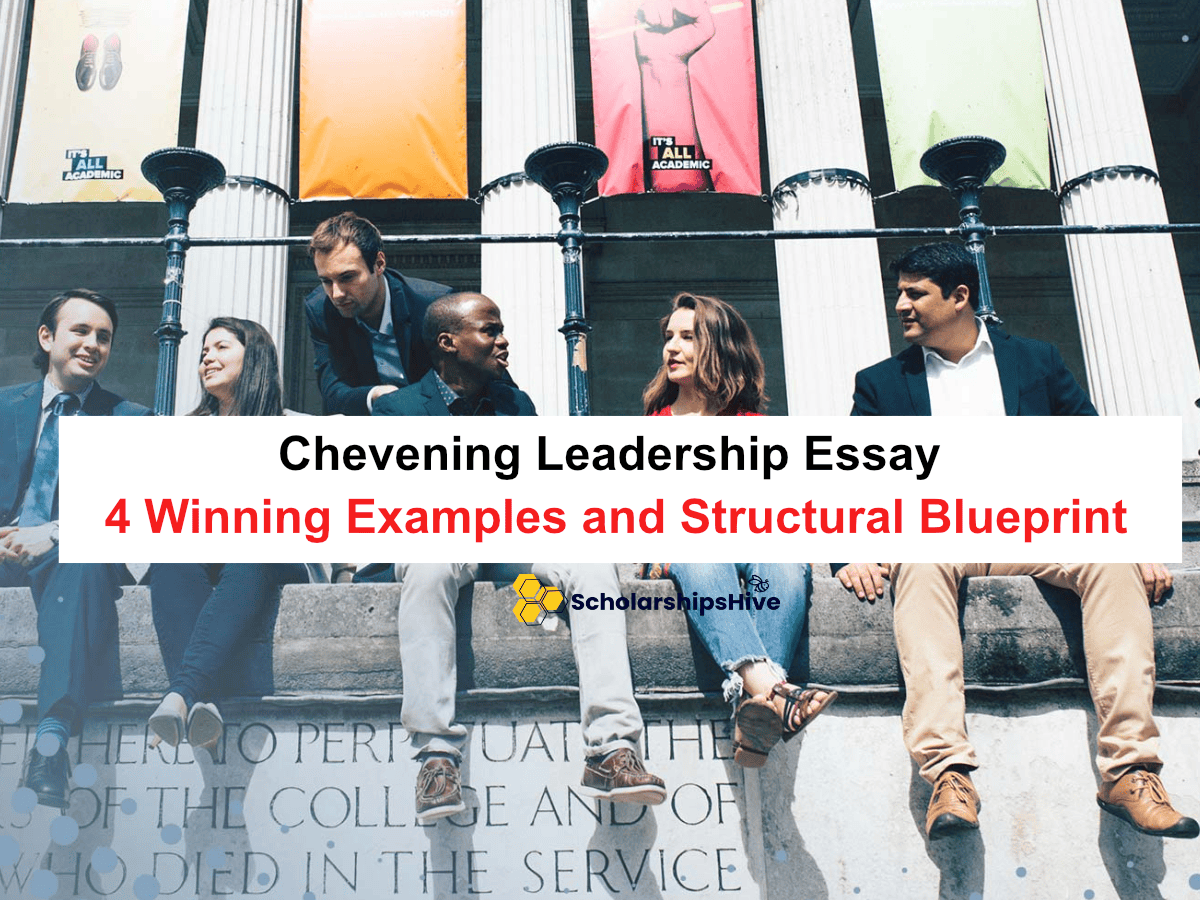
The Chevening Leadership and Influence Essay is arguably the most critical component of the UK Government’s flagship scholarship application. Selection panels review thousands of applications with stellar academic records, but the leadership essay is where successful candidates set themselves apart.
Chevening is not looking for a job description or a passive resume summary. The committee wants to see active leadership, initiative, problem-solving under pressure, and measurable influence.
This comprehensive guide breaks down the core scoring criteria, delivers a step-by-step structural blueprint, and provides four winning sample essays tailored to different professional backgrounds.
MUST READ:
- How to Secure a Recommendation Letter for Overseas Postgraduate Grants (With Samples)
- Scholarship CV / Resume Format: Standard European vs. US Templates
- How to Write a Winning Statement of Purpose (SOP) for Fully Funded Scholarships
The 4-Part Structural Blueprint (STARR Method)
To write a compelling 500-word essay, adopt a structured narrative framework. The most effective method is an adapted STARR Framework (Situation, Task, Action, Result, Reflection), divided into four distinct paragraphs:
================================================================================
CHEVENING LEADERSHIP ESSAY STRUCTURE
================================================================================

PARAGRAPH 1: LEADERSHIP DEFINITION & MAIN EXAMPLE (100 Words)
• Hook statement defining your personal leadership philosophy.
• Introduce your strongest, most impactful project/initiative.

PARAGRAPH 2: THE CHALLENGE & YOUR DIRECT ACTIONS (150 Words)
• Describe the specific obstacle, resource constraint, or crisis.
• Detail the exact steps YOU took (use "I" instead of "We").
• Highlight soft skills: negotiation, motivation, strategic planning.

PARAGRAPH 3: MEASURABLE IMPACT & OUTCOMES (150 Words)
• Quantify your results (percentages, money saved, lives impacted).
• Secondary short example demonstrating leadership growth or continuity.

PARAGRAPH 4: CHEVENING ALUMNI LINK & RELEVANCE (100 Words)
• Connect your leadership style to the Chevening network.
• Explain how you will lead and influence back in your home country.
================================================================================
Key Golden Rules for Chevening Leadership
- Use “I”, Not “We”: Scholarship panels evaluate your personal leadership contribution. Avoid passive collective phrasing like “We decided to build…” Instead, write “I organized the taskforce and delegated…”
- Quantify the Impact: Numbers provide credibility. Include concrete metrics such as people trained, funds raised, efficiency increased, or policy changes enacted.
- Show Influence, Not Just Authority: True leadership is about convincing stakeholders, navigating disagreement, and mobilizing people without relying strictly on job titles.
4 Winning Sample Essays
Example 1: STEM / Technology & Innovation Focus
Leadership, to me, is the ability to identify systemic inefficiencies and mobilize cross-functional teams toward scalable technological solutions. Throughout my career as a software engineer, I have applied this principle to leverage technology for social and operational impact.

My primary leadership milestone occurred during my tenure at TechForward, where our regional healthcare management system faced critical downtime during peak patient registration periods, delaying care for over 10,000 daily users. As the technical team lead, I initiated an unscheduled audit of our cloud architecture. Recognizing that our senior management was hesitant to allocate immediate capital for infrastructure overhaul, I drafted a detailed cost-benefit analysis demonstrating that a microservices transition would reduce operational overhead by 30% while eliminating server bottlenecks.

I persuaded executive leadership to approve a four-week sprint to refactor the legacy codebase. I restructured our eight-person developer team into specialized units, assigned clear deliverables, and established daily agile stand-ups to maintain momentum. When key API integrations failed in week three, I personally mediated technical disputes between our database architects and third-party vendors, re-establishing project milestones without compromising code security.

The resulting system migration reduced server downtime to zero during peak operational hours and increased system response speed by 45%. This project saved the organization $40,000 in annual infrastructure maintenance and earned our team the Regional Innovation Award.

As a future Chevening scholar, I intend to bring this proactive problem-solving mindset to the Chevening technology and innovation network, collaborating with global leaders to drive digital transformation initiatives across developing healthcare sectors.
Example 2: NGO / Community Development & Social Impact Focus
To lead is to empower marginalized communities by building sustainable local capacity rather than imposing top-down interventions. My leadership journey is defined by mobilizing grassroots efforts to address educational inequality in rural districts.

In 2024, following regional floods that displaced over 500 families in the Eastern District, local primary schools were left without basic learning materials. While international emergency relief provided short-term aid, educational continuity remained unaddressed. I took the initiative to establish the "Rural Read" campaign. I brought together a volunteer network of 15 university students, negotiated with local community leaders for physical space, and petitioned regional publishing houses for textbook donations.

Resource mobilization posed a significant challenge. Local authorities were initially reluctant to grant operational permits due to administrative backlogs. I scheduled face-to-face consultations with the District Education Officer, presenting a structured risk-mitigation plan and safety protocol. My persistence paid off, securing formal endorsement and access to community centers. I then instituted a peer-tutoring model where university volunteers trained 30 local high school graduates to deliver foundational literacy classes.

Over six months, our initiative restored educational access for 650 children, established three permanent community learning hubs, and secured over 2,000 donated books. The project model was subsequently adopted by a regional non-profit, ensuring long-term funding.

This experience reinforced my belief that effective leadership relies on stakeholder consensus and sustainable execution—qualities I aim to share within the Chevening community and leverage upon my return to reform regional educational policies.
Example 3: Corporate / Financial Sector & Management Focus
In the financial sector, leadership requires strategic vision, ethical decision-making, and the ability to guide teams through market ambiguity and organizational restructuring.

My significant leadership experience occurred during my role as Senior Financial Analyst at Apex Capital. Following new regional regulatory mandates requiring strict environmental, social, and governance (ESG) compliance for investment portfolios, our firm faced potential compliance penalties if we failed to restructure our $5M flagship fund within six months. Recognizing the operational gap, I volunteered to lead the internal ESG Taskforce despite being the youngest analyst on the division management board.

Managing senior colleagues required diplomatic persuasion rather than positional authority. I organized internal workshops to outline how early ESG adoption would serve as a competitive market advantage rather than a regulatory burden. I restructured our asset evaluation workflow, developed a customized ESG risk-scoring framework, and delegated sectoral audits to specific sub-teams. When two senior department heads resisted changing their portfolio evaluation criteria, I arranged one-on-one strategy sessions, presenting risk models that proved non-compliant assets posed long-term capital risks.

Under my coordination, the team successfully audited and restructured 100% of the target portfolio two months ahead of the regulatory deadline. The newly aligned fund attracted $1.2M in new institutional capital within its first quarter of operation.

Chevening values leaders who drive sustainable economic growth. I look forward to contributing my financial leadership experience to the Chevening alumni network and engaging in global economic dialogue.
YOU MAY ALSO LIKE:
- University of Tokyo MEXT University-Recommended Track Japan : Complete Step-by-Step Guide
- University of Helsinki Grant Scheme Finland : Complete Application Guide
- KTH Royal Institute of Technology Scholarship Sweden: Complete Application Guide
Example 4: Public Sector / Policy & Governance Focus
Effective public sector leadership lies in bridging the gap between national policy design and local community implementation through transparent governance and strategic diplomacy.

As a Junior Officer in the Ministry of Public Health, I demonstrated this capacity when assigned to lead the administrative rollout of the National Clean Water Initiative across five pilot municipalities. The project faced severe delays due to conflicting inter-departmental priorities between municipal municipal councils, public works departments, and local environmental advocacy groups.

To overcome this gridlock, I created a Joint Steering Committee bringing representatives from all three sectors to a single table. During initial proceedings, negotiations stalled over budget allocations for water filtration hardware. I drafted a revised, phased deployment proposal that addressed municipal budget constraints while meeting the environmental coalition’s safety standards. By shifting the focus toward shared long-term public health outcomes, I successfully negotiated a binding memorandum of understanding across all five municipalities.

I directed field implementation teams, established weekly reporting metrics, and ensured public expenditure data was published on an open portal to maintain public trust.

The initiative resulted in the successful installation of 25 community water purification units, providing clean drinking water to over 18,000 residents and reducing waterborne disease reports by 28% in target districts within one year.

This project proved that inclusive, transparent leadership can resolve public policy bottlenecks. As a Chevening scholar, I plan to leverage these governance skills to advocate for policy frameworks that drive equitable public service delivery.
FAQs
What is the word count limit for the Chevening Leadership Essay?
The essay has a strict limit of minimum 100 words and maximum 500 words. Aim for around 450 to 480 words to maximize your detailed narrative without exceeding the threshold.
Should I focus on one big leadership story or multiple small ones?
Focusing on one primary, high-impact leadership story (covering 60–70% of the essay) with a brief secondary example yields better results than listing multiple superficial achievements. Depth is preferred over breadth.
Can I write about leadership roles from my student life?
If you have limited professional work experience, you may draw upon leadership roles in university student councils, major academic research projects, or voluntary organizations. However, ensure the story demonstrates real responsibility and tangible outcomes.
Final Tip From ScholarshipsHive
Selection committees read hundreds of essays daily. Ensure your narrative is clear, logically structured, and directly highlights your individual actions and impact. Save your draft in plain text first, proofread thoroughly for grammar, and verify your word count before submitting on the official Chevening portal.
Join our WhatsApp Channel for instant scholarship updates, application guides, and templates: WhatsApp Channel