
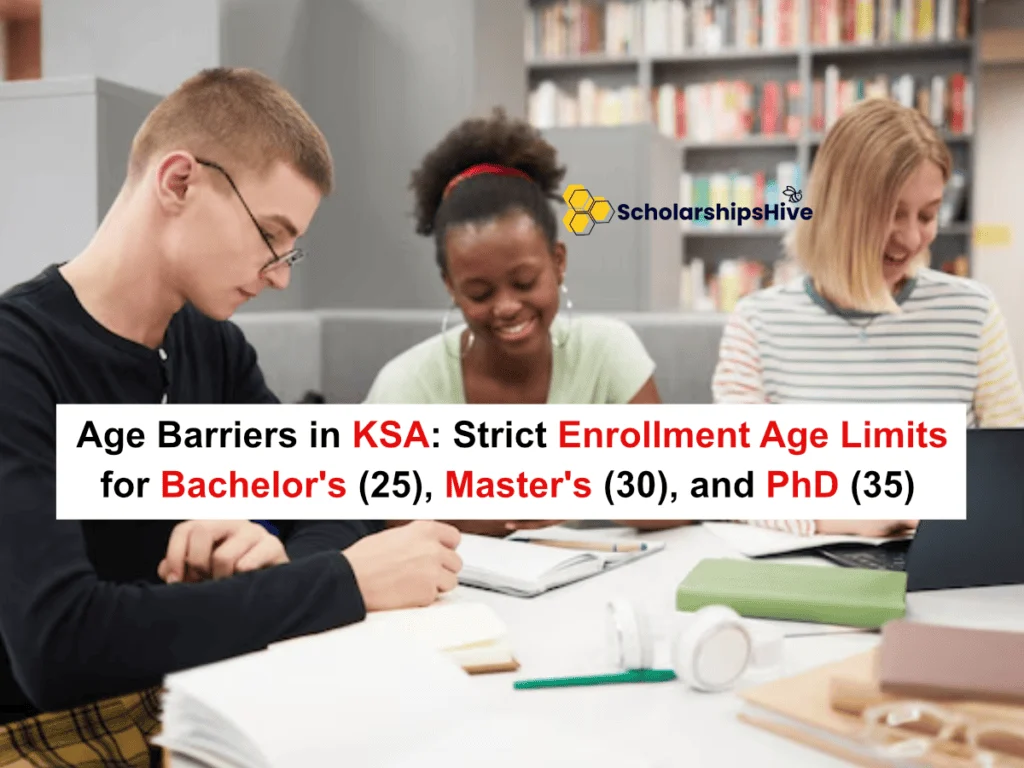
Age Barriers in KSA: Strict Enrollment Age Limits for Bachelor’s (25), Master’s (30), and PhD (35) 2026 | Fully Funded
Key facts
- Country
- Saudi Arabia
- Degree level
- Masters, PhD, Undergraduate
- Funding
- Fully Funded
As the Kingdom of Saudi Arabia continues to position itself as a premier global hub for international higher education under the ambitious framework of Saudi Vision 2030, its centralized scholarship system attracts hundreds of thousands of applicants worldwide. Through the unified Study in Saudi Portal and the overarching regulations established by the Ministry of Education (MOE), public universities across the Kingdom offer fully funded academic pathways covering complete tuition waivers, monthly living stipends, free housing, and medical care.
However, navigating these prestigious opportunities requires strict adherence to institutional eligibility frameworks. Among the most rigid and non-negotiable filters enforced by the Saudi government are strict enrollment age barriers. Designed to align with national human capital strategies, career development timelines, and long-term research integration, these age caps dictate exact cutoffs for undergraduate, master’s, and doctoral candidates. Understanding how these age thresholds are calculated, why they exist, and how to structure your application timeline is essential to securing a fully funded seat for the 2026/2027 academic cycle.
1. The Statutory Age Limit Framework Across Degree Tiers
The Ministry of Education enforces uniform age regulations across all participating public universities in the Kingdom. These parameters are codified into the legal statutes governing international student enrollment. The exact age ceilings on the official closing date of the application process are structured as follows:
- Bachelor’s Degree & Arabic Language Programs: Applicants must be between 17 and 25 years old. This tier also encompasses foundational Arabic language institutes designed for non-native speakers prior to entering mainstream undergraduate tracks.
- Master’s Degree Programs: Applicants must be under 30 years old (maximum age of 30 on the official submission deadline).
- PhD / Doctoral Programs: Applicants must be under 35 years old (strictly below 35 on the closing date of the application process).
Failure to meet these exact age boundaries results in immediate, automated disqualification by the portal’s screening algorithms before human evaluators even review academic credentials.
Check this: Master’s by Coursework vs. Research: Which Degree Structure Is Preferred for Funding in Malaysia?
2. Rationale Behind KSA’s Strict Age Ceilings
For many international applicants accustomed to flexible continuing-education policies in Western academic institutions, Saudi Arabia’s hard age limits can seem restrictive. However, these regulations serve distinct administrative, financial, and strategic objectives within the national higher education landscape:
- Long-Term Return on Investment (ROI): Fully funded scholarships provided by the Saudi government are substantial state investments. By capping entry ages at 25, 30, and 35, the system ensures that graduates have maximum career runway ahead of them to contribute to academic research, industrial innovation, or diplomatic ties.
- Peer Group Synchronization: Maintaining strict age brackets helps keep cohorts academically and socially synchronized. Master’s and doctoral candidates enter research clusters alongside peers at similar life stages, fostering cohesive collaborative environments.
- Visa and Residency Compliance: International student visas (D1 education visas) issued by the Ministry of Foreign Affairs are closely tethered to full-time student status within specific age-tier parameters mapped out by Saudi immigration and labor frameworks.
3. Critical Guidelines on Age Calculation and Deadlines
A common pitfall for international applicants is miscalculating when the age limit is assessed. The Ministry of Education evaluates age based on strict administrative criteria:
- The Closing Date Benchmark: Your age is measured precisely on the official closing date of the application portal window, not on the date you start classes, nor on your birth month during the academic year. If a PhD application window closes on May 15 and you turn 35 on May 10, you are legally ineligible, even if classes do not begin until September.
- Passport Verification Mismatch: The automated platform extracts your date of birth directly from your uploaded international passport scan. Any discrepancy between your self-reported profile data and your official passport credentials triggers an instant system flag.
- Zero-Tolerance Policy: There are no official exemptions, hardship waivers, or petition processes for candidates who miss the age cutoffs by a matter of days or weeks.
You may also like this: The HEC Attestation Rule: Verifying Your Pakistani Documents Before Applying to Malaysia
4. Strategic Academic Planning Around Age Thresholds
Because the age barriers are absolute, prospective scholars must adopt proactive timeline management to ensure they apply within the permitted window:
- For Undergraduate Aspirants: Because the window closes at 25, students completing higher secondary education should ideally apply immediately or within a few years of graduation. Delaying gap years past the mid-twenties permanently locks candidates out of undergraduate scholarships in Saudi Arabia.
- For Master’s Applicants: The 30-year ceiling requires efficient undergraduate progression. Candidates completing a four-year bachelor’s degree around age 22 or 23 have a safe buffer of 5 to 7 years to gain professional experience or complete prerequisite research before applying for a fully funded master’s program.
- For Doctoral Hopefuls: The 35-year limit for PhD tracks is particularly compressed. Scholars must transition smoothly from master’s completion to doctoral application submission without exceeding the age threshold, making early publication records and standardized test readiness vital.
5. Financial and Structural Benefits of Securing a Scholarship Within Age Limits
Meeting the criteria and successfully clearing the age filter unlocks one of the most comprehensive student funding packages available globally:
- Full Tuition Exemption: Complete waiver of all institutional and program fees for the duration of the degree.
- Monthly Living Allowance: Regular financial stipends (ranging from SAR 900 for humanities to SAR 1,000+ for scientific tracks, and higher graduate stipends) to cover daily living expenses.
- Free On-Campus Housing: Fully furnished, air-conditioned accommodation within university residential complexes, inclusive of utilities and maintenance.
- Comprehensive Healthcare: Free medical care and emergency treatment managed through university health centers and regional hospitals.
- Travel and Relocation Support: Annual round-trip airfare tickets connecting the student’s home country to the Kingdom, alongside settling-in grants.
Check this out: The Grading System Explanation: What to Upload if Your Transcripts Do Not Explicitly State a CGPA in Malaysia
Official Scholarship Links & Community
- Official Unified Scholarship Portal: Study in Saudi Arabia Official Portal
- Saudi Ministry of Education Portal: Ministry of Education Guidelines
- Join our WhatsApp Channel for the latest updates on international scholarships and deadlines.
Frequently Asked Questions
Can I apply for a Master’s scholarship if I turn 30 during the application review period?
No. The applicant must be under the maximum age limit (30 for Master’s, 35 for PhD, and 25 for Bachelor’s) on the exact closing date of the application process. If your birthday falls before or on the closing date and pushes you past the limit, you will be disqualified.
Are there any exceptions or age waivers available for exceptional academic records?
No. The age limits mandated by the Saudi Ministry of Education are statutory requirements applied uniformly across all participating public universities. There are no discretionary waivers for high GPA scores or extensive publication records.
Does the age limit apply to self-funded international students studying in Saudi Arabia?
No. The strict age caps (25, 30, and 35) primarily govern officially sponsored, fully funded scholarship students admitted through the national quota framework. Private or self-funded enrollment paths may feature separate administrative criteria determined individually by each university.
Final thoughts and advice from scholarshipshive
Navigating the stringent age barriers of Saudi Arabia’s higher education system requires meticulous timing and early preparation. Whether you are targeting an undergraduate seat before turning 25, a master’s program before 30, or a doctoral fellowship before 35, understanding these cutoffs prevents wasted effort and ensures your application aligns with official statutory guidelines. Review your timeline, verify your passport credentials against the closing dates, and utilize the centralized portal strategically to secure your fully funded academic future for the 2026/2027 cycle.
Explore similar scholarships
Never miss a deadline
Get new fully funded scholarships every day. Follow Scholarships Hive on your favourite app.
Similar scholarships
 Prince Mohammad bin Fahd University (PMU) Scholarships: Global Partnership Options and Fee Waivers 2026, Saudi Arabia | Partially Funded
 King Faisal University (KFU) Scholarships: Agricultural and Biological Research Grants in Al-Ahsa 2026, Saudi Arabia | Fully Funded
 Jazan University Scholarships: Coastal Research Infrastructure and Student Living Stipends 2026, Saudi Arabia | Fully Funded
 University of Jeddah Scholarships: Specialized Artificial Intelligence and Logistics Pathways 2026, Saudi Arabia | Fully Funded
 Taibah University Scholarships: Exploring Postgraduate Quotas in Madinah 2026, Saudi Arabia | Fully Funded
 Alfaisal University: Private Sector Options and Institutional Scholarship Structures 2026, Saudi Arabia | Partially Funded