📲 Join our WhatsApp for Daily Fully Funded Scholarship Alerts
For ambitious Pakistani students aspiring to advance their higher education in Southeast Asia, Malaysia has rapidly emerged as one of the most dynamic, globally competitive, and financially accessible destinations. Housing world-class research universities, international branch campuses of top-tier Western institutions, and vibrant multicultural urban centers, Malaysia attracts thousands of applicants from Pakistan annually. However, transitioning from a local academic background to a Malaysian university campus or submitting student visa paperwork through Education Malaysia Global Services (EMGS) involves rigorous administrative compliance.
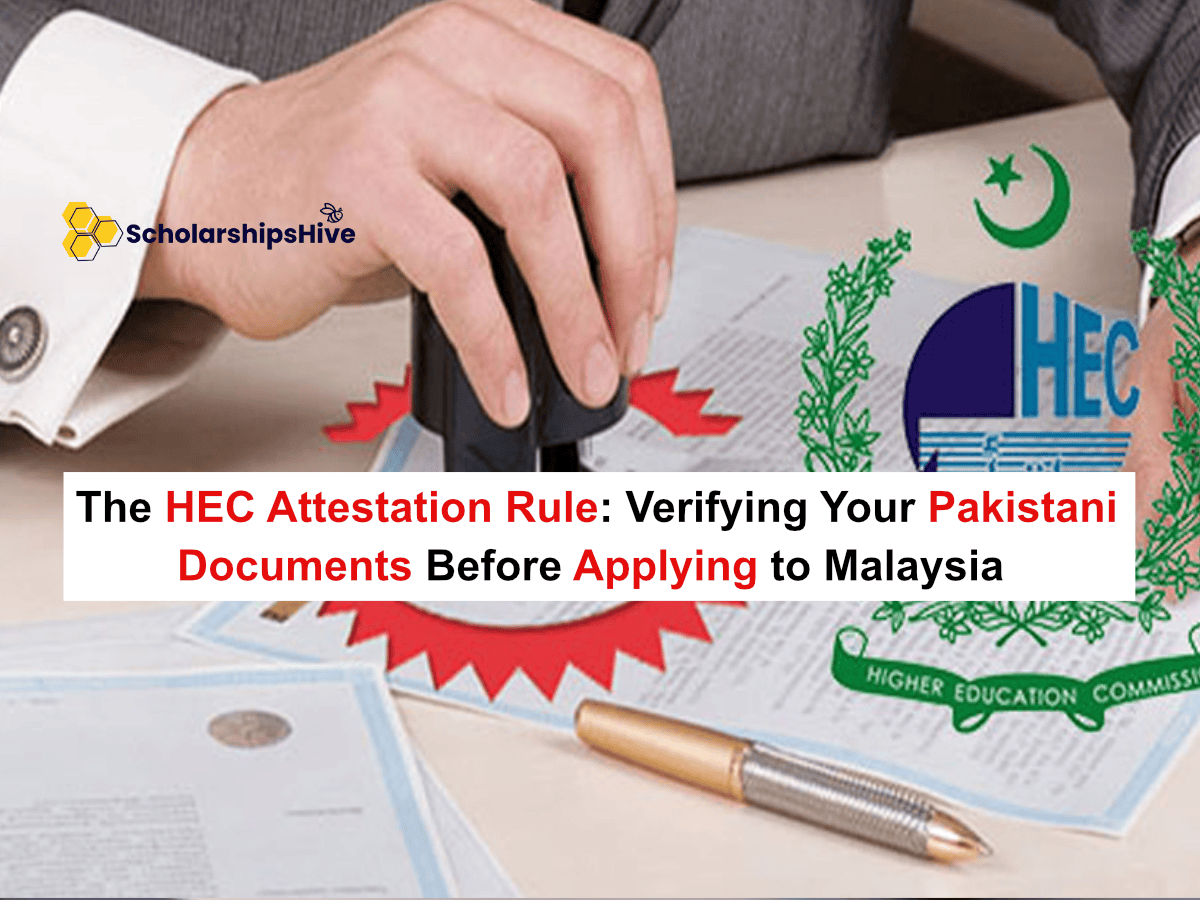
At the core of this compliance framework sits a mandatory gatekeeper: The Higher Education Commission (HEC) of Pakistan document verification rule. Before a Malaysian university senate can issue an unconditional admission offer or the Malaysian Immigration Department can approve a student pass, your academic credentials must be legally vetted, validated, and stamped. Navigating this multi-tiered verification chain correctly is critical to avoiding application halts, visa rejections, and costly travel delays during the 2026 intake cycle.
This comprehensive extended guide explores the regulatory foundation of HEC attestation, the step-by-step digital e-services workflow, downstream authentication steps with the Ministry of Foreign Affairs (MOFA) and the Malaysian High Commission, and strategic measures to safeguard your academic timeline.
1. The Core Legal Rationale: Why HEC Verification is Non-Negotiable
Why do Malaysian higher education institutions and immigration screening authorities strictly insist on HEC-attested documents from Pakistani applicants? The operational rationale involves several key factors:
- Proof of Institutional Recognition: The HEC serves as the supreme national regulatory body overseeing higher education quality, university accreditation, and degree legitimacy in Pakistan. An HEC attestation confirms definitively that your degree was earned from a legally recognized public or private university or Degree Awarding Institution (DAI).
- Preventing Fraudulent Credentialing: To satisfy quality assurance mandates monitored by the Malaysian Qualifications Agency (MQA), universities must ensure that incoming international candidates possess genuine academic foundations, eliminating risks associated with unaccredited or fraudulent credentials.
- EMGS and Immigration Compliance: When your university uploads your application packet to the EMGS portal to generate your Visa Approval Letter (VAL), immigration compliance officers cross-check your academic transcripts. Unverified local credentials will trigger an immediate administrative freeze, halting your student pass processing indefinitely.
2. The Chain of Custody: From Local Boards to Malaysian Embassies
Successfully preparing your Pakistani academic portfolio for use in Malaysia requires navigating a structured, chronological chain of legalizations. Skipping a single link in this chain will invalidate your submission:
- Intermediate and Matriculation Validation (IBCC): While university-level degrees fall under the jurisdiction of the HEC, foundational school certificates—such as your Secondary School Certificate (SSC / Matric) and Higher Secondary School Certificate (HSSC / Intermediate)—must first be verified and attested by the Inter Board Coordination Commission (IBCC).
- Higher Education Commission (HEC) Attestation: For undergraduate, postgraduate, Master’s, and PhD degrees, your university transcripts, mark sheets, and degree scrolls must be authenticated through the HEC.
- Ministry of Foreign Affairs (MOFA, Pakistan) Attestation: Once your educational documents bear the necessary HEC digital verification or stamps, they must be presented to the Ministry of Foreign Affairs of Pakistan. MOFA attestation validates the authenticity of the HEC’s stamps, making the documents legally exportable for foreign use.
- Malaysian High Commission / Embassy Legalization (When Mandated): For certain specialized professional programs, scholarship panels, or public university administrative requirements, the MOFA-verified documents must undergo final diplomatic legalization by the High Commission of Malaysia in Islamabad.
You may also like this: Sunway University: Jeffrey Cheah Foundation Scholarships for International Postgraduates, Malaysia | Fully Funded
3. Step-by-Step HEC e-Services Digital Workflow
The Higher Education Commission utilizes a streamlined digital portal (e-Services) to manage degree and transcript attestation. Understanding the exact operational workflow ensures a seamless application:
- Account Registration: Access the official HEC e-Services portal (
eservices.hec.gov.pk) to create a secure user profile using a valid email address and mobile number. - Complete Educational Profile: Input your complete academic history chronologically, starting from Matric onward. You must enter exact roll numbers, session years, institutional titles, and registration details. Crucial Rule: Every spelling detail on your academic profile must match your Computerized National Identity Card (CNIC) or passport identically.
- Document Upload: Upload clear, high-resolution, full-page scanned copies (in PDF or JPEG format) of your CNIC (front and back), Matric certificate, Intermediate certificate, Bachelor’s/Master’s degree, and complete cumulative transcripts.
- Application Submission & Fee Payment: Select the specific documents you wish to have attested, choose your processing mode (normal or urgent), and generate the electronic payment challan through 1-Link / 1-Bill. Fees are structured per document (typically covering original certificates and copies).
- University Verification & System Scrutiny: HEC conducts an initial compliance check and digitally coordinates with your issuing university to verify institutional records. Once verified, HEC generates your official e-Attestation Certificate or updates your digital profile for final clearance.
You may also like this: Sunway University: Jeffrey Cheah Foundation Scholarships for International Postgraduates, Malaysia | Fully Funded
4. Common Pitfalls That Cause HEC Attestation Rejections
Applicants frequently encounter avoidable delays or outright rejections due to minor administrative oversights:
- Name and Particulars Discrepancies: If your name, your father’s name, or your date of birth differs by even a single letter between your Matric certificate, your university degree, and your CNIC, the system will flag the file. Legal affidavits or corrected certificates must be processed before re-submitting.
- Skipping Intermediate or Matric Details: Even if you are applying for a PhD and only attesting your postgraduate degree, HEC regulations mandate that you input and upload all antecedent qualifications starting from Matric. Omitting foundational documents marks your application as deficient.
- Submitting Unrecognized Degrees: Degrees earned from unaccredited institutions, unapproved sub-campuses, or unauthorized franchise programs that lack formal HEC recognition will be permanently rejected.
Official Portals and Resources
- HEC e-Services Portal: Official HEC Degree Attestation System
- Inter Board Coordination Commission (IBCC): IBCC School Certificate Attestation Hub
- Ministry of Foreign Affairs Pakistan: MOFA Legalization Portal
- Education Malaysia Global Services (EMGS): EMGS Official Student Visa Hub
- Join our WhatsApp Channel for the latest updates on international scholarships and deadlines.
FAQs
Is HEC attestation mandatory if I am studying in Malaysia on an online program or credit transfer?
Yes. Whether you are enrolled in a full-time on-campus program in Bandar Sunway or executing a specialized cross-border research partnership, Malaysian institutions and immigration compliance frameworks require official HEC and MOFA validation for any prior qualifying credentials obtained in Pakistan.
Can someone else submit my documents to HEC or MOFA on my behalf?
Yes. If you cannot visit an HEC regional center or MOFA camp office in person, you can authorize a blood relative or representative via a formal written authority letter, or process your documents securely through authorized courier services like FedEx/Gerry’s where applicable.
What should I do if my university takes too long to verify my degree with HEC?
University verification bottlenecks are common. You should initiate your HEC digital application at least six to eight weeks before your intended Malaysian university application deadline. Proactively contacting your university’s examination department to expedite their internal verification response can significantly accelerate the process.
Final thoughts and advice from ScholarshipsHive
Navigating the HEC attestation rule for your Pakistani academic documents during the 2026 intake cycle is an indispensable step toward realizing your study-abroad goals in Malaysia. By systematically clearing the verification chain—starting from IBCC school certificates to HEC university approvals, MOFA stamps, and Malaysian consular legalizations—you protect your academic dossier from administrative rejection. Early preparation, meticulous attention to personal details, and strict adherence to institutional timelines guarantee a smooth transition into Malaysia’s vibrant higher education ecosystem.