📲 Join our WhatsApp for Daily Fully Funded Scholarship Alerts
So, you’ve decided to study in Italy. You’ve picked your university, you’re dreaming of pasta near the Colosseum or the Duomo, and you’ve heard about the life-changing DSU or other regional scholarships. But then, you hit a wall called the ISEE Parificato.
If you feel overwhelmed, don’t worry—you’re not alone. Almost every international student goes through this “document nightmare.” In this guide, I’m going to walk you through every single detail of the ISEE Parificato for 2026. No fluff, just the real steps you need to take to secure your €7,000+ scholarship.
Check out our Complete Guide on DSU Scholarship.
What Exactly is ISEE Parificato? (And Why Do You Need It?)
Before we dive into the “how,” let’s talk about the “what.” ISEE stands for Indicatore della Situazione Economica Equivalente. In plain English, it’s a number that tells the Italian government how much money your family has.
Italy is famous for its “Right to Study” (Diritto allo Studio). They believe that even if you aren’t wealthy, you deserve a world-class education. But to prove you need the money, they need to see your financial status. Since you live outside of Italy and don’t pay taxes there, you cannot get a standard ISEE. Instead, you get the ISEE Parificato—which is basically an “equivalent” calculation for foreigners.
Why is it the “Golden Ticket”?
Without this document, you are considered a “wealthy” student by default. You’ll have to pay full tuition fees (which can be thousands of Euros) and you won’t get a cent of the stipend or free meals.
The 2-Year-Prior Rule: Don’t Get the Year Wrong!
This is the mistake that costs students their scholarships every year. For the 2026 scholarship cycle, the Italian government looks at your financial history from two years prior.
Important: Your income, bank balances, and property details must be from the calendar two year prior (January 1st to December 31st).
The “Big Four” Documents You Must Prepare
Let’s get into the heavy lifting. You need four main types of information. Everything must be official, stamped, and legalized.
1. Family Composition (Who lives with you?)
The authorities need to know how many people are supported by your family’s income.
- What to get: An official Family Registration Certificate (FRC) or a similar document from your local municipality.
- Insider Tip: Make sure it includes everyone—parents, siblings, and even grandparents if they live in the same house and are part of the “household.”
2. Family Income (How much do you earn?)
You need to show the gross income for every member of the family who worked in 2024.
- If they have a job: Get a salary certificate or tax return.
- If they are a business owner: You need a profit/loss statement or tax documents for the business.
- If they are unemployed: This is crucial! You must get a “Certificate of Non-Employment” or a “Nil Income” certificate. You cannot just leave it out; you have to prove they earned zero.
3. Real Estate/Property (Where do you live?)
This is where it gets tricky. Italy measures wealth based on property ownership.
- What to get: A certificate showing the ownership of your family home as of December 31, 2024.
- The “Square Meter” Rule: Your document must state the size of the house in m² . If your document says “Square Feet” or “Acres,” the Italian CAF office might ignore it. Convert it or make sure the official paper reflects the m² value.
- What if you rent? You need a copy of the rent agreement that was valid in 2024.
4. Movable Assets (What’s in your bank?)
You need to show the “wealth” inside your bank accounts.
- Bank Statements: You need the closing balance as of December 31, 2024.
- Stocks/Bonds: If your family owns shares or gold certificates, those need to be declared too.
The Legalization Maze: MOFA, Translation, and the Embassy
Gathering the papers is only 30% of the work. The rest is making them “legal” for use in Italy. Follow this sequence exactly:
- Local Attestation: Get your documents stamped by your local Ministry of Foreign Affairs (MOFA) or the Department of State.
- Italian Translation: Your documents are likely in English, Urdu, Hindi, or Arabic. Italy requires them in Italian. Use a translator that is “recognized” or “approved” by the Italian Embassy.
- Embassy Legalization: This is the final boss. You take your MOFA-stamped and translated papers to the Italian Embassy. They will put a “perfezionamento” stamp on them. Only then are they valid in Italy.
Check out: Universitaly Pre-Enrollment Guide: Step-by-Step for International Students
How to Submit to a CAF Office (Online)
Once you have your legalized papers, you don’t actually send them to the university. You send them to a CAF (Centro di Assistenza Fiscale).
Since you are likely still in your home country during the summer, you should look for a CAF office that accepts online applications.
- Step 1: Email the CAF office (usually provided by your university’s scholarship page).
- Step 2: Send them clear PDF scans of your legalized documents.
- Step 3: Fill out their internal form (Dichiarazione Sostitutiva Unica).
- Step 4: Wait. It usually takes 10–20 days for them to send you the ISEE Parificato certificate.
Calculating the ISEE Value: The Math Behind the Magic
The CAF office uses a specific formula to calculate your ISEE. While you don’t need to do the math yourself, it’s good to understand it.
The formula is roughly:
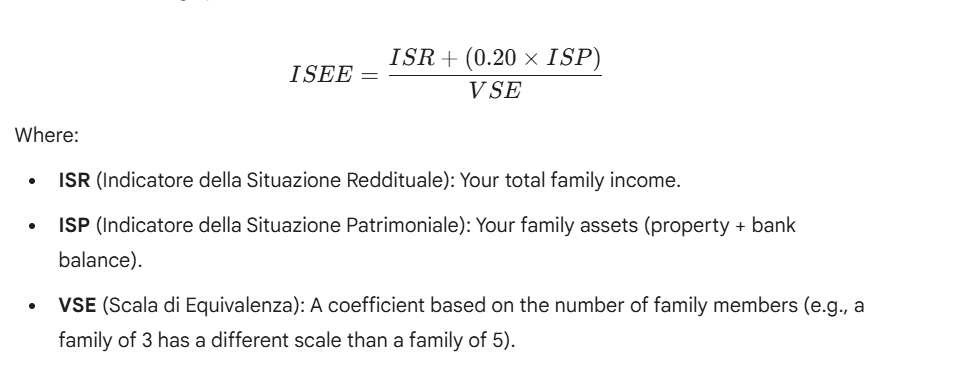
If your final ISEE value is below the threshold (usually around €25,000 to €27,000), you are eligible for the full scholarship!
Common Pitfalls and How to Avoid Them
- The “Income-Wealth” Mismatch: If you show zero income but own a 500 square meters mansion, the Italian government will find it suspicious. Make sure your documents reflect a logical financial story.
- Missing the Deadline: Most regional scholarships like DSU Toscana have a deadline in early September. If you start your embassy legalization in August, you will fail. Start in May.
- Incorrect Currency Conversion: Don’t convert the money yourself. The CAF office uses the official exchange rate set by the Bank of Italy for the end of the year 2024.
Official Links to Bookmark
Don’t trust random blogs; always verify with these official portals:
- You can start your application on the DSU Toscana Official Portal: https://www.dsu.toscana.it/
- For more details on document stamps, visit the Italian Ministry of Foreign Affairs (Legalization Info): https://www.dsu.toscana.it/-/foreign-students
- Universitaly: https://www.universitaly.it/
Final Thoughts
Getting your ISEE Parificato is a test of patience. It’s bureaucratic, it’s slow, and it involves a lot of stamps. But remember the reward: A world-class degree from Italy, no tuition debt, and enough money in your pocket to travel Europe while you study.
Now that you know how to handle the paperwork, make sure you understand the full application timeline and benefits by visiting our Complete DSU Scholarship Guide.
