📲 Join our WhatsApp for Daily Fully Funded Scholarship Alerts
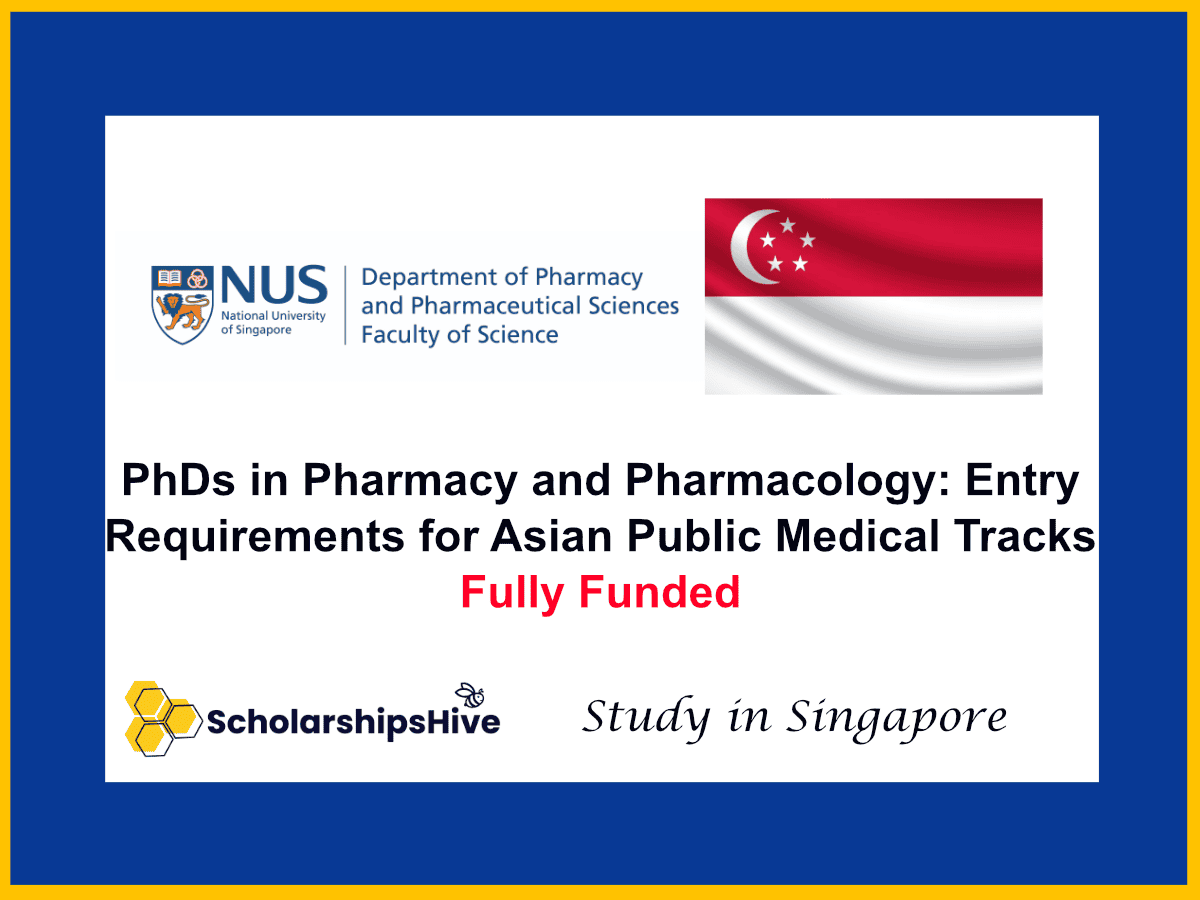
As global healthcare transitions into precision medicine, targeted drug delivery, pharmacogenomics, and advanced biopharmaceutical engineering, the demand for elite doctoral researchers in pharmacy and pharmacology has surged to unprecedented levels. For ambitious international life science graduates, pharmacists, and pharmaceutical scientists aiming to conduct pioneering drug discovery and clinical pharmacology research, Singapore’s world-class public university medical faculties represent an elite global destination.
Anchored by premier institutions such as the National University of Singapore (NUS) Department of Pharmacy under the Yong Loo Lin School of Medicine, and Nanyang Technological University (NTU), Singapore’s medical research tracks combine rigorous clinical translation with heavily funded national scholarships like the Singapore International Graduate Award (SINGA) and NUS Research Scholarships.
This exhaustive, expanded blueprint breaks down the specialized pharmacology tracks, rigorous entry requirements, financial funding packages, and a strategic application roadmap for the 2026 intake.
1. The Strategic Advantage of Pharmacology & Pharmacy Research in Singapore
Singapore’s biomedical manufacturing and translational research hubs (such as Biopolis and the National University Health System (NUHS) ecosystem) provide a seamless bridge between molecular discovery and patient bedside applications.
When enrolled in a pharmacology or pharmaceutical science PhD track in Singapore, researchers gain distinct advantages:
- Translational Drug Discovery: Direct access to clinical trial networks, high-throughput screening facilities, and advanced mass spectrometry platforms for pharmacokinetic and pharmacodynamic (PK/PD) modeling.
- Interdisciplinary Collaboration: Close partnerships between chemists, clinicians, bioengineers, and data scientists, facilitating multi-modal approaches to overcoming drug resistance and optimizing targeted therapeutics.
- High-Impact Publications: Mentorship by world-renowned faculty enabling candidates to publish in top-tier pharmacological and clinical journals (such as Nature Reviews Drug Discovery, Clinical Pharmacology & Therapeutics, and the Journal of Medicinal Chemistry).
2. Specialized Pharmacy and Pharmacology Research Tracks
Prospective PhD candidates align their academic profiles with key high-demand specialized research divisions:
Track A: Molecular Pharmacology and Drug Discovery
- Focus Areas: Receptor pharmacology, signal transduction pathways, identification of novel therapeutic targets, structure-based drug design, and high-throughput screening of small molecules and biologics.
- Research Application: Discovering lead drug candidates for oncology, infectious diseases, and neurodegenerative disorders.
Track B: Pharmaceutics, Nanomedicine, and Drug Delivery Systems
- Focus Areas: Nano-carrier formulations, lipid nanoparticles (LNPs), polymer-based sustained release systems, targeted gene delivery, and biomaterials engineering.
- Research Application: Overcoming biological barriers to enhance the bioavailability and targeted delivery of therapeutic peptides, RNA, and hydrophobic drugs.
Track C: Clinical Pharmacy, Pharmacogenomics, and Outcomes Research
- Focus Areas: Personalized medicine, genetic biomarkers influencing drug response, adverse drug reaction modeling, real-world evidence analytics, and pharmacoeconomics.
- Research Application: Translating genetic profiles into optimized, personalized dosing regimens and improving public health medication safety frameworks.
You may also like this: The Research Proposal Structure: Outlining Your STEM Project for the Selection Committees, Singapore | Fully Funded
3. The Complete Fully Funded Financial Package
Doctoral research tracks in pharmacy and pharmacology across Singapore’s public medical universities are fully supported by prestigious national and institutional scholarships, completely removing financial barriers:
- 100% Tuition Fee Waiver: Full coverage of all doctoral tuition fees for up to 4 years of study.
- Generous Monthly Living Stipend: Tax-free monthly allowances starting at S$2,700 to S$3,100, which automatically increase upon successfully passing your doctoral Qualifying Examination (QE).
- Relocation & Airfare Support: A one-time settling-in allowance (typically S$1,000) and economy airfare grants covering initial travel to Singapore.
- Research & Conference Allowances: Dedicated financial support for laboratory reagents, animal model maintenance, specialized software licenses, and international travel to present research at global conferences (such as ASPET, EPHAR, or Controlled Release Society meetings).
4. Strict Entry Requirements and Academic Prerequisites
Because Singapore’s medical faculties maintain rigorous academic standards, applicants for PhD tracks in pharmacy and pharmacology must satisfy detailed entry criteria:
- Academic Excellence: Applicants must hold a stellar Bachelor’s (with First Class Honours or equivalent) and/or Master’s degree in Pharmacy, Pharmacology, Pharmaceutical Sciences, Chemistry, Biochemistry, Biomedical Sciences, or Chemical Engineering.
- Quantitative and Scientific Foundation: Demonstrated mastery of organic chemistry, human physiology, molecular biology, biostatistics, and physical chemistry.
- Standardized Testing & Language Proficiency: Strong academic records supported by competitive GRE scores (where required by specific department tracks) and proof of English proficiency (TOEFL/IELTS) for non-native English instruction backgrounds.
- Laboratory Competency: Hands-on wet-lab research experience, undergraduate thesis projects involving cell culture, chromatographic assays (HPLC/LC-MS), in-vitro/in-vivo testing, or computational drug modeling.
5. Step-by-Step Application Roadmap for 2026
Step 1: Explore Faculty Profiles and Labs (Months 1–2)
Explore the NUS Department of Pharmacy and Yong Loo Lin School of Medicine faculty directories. Identify principal investigators whose published work in drug delivery, molecular pharmacology, or pharmacogenomics matches your research goals.
Step 2: Craft a Rigorous Research Proposal (Months 3–4)
Draft a concise, scientifically rigorous proposal detailing your hypothesis, proposed experimental methodologies, anticipated analytical outcomes, and clinical translation relevance.
Step 3: Secure Technical Referees (Month 5)
Engage academic professors or research supervisors who can explicitly attest to your laboratory safety practices, analytical rigor, and capacity for independent scientific inquiry.
Step 4: Portal Submission and Deadlines (Month 6)
Submit your application packages through official university portals (such as the NUS Graduate Admission system or A*STAR SINGA portal) well ahead of institutional deadlines (typically December for August intakes).
Check this out: No-Bond Advantage: Why the SINGA Scholarship Is Called a “Bond-Free” Full Ride, Singapore | Fully Funded
Official Scholarship Links & Resources
- NUS Department of Pharmacy Graduate Programmes: NUS Pharmacy Graduate Portal
- NUS Yong Loo Lin School of Medicine Research: NUS Medicine Graduate Research
- Official SINGA Portal & Guidelines: A*STAR SINGA Application Portal
- Join our WhatsApp Channel for the latest updates on international scholarships and deadlines.
Frequently Asked Questions
Is a professional Pharmacy (B.Pharm / Pharm.D) degree mandatory to apply for a Pharmacology PhD?
No. While B.Pharm and Pharm.D graduates are warmly welcomed, candidates with strong Bachelor’s or Master’s degrees in Biochemistry, Chemistry, Biomedical Sciences, or Chemical Engineering who possess robust life science laboratory experience are fully eligible.
Do these PhD scholarships require a post-graduation employment bond?
Standard PhD scholarships like SINGA and NUS Research Scholarships do not carry mandatory local employment bonds, granting graduates complete freedom to pursue global academic postdocs, pharmaceutical industry R&D roles, or biotechnology ventures worldwide.
Can I apply directly with a Bachelor’s degree into a PhD track?
Yes. Exceptional Bachelor’s degree holders with outstanding academic transcripts, high GPAs, and substantive undergraduate research experience can apply directly to integrated PhD programs in Singapore without needing an intermediate Master’s degree.
Final thoughts and advice from scholarshipshive
Targeting a fully funded PhD in pharmacy or pharmacology within Singapore’s world-class medical research ecosystem places you at the vanguard of global healthcare innovation. By aligning your academic portfolio with elite faculties like NUS Pharmacy, preparing a scientifically rigorous proposal, and submitting your application ahead of schedule, you can secure complete financial backing for your doctoral journey. Plan your roadmap meticulously, beat the deadlines, and step forward into your advanced pharmaceutical research career!