
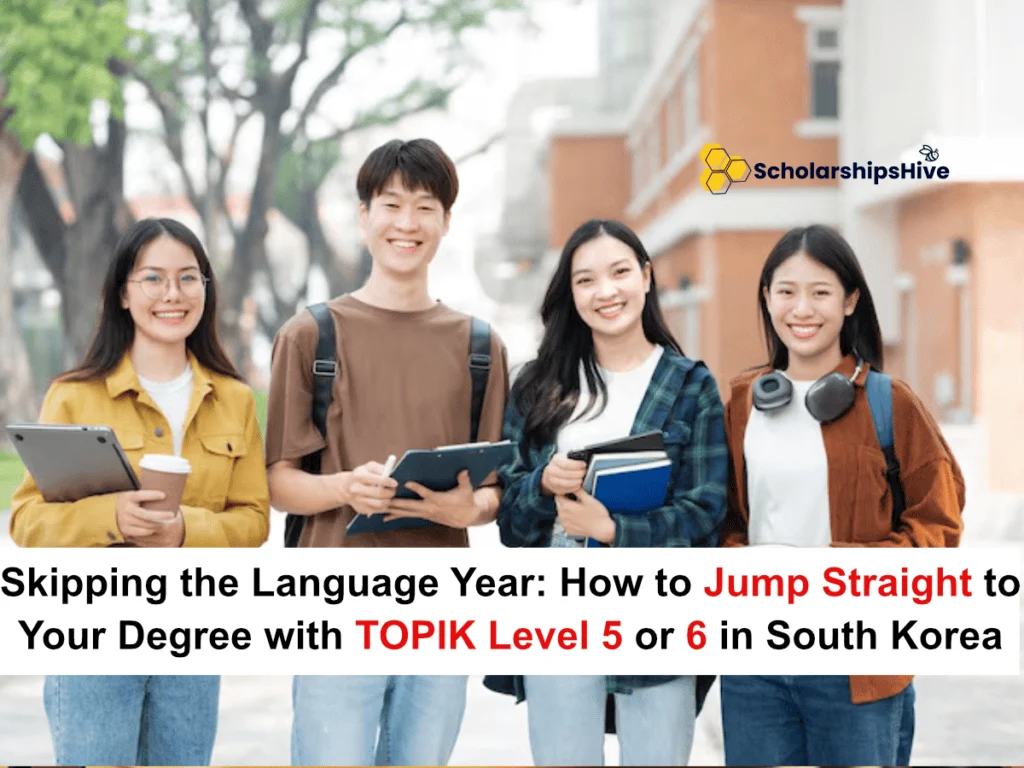
Skipping the Language Year: How to Jump Straight to Your Degree with TOPIK Level 5 or 6 in South Korea 2026
Key facts
- Country
- South Korea
- Degree level
- Masters, Undergraduate
- Funding
- Fully Funded, Partially Funded
For ambitious international students aiming to secure South Korea’s flagship Global Korea Scholarship (GKS)—administered by the National Institute for International Education (NIIED)—the standard scholarship timeline spans a preparatory year of linguistic immersion followed by an undergraduate or graduate degree track. However, applicants who enter the selection pool armed with an advanced Test of Proficiency in Korean (TOPIK) Level 5 or Level 6 certificate unlock a major institutional shortcut: complete exemption from the one-year language training program. Understanding the policy mechanics, strategic application steps, and financial perks of bypassing the language phase allows top-tier candidates to accelerate their academic careers in South Korea for the 2026 intake cycles.
The Mechanics of the Language Program Exemption Policy
Under NIIED’s official operational guidelines, the standard structural duration for a master’s degree program is three years (one year of language training plus two years of coursework), while doctoral programs span four years (one year of language training plus three years of research/coursework). For undergraduate studies, the timeline spans five to seven years depending on the major.
When a candidate successfully submits a valid, high-tier TOPIK score during the initial application rounds or achieves it within specific operational windows, the National Institute for International Education applies strict exemption clauses:
- Direct Initial Exemption: Applicants who submit a valid TOPIK Level 5 or Level 6 score report during the application cycle are officially classified as direct-entry candidates. Upon arriving in South Korea, they bypass the language institute entirely and begin their academic degree coursework in their very first semester.
- The Mid-Course Fast-Track Rule: Scholars who enter South Korea with a lower TOPIK level (or none at all) but manage to pass and officially acquire TOPIK Level 5 or Level 6 within the first six months of their language training program are similarly exempted from the remaining six months, allowing them to fast-track directly into their degree classes by the subsequent autumn semester.
Check this: Jeonbuk National University (JBNU): Hidden Research Gems, Housing Frameworks, South Korea | Fully Funded
Strategic Advantages of Skipping the Language Year
Bypassing the foundational language year offers profound academic, structural, and professional advantages for high-achieving international scholars:
- Accelerated Graduation Timelines: By eliminating the 12-month language training prerequisite, master’s and doctoral candidates compress their total scholarship duration, completing their degrees faster and entering the global workforce or advanced research pipelines ahead of schedule.
- Immediate Academic Integration: Direct-entry scholars dive straight into advanced seminars, specialized thesis research, and faculty laboratories alongside domestic Korean peers, maximizing early research output and publication metrics.
- Automatic Korean Proficiency Grants: GKS scholars who are initially exempted from the language program with a valid TOPIK Level 5 or 6 automatically qualify for a monthly Korean Proficiency Grant (KRW 100,000 per month), adding a steady financial bonus on top of their standard monthly stipends throughout their degree phases.
Important Caveats and Restrictions to Keep in Mind
While skipping the language year is highly advantageous, NIIED guidelines enforce strict administrative boundaries that applicants must carefully review:
- Validity and Score Verification: Only official, unexpired TOPIK score reports issued within NIIED’s accepted exam window (typically spanning recent official tests designated in the annual guidelines) are deemed valid for direct exemption processing. Institutional or mock test scores are strictly rejected.
- Entry Airfare Restrictions: Newly selected GKS scholars who are already residing inside South Korea at the time of the final successful announcement—or those who enter from a country other than their official country of citizenship—may face specific limitations regarding entry airfare reimbursements under standard NIIED rules.
- Program Exceptions: The direct-entry rule does not apply to specific non-degree frameworks, certain research-only tracks, or specialized institutional models where language training is structurally mandatory.
You may also like this: Chungnam National University: Government-Funded Science Parks and Study Pathways, South Korea | Fully Funded
Actionable Roadmap: How to Prepare Your TOPIK Credentials
Securing direct-entry status requires meticulous planning well in advance of the GKS application window:
- Target the Right Exam Dates: Register for official TOPIK PBT or iBT tests months ahead of the GKS application cycle to ensure your official certificate is printed and ready for submission.
- Verify Score Thresholds: Ensure your composite score meets or exceeds the strict score bounds required for Level 5 or Level 6 certification.
- Digital Document Uploading: Upload your official TOPIK verification document alongside your GKS application forms via the Study in Korea portal, ensuring that the certificate verification number remains checkable by NIIED officers.
Check this out: Dongguk University: Film, Media, and Traditional Studies, South Korea | Partial Funding Options
Official Portals and Resources
- Official Government Study Portal: Study in Korea Hub
- Official TOPIK Portal & Registration: TOPIK Examination Center
- Join our WhatsApp Channel for the latest updates on international scholarships and deadlines.
FAQs
Does having a TOPIK Level 5 or 6 guarantee selection for the GKS scholarship?
No. While possessing an advanced TOPIK score provides a major strategic advantage during document evaluation and secures a direct language exemption if selected, final scholarship selection depends on a holistic review of your CGPA, letters of recommendation, study plan, interview performance, and regional country quotas.
Can I submit my TOPIK certificate after the initial application deadline?
Generally, your valid TOPIK certificate must be submitted within the designated application document window. For specific embassy or university tracks, late-breaking test results must meet strict NIIED verification deadlines (such as December submissions for certain cycles) to be factored into direct-entry classification.
Will my monthly living allowance change if I skip the language year?
No. You will continue to receive your standard monthly living stipend (KRW 900,000 for undergraduate or graduate degree levels) plus the added monthly Korean Proficiency Grant designated for high-tier TOPIK holders.
Final Thoughts From ScholarshipsHive
Earning a TOPIK Level 5 or Level 6 before applying for the Global Korea Scholarship transforms your academic trajectory, allowing you to bypass preparatory language classes and dive straight into your chosen degree program. By mastering the language early, meeting NIIED documentation standards, and leveraging financial incentives, you can maximize your time and impact in South Korea for the 2026 intake.
Explore similar scholarships
Never miss a deadline
Get new fully funded scholarships every day. Follow Scholarships Hive on your favourite app.
Similar scholarships
 How to Email Professors for Research Supervision (Ph.D. & Master’s Cold Email Templates)
 How to Get IELTS Fee Waivers and English Proficiency Certificates for University Admissions
 KAIST Graduate International Scholarships South Korea 2027: Complete Application Guide
 Korea Advanced Institute of Science and Technology (KAIST) International Graduate Scholarship 2027
 Ulsan National Institute of Science and Technology (UNIST) International Scholarships South Korea 2027
 Daegu Gyeongbuk Institute of Science and Technology (DGIST) Graduate Scholarship South Korea 2027