📲 Join our WhatsApp for Daily Fully Funded Scholarship Alerts
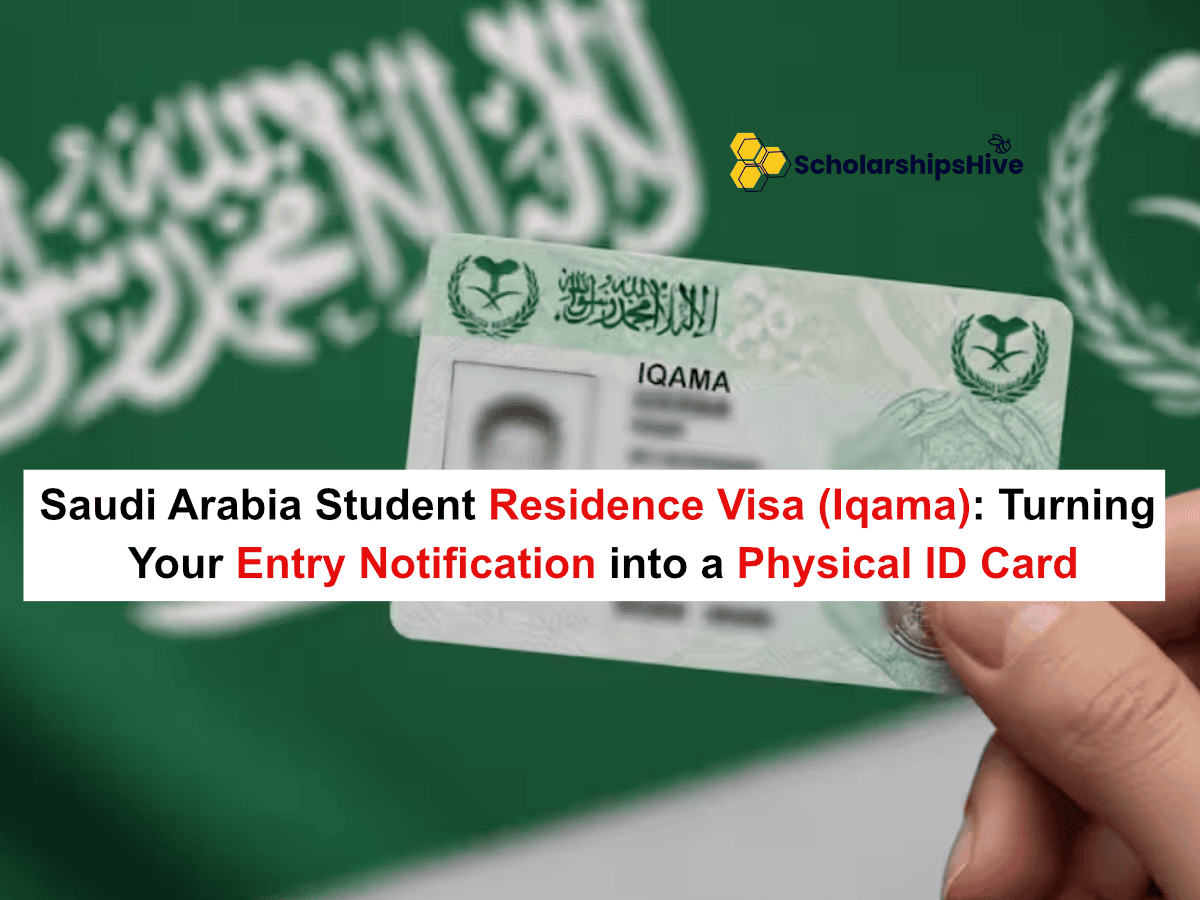
Arriving in the Kingdom of Saudi Arabia on an educational scholarship or student entry clearance is an exciting milestone. However, stepping across immigration control is only the first part of your journey. Your entry visa is merely a temporary permission slip to enter the country; your true legal foundation as an international student is the Saudi Student Residence Visa (Iqama).
Because higher education institutions in Saudi Arabia act as your official legal sponsors under the Ministry of Education and the Ministry of Interior (Jawazat), the Iqama issuance process requires close administrative coordination with your university’s international student services office.
This comprehensive guide walks you through every precise operational step, timeline, health screening requirement, and administrative mandate needed to convert your entry notification into your official physical residence ID card smoothly.
1. Understanding the Role of University Sponsorship
Unlike standard tourist or temporary entry visas, student residency in Saudi Arabia operates entirely through institutional sponsorship:
- The Sponsor-Student Relationship: Your university assumes legal and administrative responsibility for your residency status throughout your degree program.
- The Border Number (Unified Number): Upon clearing immigration at a Saudi airport, you are assigned a permanent border number stamped in your passport. This number links all your preliminary records—visa, passport data, and entry timestamp—into the National Information Center database.
- The Timeline Mandate: Under Saudi residency regulations, incoming international students must complete all medical, insurance, and biometric requirements so that their Iqama application can be formally submitted within 90 days of arrival. Failing to initiate or complete this process risks heavy administrative penalties or visa cancellation.
2. Step-by-Step Roadmap: From Airport Arrival to Physical Iqama
To ensure your transition into official residency happens without friction, follow this chronological 5-phase action plan:
Phase 1: Immediate University Check-In (Days 1 to 7)
- Report to the International Office: Within 48 to 72 hours of touching down in the Kingdom, visit your university’s international student affairs department.
- Required Handovers: Bring your original passport, entry stamp copy, admission offer letter, and scholarship documentation. The university visa coordinator will open your institutional residency file and guide you through local registration protocols.
- Secure Mobile Communications: Purchase a local SIM card (STC, Mobily, or Zain). Note that while you can activate a temporary tourist or passport-linked line initially, you must update your telecom registration with your 10-digit Iqama number as soon as it is generated to prevent service deactivation.
Phase 2: The Mandatory Post-Arrival Medical Examination
Before an Iqama card can be authorized, Saudi health regulations require every incoming resident to prove they are free from communicable diseases.
- Approved Facilities: Your university will direct you to a Ministry of Health (MoH) approved hospital or diagnostic center. Do not visit unaccredited private clinics.
- Required Diagnostics: The medical screening includes a comprehensive physical examination, a Chest X-Ray (to screen for tuberculosis), and a blood pathology panel testing for HIV, Hepatitis B (HBsAg), Hepatitis C (Anti-HCV), and Syphilis.
- Digital Transmission: Results are uploaded directly through government health portals (such as the Elm or Jawazat networks) within 24 to 48 hours. Ensure your name and passport details match your university dossier precisely to prevent data mismatches.
You may also like this: Medical Fitness Reports: The Specific Laboratory Checks Required for Saudi University Clearance, Saudi Arabia
Phase 3: Activating CCHI-Compliant Health Insurance
Health insurance is a strict legal prerequisite for residency in the Kingdom.
- Regulatory Standard: Your insurance policy must be issued by a Council of Cooperative Health Insurance (CCHI) approved provider (such as Bupa Arabia, Tawuniya, or MedGulf).
- Integration: For fully funded scholarship students, health insurance is typically managed and paid for directly by the university as part of your scholarship package. Once active, the insurance policy is electronically linked to your border number in the national database.
Phase 4: Biometric Registration (Fingerprinting & Facial Imaging)
If your home-country Saudi consulate or VFS Tasheer center did not capture your complete biometrics during visa processing, you must complete them locally.
- Where to Go: Authorized Jawazat fingerprinting centers or university-coordinated mobile biometric units.
- What to Bring: Your original passport, border number slip, and medical clearance confirmation. Fingerprint scans and facial photography are recorded to secure your legal identity.
Phase 5: Final Iqama Generation and Card Delivery
Once your medical test results are approved, health insurance is linked, and your biometrics are verified, your university’s administrative portal submits the final electronic Iqama application.
- Digital Activation: Your residency status updates to “Active” on the Absher and Muqeem platforms, assigning you a permanent 10-digit Iqama number (traditionally beginning with the number ‘2’ for resident expatriates).
- Physical Card Delivery: Under updated postal logistics, physical resident ID cards are dispatched via the Saudi Post (Wasil) service directly to your university’s designated institutional address or registered National Address.
- Card Validity: Student Iqamas are typically aligned with your academic program duration and require annual administrative enrollment verification by your university to maintain active status.
Summary Checklist for Student Residency Clearance
| Administrative Step | Responsible Party | Key Dependency / Document |
|---|---|---|
| University Check-In | Student & University | Admission letter, Original Passport |
| Medical Examination | Student | MoH-approved clinic referral |
| Health Insurance | University / Student | CCHI-certified student policy |
| Biometric Enrollment | Student | Fingerprint appointment slip |
| Iqama Generation | University Admin | All electronic clearances met |
Check this out: The Foreign Police Clearance Certificate: Formatting Your Local Non-Criminal Background Check in Saudi Arabia
Official Scholarship Links & Resources
- Unified Government Scholarship Platform: Study in Saudi Arabia Portal
- Saudi Ministry of Interior (Absher / Jawazat): [suspicious link removed]
- Council of Cooperative Health Insurance: CCHI Portal
- Join our WhatsApp Channel for the latest updates on international scholarships and deadlines.
Frequently Asked Questions
Can I travel outside Saudi Arabia before my physical Iqama card is printed?
No. While your entry visa brought you into the country, travelling internationally before your Iqama is fully issued and active will invalidate your legal status. Once your Iqama is active, any future international travel during semester breaks requires obtaining an official Exit and Re-Entry Visa through your university’s sponsorship coordination.
What should I do if my medical test results show a minor discrepancy?
If a laboratory marker requires re-testing or clarification, your university’s international office will coordinate with the medical facility. Always follow your university advisor’s instructions immediately to prevent missing the 90-day Iqama issuance window.
When can I open a local bank account in Saudi Arabia?
You can officially open a fully functional resident bank account (with institutions like Al Rajhi Bank, SNB, or Riyad Bank) only after your physical Iqama card is issued and your mobile number is updated with your new residency credentials.
Final thoughts and advice from scholarshipshive
Turning your entry notification into a physical Saudi Student Residence Visa (Iqama) is the final operational bridge between being an admitted applicant and a fully integrated resident scholar in the Kingdom. By respecting the 90-day post-arrival timeline, completing your Ministry of Health screenings, and maintaining close coordination with your university’s international office, you ensure a frictionless legal transition. Secure your residence documents, embrace campus life, and step forward with absolute confidence toward your academic success in Saudi Arabia.