📲 Join our WhatsApp for Daily Fully Funded Scholarship Alerts
Securing a supervisor’s nod is the single most powerful way to fast-track your academic journey to East Asia. When applying for postgraduate admission or a Fully Funded Chinese Government Scholarship (CGS), holding a formal acceptance letter from a host supervisor can instantly separate your application from thousands of competing global profiles.
Many high-achieving candidates make the mistake of sending generic blast messages, leading to empty inboxes and missed deadlines. Chinese faculty members review dozens of cold emails daily; winning their attention requires a highly strategic, professional approach. This comprehensive guide provides field-tested strategies and cold email frameworks designed to secure a research spot for your 2026 or 2027 academic cycle.
Why a Professor Acceptance Letter Changes Everything
While an acceptance letter is technically categorized as an optional document on the central China Scholarship Council (CSC) application portal, it operates as a golden ticket behind the scenes.
- Bypassing the Quota Bottleneck: Chinese universities receive massive stacks of blind student profiles. If an influential faculty member tells the international admissions office, “I want this student in my laboratory and have the space for them,” your dossier skips a major portion of the initial competitive screening. DAAD Scholarship
- Securing a Monthly Stipend: Top-tier researchers often command dynamic departmental research funds. Impressing a principal investigator (PI) can help you land university grants, local provincial stipends, or high-tier CGS Type B spots.
- The No IELTS Advantage: If your previous degree program was completed entirely in English, a positive interaction with a professor allows them to issue an official language proficiency waiver. This makes it possible to secure your placement with No IELTS or TOEFL friction.
Check this: How to Contact US Professors for Research Assistantships (RA) : Strategic Faculty Outreach and Funding Guide
Strategic Cold Email Blueprints for Research Spots
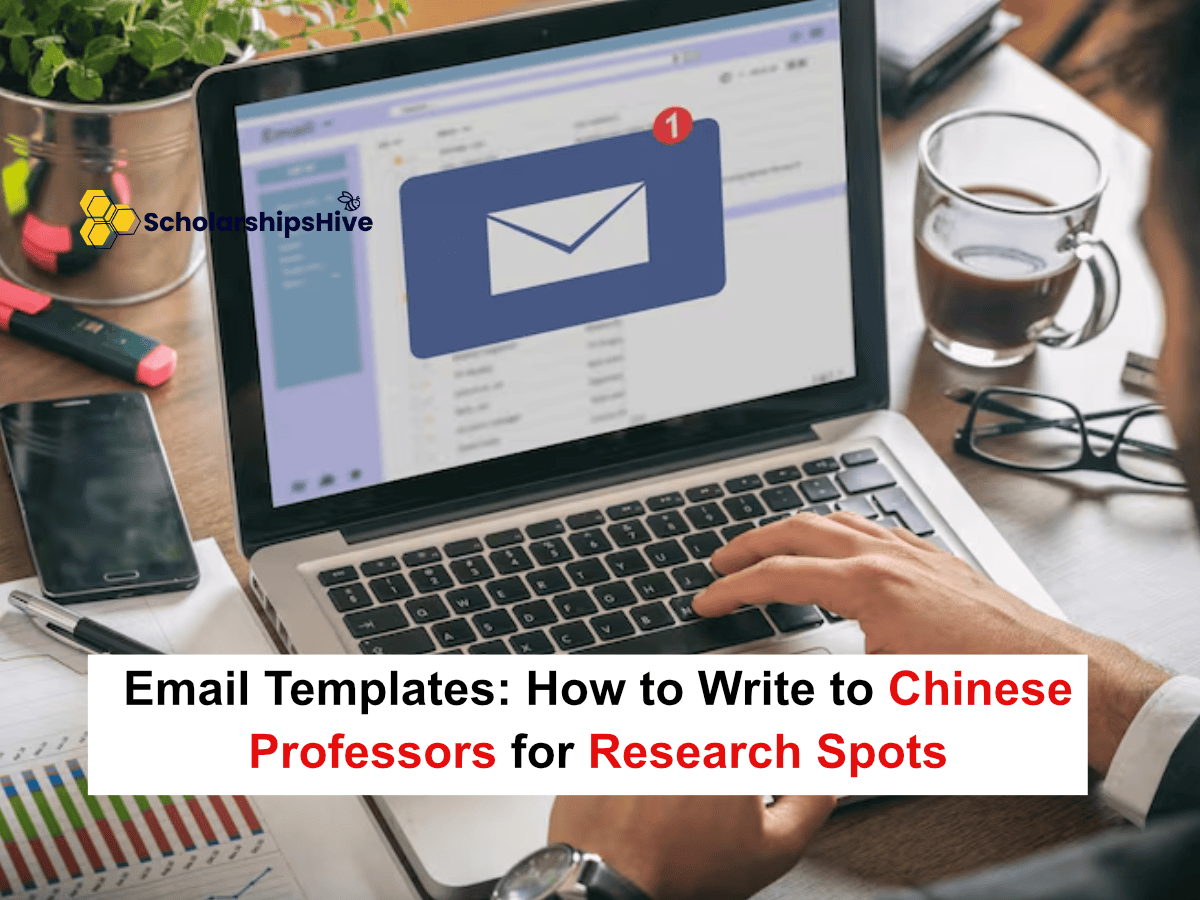
To stand out to busy faculty members, your communication must be structured, targeted, and immediately clear. Avoid loose introductory fluff and use the precise, professional formats outlined below.
Template 1: The Master’s Supervision Framework
This structure balances academic humility with proven execution. It is tailored for students moving from a Bachelor’s degree into advanced lab environments.
Subject: Inquiry for Master’s Research Supervision – [Your Full Name] – CSC Scholarship Applicant
Dear Professor [Professor’s Last Name],
I hope this email finds you well. My name is [Your Name], and I recently graduated with a Bachelor’s degree in [Your Major] from [Your University Name] in [Your Country], where I achieved a [GPA/Percentage, e.g., GPA of 3.85/4.0].
I have been actively reviewing your laboratory’s recent research on [Mention 1 Specific Topic from the Professor’s Faculty Profile] and read your published paper titled, “[Insert Paper Title Here]”. Your focus on [Specific Sub-field] aligns perfectly with my academic background, particularly my senior thesis work investigating [Briefly mention your own major undergraduate project or skill set].
My primary goal is to pursue a Master’s degree under your expert supervision at [Chinese University Name] for the 2027 intake. I intend to apply through the Fully Funded Chinese Government Scholarship program, ensuring my tuition and Stipend requirements are fully covered.
I have attached my academic CV and an initial research statement to this email for your review. If your laboratory has an open research spot, I would be honored to speak briefly via Zoom or WeChat to discuss how my background can support your ongoing projects.
Thank you for your time, consideration, and guidance.
Respectfully,
[Your Full Name]
[Your Contact WhatsApp/WeChat Number]
You may also like this: How to Get a Letter of Recommendation (LOR) for US Professors: Strategic Academic Outreach and Reference Guide
Template 2: The High-Intent PhD Research Pitch
Doctoral candidates must show concrete independent research capability. This template positions you as a high-value asset capable of contributing to their publication goals.
Subject: Request for PhD Supervision & Research Spot – [Your Full Name] – [Your Current Country]
Dear Professor [Professor’s Last Name],
My name is [Your Full Name], and I am writing to express my strong interest in joining your research group as a PhD candidate for the upcoming academic year. I completed my Master’s degree in [Your Field] at [University Name], where my research led to a co-authored publication in [Name of Journal, or mention your Master’s thesis title].
I am highly interested in your current project concerning [Insert exact research theme from the professor’s recent publications]. My expertise in [Mention 2 specific lab techniques, software tools, or methodologies, e.g., Python modeling, SEM imaging, or econometrics] allows me to contribute directly to your team’s objective of solving [Specific problem the professor works on].
I am preparing a comprehensive Application Process packet for the Fully Funded CSC/University Scholarship cycle. Securing your provisional consent and a formal acceptance letter would be an invaluable asset to my application portfolio.
I have attached the following essential files for your expert evaluation:
- Comprehensive Academic CV (including my publication record)
- A 2-page Research Proposal targeted to your lab’s direction
- Scanned Academic Transcripts
I would highly appreciate the opportunity to discuss potential research alignment in a brief digital meeting. Thank you for your valuable time and mentorship.
Sincerely,
[Your Full Name]
[Your LinkedIn/ResearchGate Profile Link]
The Correct Timeline to Contact Chinese Faculty
Reaching out at the right time is crucial for success. If you send emails too late, the professor’s departmental quota for International Students will already be full. Follow this strategic timeline to manage your outreach effectively:
1.Target Mapping and Deep Literature Review:September to November.
Identify 10 to 15 host institutions across China. Download 2 recent research papers from each target professor using Google Scholar or ResearchGate to understand their active research directions.
2.First-Contact Email Campaign Execution:November to January.
Dispatch your tailored email templates. Keep tracking sheets to log your responses. If a professor remains silent, send a single, highly polite follow-up nudge after exactly 10 working days.
3.Interviewing and Letter Procurement:January to March.
Attend brief WeChat or Zoom technical discussions if requested. Once a professor gives verbal consent, secure their formal signature on the official university Acceptance Letter head.
4.Portal Finalization and Document Submission:March to April.
Upload your signed acceptance paper directly into the central CSC portal alongside your medical forms, study plans, and university application documents to close out the process.
Check this out: Comparison: Fully Funded vs. Partially Funded US Scholarships for International Students
Four Fatal Mistakes to Avoid When Emailing Faculty
- The Massive CC Blast: Never copy multiple faculty members from the exact same department into one email thread. Professors talk to each other; discovering you blast-emailed the entire faculty group signals a lack of genuine interest and can result in your profile being set aside.
- Massive File Sizes: Avoid attaching uncompressed 50MB PDF files containing entire project records. High-resolution scans can bounce off university firewalls. Keep your combined CV and transcript attachments under 5MB by using optimized, clean PDF formats.
- Leading with Financial Demands: Do not start your email by asking about money. Frame your inquiry entirely around your academic fit, research skills, and lab contributions. Let the professor know you are proactively targeting external funding like the CSC platform.
- Using Casual Contact Channels: Always send your messages from a professional, cleanly named email account (e.g., [email protected]) rather than using old social handles or casual nicknames.
Official Scholarship Links & Community Resources
To track faculty directories, review institutional research priorities, or connect with fellow global applicants, check out these vetted digital resources:
- Official Chinese Government Scholarship System: www.campuschina.org — Research approved university lists, department categories, and supervisor tracking tools.
- China Scholarship Council Directory: www.csc.edu.cn — Review official policy frameworks, document guidelines, and funding updates.
- Join our WhatsApp Channel for the latest updates on international scholarships and deadlines.
Frequently Asked Questions (FAQs)
What should I do if a Chinese professor asks to move our conversation to WeChat?
You should treat this as an incredibly positive indicator. WeChat is the primary communication tool used for daily professional and academic operations within China. Download the application, set up a professional profile picture using your formal name, and respond to their messages promptly and politely, treating the platform with the same level of respect as an official email thread.
Can I apply for the CSC Scholarship if I do not receive an acceptance letter?
Yes, absolutely. Thousands of international students secure fully funded Chinese Government Scholarships every year through Type A (Embassy Track) or Type B (University Track) nominations without holding an advance acceptance letter. While having one significantly boosts your chances, a strong research proposal, a high GPA, and solid recommendation letters can still make your application highly competitive.
Should I translate my academic CV and research statement into Chinese?
No, this is generally unnecessary unless you are applying specifically for a program taught entirely in the Chinese language. For all English-medium research programs, science tracks, and engineering laboratories, Chinese professors prefer receiving your academic files in clean, professionally edited English, as this mirrors the language used for international journal publications.
Final Thoughts & Advice by Scholarships Hive
Standing out in a professor’s inbox comes down to showing that you have done your homework. Instead of just asking for a scholarship, focus on what you can bring to their lab—whether that is your experience with a specific software tool, your background in a particular research method, or your familiarity with their recent papers. Taking an extra 15 minutes to tailor each email template to a professor’s actual work is the secret to getting a positive reply and securing your fully funded research spot.