
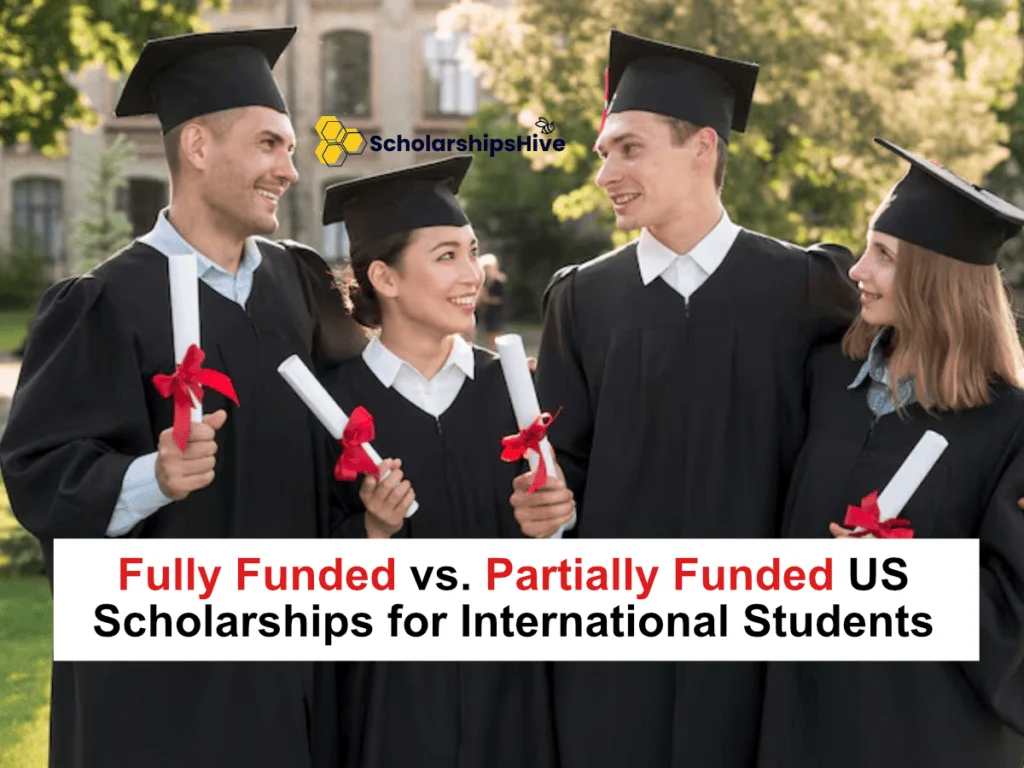
Comparison: Fully Funded vs. Partially Funded US Scholarships for International Students 2026
Key facts
- Country
- USA
- Funding
- Fully Funded, Partially Funded
Navigating the financial aid landscape in the United States requires a clear, strategic understanding of how different scholarship models operate. For international students planning their academic pathways for the 2026 and 2027 admission cycles, higher education funding is rarely a one-size-fits-all framework. Instead, institutional awards and private endowments are broadly split into two distinct categories: fully funded packages and partially funded grants.
Choosing the right path is not just about looking at the initial dollar value; it directly impacts your overall application strategy, your visa documentation, and your day-to-day living situation in the US. By analyzing this comprehensive Comparison: Fully Funded vs. Partially Funded US Scholarships, you can make informed decisions that align your academic goals with a budget that keeps your journey secure and stress-free.
The Financial Architecture of American Scholarship Packages
To build a successful funding plan, you need to understand how American universities categorize financial support. The core difference between these two funding tracks lies in who handles the total cost of attendance (COA), which includes tuition, campus fees, housing, dining, and mandatory health insurance.
A fully funded scholarship acts as a complete financial shield, meaning the providing organization or university endowment takes on the absolute financial responsibility for your degree. A partially funded scholarship, on the other hand, acts as a helpful discount or financial cushion. It significantly lowers your overall costs, but leaves the student responsible for covering the remaining balance through personal savings, family sponsorships, or on-campus employment.
Check this: Boston University Trustee Scholarship: Undergraduate International Students, USA | Fully Funded
Side-by-Side Comparison Matrix
This breakdown highlights the practical operational differences between both funding options:
| Comparative Dimension | Fully Funded Scholarships | Partially Funded Scholarships |
|---|---|---|
| Tuition Coverage | 100% complete waiver of all baseline tuition and mandatory course fees. | Fixed dollar amount discount (e.g., $5,000–$15,000) or an out-of-state fee waiver. |
| Living Allocations | Provides a regular monthly stipend to comfortably cover housing and dining. | Zero living support; applicants must cover room and board independently. |
| Visa I-20 Preparation | The award letter satisfies the full financial proof required for the F-1 visa. | Applicants must show official bank statements covering the remaining cost balance. |
| Competition Matrix | Exceptionally high; requires top-tier profiles, rigorous testing, or specialized research skills. | Moderate to accessible; often awarded automatically based on baseline GPA tiers. |
| Language Testing | Strict requirements; specific programs may offer a No IELTS path if background rules fit. | Highly flexible; often pairs easily with university English preparatory pathways. |
Analyzing the Fully Funded Track
The Core Advantages
The primary benefit of securing a fully funded award is absolute financial freedom. Programs like the Fulbright Fellowship, major university presidential awards, or Graduate Research Assistantships (RAs) allow you to focus entirely on your studies without the stress of managing a monthly budget gap. Furthermore, entering your student visa interview with an official full-ride letter eliminates the need to present extensive family bank statements to the consular officer.
The Application Reality
Because these packages carry massive financial value, they attract an incredibly competitive global applicant pool. Selection committees utilize multi-layered evaluation processes, requiring comprehensive portfolios that showcase exceptional leadership, community impact, strong personal statements, and flawless recommendation letters.
Analyzing the Partially Funded Track
The Core Advantages
Partially funded merit awards and out-of-state tuition discounts are much more widely available than full rides. Many public universities across states like Texas, Ohio, and Illinois automatically evaluate international students for these discounts right at the admissions gate, without requiring a separate scholarship application. If you maintain a steady, solid academic track, these awards provide an excellent way to slash your educational costs by thousands of dollars annually.
The Application Reality
While these discounts make a US degree much more affordable, you must have a clear plan to cover the remaining costs. You will need to show verified personal or family funds on your Form I-20 to secure your student visa. Many resourceful students successfully manage this gap by combining a partial tuition waiver with permitted on-campus employment, working up to 20 hours per week to comfortably cover their daily living expenses.
You may also like this: University of Rochester Dean’s Scholarship: Undergraduate International Students, USA | Partially Funded
The Strategic Selection and Application Routine
Maximizing your funding opportunities requires an organized approach to identifying programs, auditing your personal finances, and managing your submission timelines.
1.Determine Your True Maximum Annual Educational Budget:
Sit down with your family to calculate exactly how much personal capital you can comfortably commit to your education each year, establishing a clear baseline for your search.
2.Build a Balanced University Application List:
Divide your target list strategically: apply to two or three highly competitive, fully funded institutions, and pair them with three or four reliable universities offering strong partial merit discounts.
3.Tailor Your Portfolios to Match Specific Provider Goals:
For full-ride applications, focus your essays heavily on global impact, community service, and advanced research potential. For partial merit awards, highlight your steady academic growth and practical technical skills.
4.Organize All Certified Financial Proofs and Bank Statements:
Gather your certified family bank statements, property valuations, or sponsor affidavits early. This ensures you can move quickly to secure your I-20 documentation the moment an admission offer arrives.
Check this out: Wesleyan Freeman Asian Scholarship Program: Undergraduate International Students, USA | Fully Funded
Official Program Resources and Verification Links
Official EducationUSA Funding Resource Guide: https://educationusa.state.gov/ — The primary government informational network providing global toolkits for analyzing educational costs and discovering institutional aid paths.
Official College Board BigFuture Scholarship Portal: https://bigfuture.collegeboard.org/pay-for-college — The centralized database utilized by international applicants to search, sort, and compare private foundation awards and university merit packages.
Join our WhatsApp Channel for the latest updates on international scholarships and deadlines.
Frequently Asked Questions
Can I upgrade a partially funded scholarship into a fully funded one after arriving in the US?
Yes, this is a highly successful strategy used by many resourcefulness international students. If you enter a university with a partial tuition discount, you can use your first two semesters to build strong relationships with faculty members, maintain a top-tier GPA, and apply for internal department fellowships or Graduate Assistantships. Transitioning into a Teaching Assistant (TA) or Research Assistant (RA) position later in your program can upgrade your partial award into a full ride.
Does receiving a partial scholarship make it harder to pass the F-1 visa interview?
Not necessarily. Consular officers evaluate your financial reliability based on your ability to cover the entire balance listed on your Form I-20. If you hold a partial scholarship that covers $15,000 of your costs, you simply need to present solid, credible bank statements showing that your family or sponsor can comfortably pay the remaining balance without facing financial hardship.
Are health insurance fees covered under partial scholarship frameworks?
In the vast majority of cases, no. Partially funded awards are typically applied directly against your baseline classroom tuition costs. Mandatory campus health insurance fees, which usually range from $1,500 to $3,000 per year, remain the personal responsibility of the student and must be factored into your annual living budget.
Final Thoughts & Advice by Scholarships Hive
Approaching the US higher education landscape with a clear, realistic plan for both fully funded and partially funded scholarship tracks is an exceptionally smart strategy that maximizes your chances of success. By aiming for highly competitive full rides while keeping reliable, high-yield partial merit discounts on your radar, you can build a versatile and budget-friendly educational path. Keep your application checklists organized, submit your documents early, and step into the selection cycle with professional confidence. final thoughts and advice from scholarshipshive
Explore similar scholarships
Never miss a deadline
Get new fully funded scholarships every day. Follow Scholarships Hive on your favourite app.
Similar scholarships
 Emily Lester Vermont Opportunity Scholarship Application Guide 2026–2027: Requirements & Deadline
 Richard T. Gates Engineering and Technology Endowed Challenge Scholarship Application Guide 2026–2027: Requirements & Deadline
 Alice C. Coapland Scholarship Application Guide 2026–2027: Requirements & Deadline
 Vermont Police Association Scholarships Application Guide 2026–2027: Requirements & Deadline
 Vermont State Grange Educational Aid Fund Application Guide 2026–2027: Requirements & Deadline
 Vermont John H. Chafee Education and Training Scholarship Application Guide 2026–2027: Requirements & Deadline