
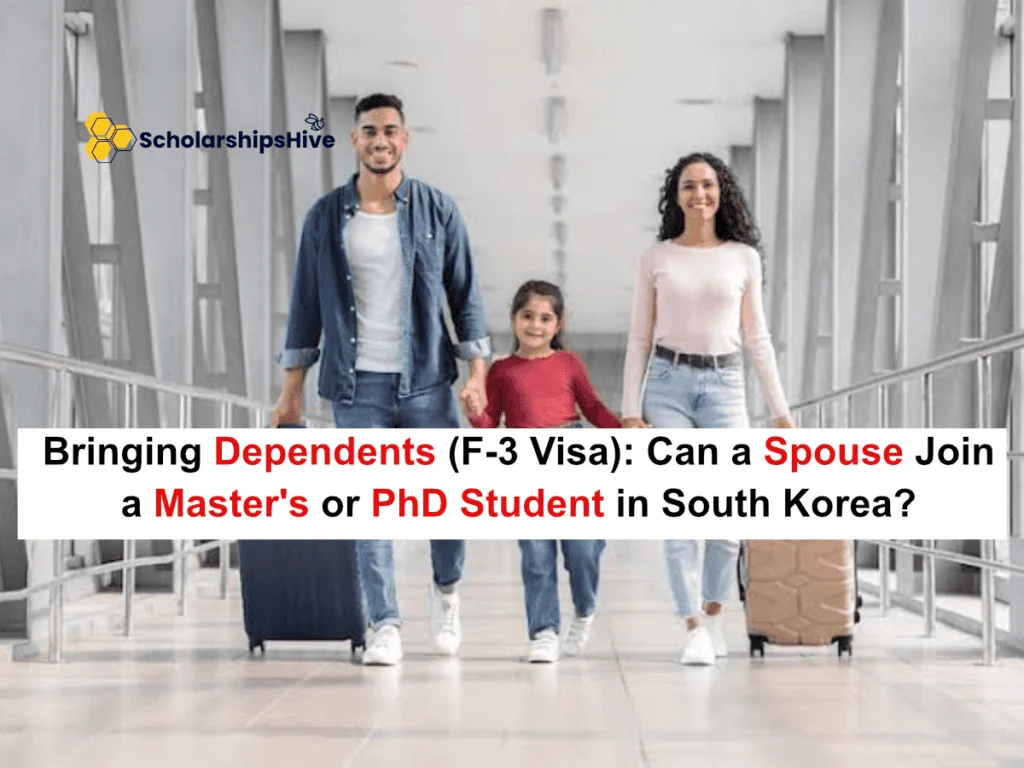
Bringing Dependents (F-3 Visa): Can a Spouse Join a Master’s or PhD Student in South Korea? 2026
Key facts
- Country
- South Korea
Embarking on a Master’s or PhD program in South Korea is a transformative academic milestone. For married scholars, however, the excitement of acceptance often comes with an urgent logistical question: Can my spouse join me, and how does the dependent visa process work?
Fortunately, South Korea’s immigration framework allows long-term student visa holders to bring their spouses and minor children. Under the F-3 Dependent Family Visa regulations, graduate students enrolled in regular degree programs can legally host their families. Navigating this process successfully during 2026 requires a precise understanding of eligibility timelines, financial proof requirements, and application workflows.
1. Eligibility Criteria: Can D-2 Master’s and PhD Students Bring Spouses?
Yes, spouses and unmarried minor children of D-2 student visa holders are legally eligible for the F-3-1 Dependent Visa. However, South Korean immigration enforces specific prerequisite waiting periods to ensure that the primary student has successfully settled into their academic routine before managing dependents.
- The 6-Month Rule for Degree Students: If you are enrolled in a regular bachelor’s, master’s, or doctoral degree program (D-2-2, D-2-3, or D-2-4), you must complete at least six months of enrollment at a South Korean university before you can formally invite your spouse or children.
- Excluded Visa Subtypes: Spouses of students holding short-term or specialized exchange statuses—such as associate college students (D-2-1), exchange students (D-2-6), visiting students (D-2-8), or general language trainees (D-4-1)—face much stricter restrictions, often requiring a minimum residency of two years before family invitation is permitted.
- Sequential Arrival Strategy: Many couples choose a staggered arrival model where the student arrives first, completes their initial semester, establishes housing, secures their Alien Registration Card (ARC), and then initiates the F-3 visa application for their spouse from their home country or locally through immigration.
Check this: No Application Fee Portals: Sending Digital Submissions Through Study in Korea with $0 Costs in South Korea
2. Financial Proof and Maintenance Requirements
South Korea’s Ministry of Justice requires student sponsors to prove they possess adequate financial resources to support cohabiting family members without relying on public public assistance or unauthorized employment.
- Demonstrating Financial Capability: As an international student inviting a spouse, you must provide official bank statements and certificate of balance documents showing stable funds under your name. The required savings threshold depends on your length of stay and local living costs, but generally requires proving sufficient capital to cover housing and living expenses for your household size.
- Scholarship Synergy: If you are a scholarship recipient—such as a Global Korea Scholarship (GKS) awardee receiving a dependable monthly stipend of 1,000,000 KRW or more—your official NIIED financial certificate serves as powerful proof of stable income to immigration authorities.
- Housing Verification: You must present a formal, notarized residential lease agreement (Jeonse or monthly rent contract) under your name. The apartment size and lease duration must adequately accommodate multiple occupants and remain valid for at least three months past your application date.
3. Step-by-Step Application Workflow
Securing an F-3 dependent visa involves coordination between the student in Korea, the university administration, and the home country’s Korean embassy or consulate:
- Meet the Time Threshold: Ensure you have completed at least one full semester (6 months) of your Master’s or PhD program and hold an active Alien Registration Card (ARC).
- Gather Required Documentation:
- From the Student (Inviter): Original Certificate of Enrollment, official university transcript, copy of your ARC (front and back), lease agreement, and bank balance certificate.
- From the Spouse (Applicant): Completed visa application form, original passport, official marriage certificate (apostilled or legalized), and a clean criminal record certificate if required by your local consulate. Medical checks, including a tuberculosis screening test from a designated hospital, are also mandatory.
- Submission: The spouse applies for the F-3 visa at the South Korean Embassy or Consulate in their home country. In certain cases where the spouse is already legally residing in South Korea on another long-term visa, a change of status can be processed directly through a local immigration office.
- Issuance and Travel: Once approved, the single or multi-entry F-3 visa is stamped into the spouse’s passport, allowing them to enter South Korea and join you. Upon arrival, the spouse must complete foreigner registration and fingerprinting to receive their own ARC.
You may also like this: The Certificate of Expected Graduation: Formatting Rules for International Universities in South Korea
4. Important Limitations and Regulations for F-3 Visa Holders
While the F-3 visa successfully unites families, spouses should be aware of key operational constraints enforced by South Korean immigration:
- Work Restrictions: By default, an F-3 dependent visa does not grant permission to work in South Korea. If your spouse wishes to take up part-time or full-time employment, they must independently qualify for and transition to a separate working visa (such as an E-2 teaching visa, E-7 professional visa, or part-time student-linked status if they enroll in studies themselves). Unauthorized employment on an F-3 visa is illegal and risks deportation.
- Visa Dependency: An F-3 visa is entirely tied to the primary student’s legal status (D-2). If you graduate, drop out, or your student visa status lapses, your spouse’s F-3 visa validity expires concurrently. You must coordinate visa extensions together prior to each semester review.
- National Health Insurance (NHIS): Spouses residing in South Korea on an F-3 visa are automatically enrolled as mandatory dependents under the primary student’s National Health Insurance policy after a brief residency period, ensuring full access to South Korea’s world-class healthcare system at affordable monthly rates.
Check this out: GKS Documents Checklist: The Exact Order to Stack Your Application Pages in South Korea
Summary of F-3 Dependent Visa Requirements
| Requirement Category | Standard Graduate Student Condition (Master’s / PhD) |
| Minimum Enrollment Period | At least 6 months completed in a degree program (D-2-3 / D-2-4) |
| Required Proof of Relationship | Official, legalized Marriage Certificate |
| Housing & Financial Proof | Valid lease agreement and bank balance / scholarship proof |
| Work Rights | Unpaid activities permitted; formal employment requires a visa change |
Official Portals and Resources
- Official Government Visa Portal: Korea Visa Portal
- Official Government Study Portal: Study in Korea Hub
- Join our WhatsApp Channel for the latest updates on international scholarships and deadlines.
FAQs
Can my spouse work in South Korea on an F-3 dependent visa?
No. Standard F-3 visa holders are legally restricted from engaging in local economic employment. If your spouse secures a job offer, they must change their visa status to an appropriate work visa (such as E-7 or E-2) before starting work.
Can we apply for the F-3 visa simultaneously before moving to Korea?
Generally, no. Immigration rules dictate that the primary student holding a D-2 visa must be enrolled for at least six months and hold a registered ARC before family invitation documents can be successfully processed. Most families utilize the staggered arrival approach.
Does the F-3 visa cover children as well as spouses?
Yes. Unmarried minor children of the D-2 visa holder are also eligible for the F-3-1 dependent visa, allowing immediate family units to live together during your graduate studies.
Final Thoughts From ScholarshipsHive
Bringing your spouse to South Korea on an F-3 dependent visa requires careful timing, strict adherence to the 6-month enrollment rule, and thorough financial documentation. By preparing your marriage certificates, lease agreements, and scholarship proofs ahead of time during 2026, you can successfully share your Master’s or PhD journey in South Korea with your loved ones.
Explore similar scholarships
Never miss a deadline
Get new fully funded scholarships every day. Follow Scholarships Hive on your favourite app.
Similar scholarships
 How to Email Professors for Research Supervision (Ph.D. & Master’s Cold Email Templates)
 How to Get IELTS Fee Waivers and English Proficiency Certificates for University Admissions
 KAIST Graduate International Scholarships South Korea 2027: Complete Application Guide
 Korea Advanced Institute of Science and Technology (KAIST) International Graduate Scholarship 2027
 Ulsan National Institute of Science and Technology (UNIST) International Scholarships South Korea 2027
 Daegu Gyeongbuk Institute of Science and Technology (DGIST) Graduate Scholarship South Korea 2027