📲 Join our WhatsApp for Daily Fully Funded Scholarship Alerts
Securing a fully funded postgraduate position through prestigious initiatives like the Malaysia International Scholarship (MIS)—administered by the Ministry of Higher Education (MOHE) Malaysia—requires far more than just stellar academic transcripts and compliance with age caps. For candidates pursuing a Master’s by Research or a doctoral pathway, the core instrument that determines scholarship allocation is the written research proposal.
The Ministry explicitly evaluates applicants based on the quality of their research proposal and its direct, tangible contribution toward the advancement of technology and human well-being. Crafting a document that satisfies rigorous institutional rubrics requires an understanding of how Malaysian university panels and government reviewers evaluate submissions for 2026 and 2027 intake cycles.
1. Core Evaluation Pillars Set by the Ministry of Higher Education
When your document is submitted via the official portal, it is subjected to academic screening by subject-matter experts and committee members across Malaysia’s premier research universities (such as Universiti Malaya, Universiti Putra Malaysia, or Universiti Sains Malaysia). Reviewers assess submissions against three non-negotiable pillars:
- Scientific Rigor and Originality: Does the proposal address a genuine theoretical gap or practical bottleneck? Reviewers look for clear problem statements rather than generalized topics.
- National and Global Relevance: Under official MIS guidelines, research proposals must align with priority study areas—such as STEM, biotechnology, food security, digital infrastructure, or sustainable economics—and demonstrate clear utility for Malaysia or the broader global community.
- Methodological Feasibility: Can the proposed study realistically be executed within a standard two-year Master’s by Research timeline using local laboratory facilities, field data, or computational resources available in Malaysia?
Check this: Dokuz Eylül University: Business, Maritime and Tech Scholarship Tracks, Turkey | Partially Funded
2. Structural Anatomy of a Winning MIS Research Proposal
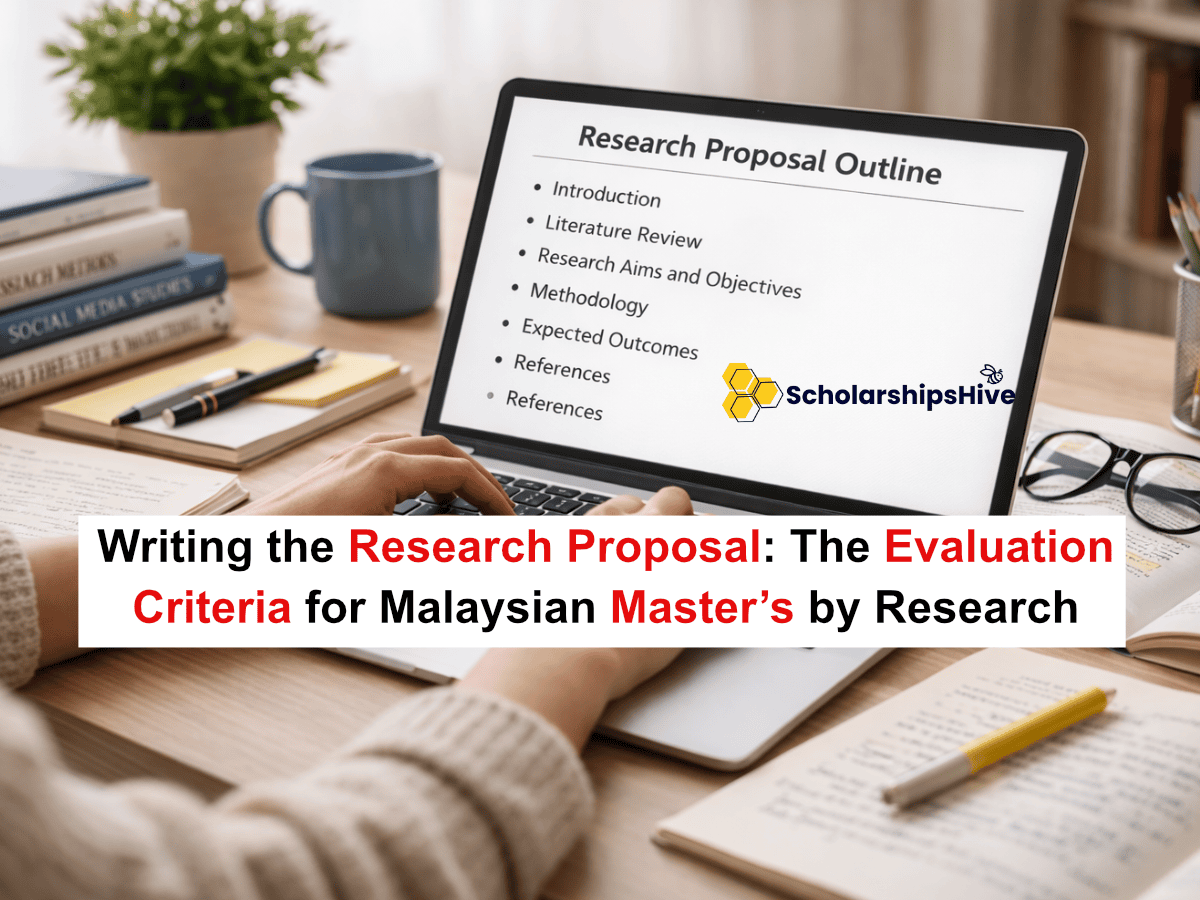
To score high marks under university evaluation sheets, your proposal—spanning a minimum of 1,000 words—must follow a clean, professional academic structure:
- Title (Clear and Descriptive): Avoid vague or overly poetic titles. Your title must explicitly state the core variables, the target context, and the methodology (e.g., “Optimizing Smart Irrigation IoT Frameworks for Sustainable Agriculture Resilience in Tropical Malaysian Highlands”).
- Introduction and Background Context: Establish the macro-level importance of the issue, narrowing down quickly to the specific micro-problem your research solves.
- Problem Statement: Clearly articulate what is currently broken, unknown, or inefficient in existing literature or industrial practice, and explain why resolving this gap matters.
- Research Questions and Objectives: Outline 2 to 3 primary research questions paired with measurable objectives that your thesis intends to achieve.
- Significance and Expected Contributions: Explicitly link your expected outcomes to national development goals, technological advancement, or human well-being, directly satisfying key MIS evaluation metrics.
- Methodology Framework: Detail your data collection techniques, analytical models, software tools, or experimental setups. Reviewers heavily penalize vague methodology sections.
You may also like this: Boğaziçi University Scholarship: English Proficiency Rules and Academic Admission Criteria, Turkey | Partially Funded
3. Aligning Your Proposal with Malaysia’s Priority Fields
A common pitfall among international applicants is submitting brilliant research proposals that fall outside Malaysia’s national strategic funding interests. To maximize your evaluation score, ensure your topic anchors tightly to approved national sectors:
- Science, Engineering, and Technology: Advanced materials, renewable energy systems, robotics, and artificial intelligence integration.
- Agriculture, Fisheries, and Food Security: Climate-resilient crop production, aquaculture optimization, and supply chain biotechnology.
- Information and Communication Technology (ICT): Cybersecurity frameworks, cloud infrastructure, and data analytics for public governance.
- Environmental Studies and Infrastructure: Sustainable urban development, waste management technologies, and water resource engineering.
4. Common Pitfalls That Lead to Low Proposal Scores
Understanding what failure looks like helps safeguard your application from immediate desk rejection during the review phase:
- Plagiarism and Unoriginality: Submitting generic templates or recycled internet text triggers instant disqualification through automated plagiarism screening tools used by Malaysian graduate schools.
- Overly Ambitious Scope: Proposing a multi-country, five-year industrial mega-project for a two-year Master’s by Research program signals a lack of feasibility to evaluators.
- Poor Formatting and Grammar: Grammatical errors, erratic referencing styles, and messy visual layouts undermine your perceived credibility and violate the Ministry’s emphasis on strong English communication skills.
Check this out: Middle East Technical University (METU) Scholarship: Campus Guide and Scholarship Rules, Turkey | Partially Funded
Official Portals and Resources
- Official Scholarship Application Link: MOHE Malaysia International Scholarship System
- Join our WhatsApp Channel for the latest updates on international scholarships and deadlines.
FAQs
Is a research proposal mandatory for all Malaysia International Scholarship applicants?
No. A written research proposal of at least 1,000 words is strictly compulsory for Master’s by Research and PhD candidates. Master’s by Coursework applicants generally follow different academic evaluation criteria and do not require a full research proposal.
Can I change my research topic after winning the scholarship?
Generally, no. Scholarship holders must follow their approved programs and research scopes. Changing your core research topic or study program after award activation requires formal written approval from both your host university and the Ministry of Higher Education.
How technical should the methodology section be in a Master’s proposal?
It should be detailed enough to prove you possess a clear roadmap for your studies. Reviewers want to see that you understand data collection protocols, software packages, or laboratory procedures required for your specific thesis track.
Final thoughts and advice from ScholarshipsHive
Mastering the research proposal is the single most effective way to elevate your application above tens of thousands of competitors vying for the Malaysia International Scholarship. By anchoring your study in rigorous academic principles, aligning your objectives with Malaysia’s national priority fields, and demonstrating absolute methodological feasibility, you signal to review boards that you are ready to excel as an elite researcher. Approaching your writing process with precision, originality, and strict adherence to portal guidelines guarantees a formidable submission for 2026 and 2027 selection cycles.