
Schwarzman Scholars Interview Questions: Real Interview Experiences
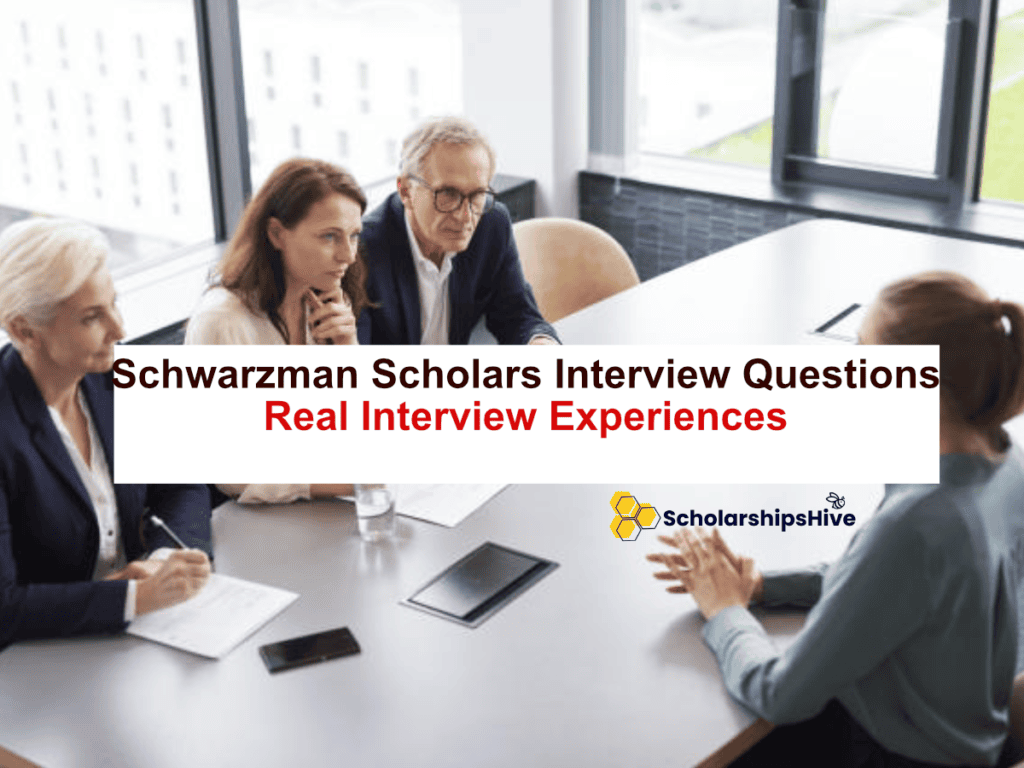
The Schwarzman Scholars interview is famously dynamic, fast-paced, and intense. Unlike standard graduate school interviews, candidates face a rapid-fire panel of 5 to 7 global leaders—diplomats, CEOs, university presidents, and journalists—who have thoroughly digested your application dossier.
The 25-minute interview moves quickly and evaluates three core traits: intellectual agility, authentic leadership under pressure, and a grounded perspective on China’s role in global affairs.
MUST READ:
- Chulabhorn Graduate Institute Scholarship Thailand Early Track Masterclass
- Humboldt Research Fellowship for Postdoctoral Researchers Germany: The Complete Strategy Guide
- Swiss Excellence Scholarships for Foreign Scholars: Complete Document Assembly Guide
1. The 25-Minute Interview Architecture
Panelists split the short timeframe to test different aspects of your profile:
┌─────────────────────────────────────────────────────────────┐
│             SCHWARZMAN INTERVIEW TIME SPLIT                 │
├──────────────────────────────┬──────────────────────────────┤
│ 1. Opening Pitch             │ ~1–2 Minutes                 │
│    (Your Elevator Narrative) │ (High Impact, Self-Set Tone) │
├──────────────────────────────┼──────────────────────────────┤
│ 2. Deep Dive: Leadership & CV │ ~10–12 Minutes               │
│    (Probing Past Actions)    │ (Stress-testing decisions)   │
├──────────────────────────────┼──────────────────────────────┤
│ 3. Policy, China & Geopolitics│ ~10–12 Minutes               │
│    (Current Affairs Debates) │ (Spontaneous Analysis)       │
└──────────────────────────────┴──────────────────────────────┘
2. Real Interview Questions (Categorized)
Category A: The “Self-Setting” Openers
Panels almost always begin by asking for a brief, 60-to-90-second self-introduction.
- “Give us a 1-minute pitch on who you are and why China is mandatory for your next step.”
- “What is one thing about your background that we cannot find anywhere in your application, essays, or video?”
- “If you could solve one specific problem in your home country over the next decade, what is it and why are you the person to do it?”
Category B: Stress-Testing Your Leadership Claims
Panels will challenge your Leadership Essay and resume metrics. They look for self-awareness, conflict resolution, and resilience rather than titled positions.
- “You wrote about leading [Project X]. Who was your biggest critic during that process, and how did you handle them?”
- “Describe a situation where your team failed because of your decision. What did you learn about your leadership blind spots?”
- “How do you persuade people when you hold zero positional authority over them?”
- “You mention wanting to reform [Industry/Sector]. What if key stakeholders actively resist your vision? Walk us through your backup strategy.”
Category C: Geopolitics, China & Current Affairs
Every candidate receives at least one probing question regarding international policy or contemporary global issues.
- “How does your home country’s current economic policy toward China impact your specific industry?”
- “If you were sitting across from a Chinese policymaker today, what is the single biggest misconception about your country you would push to clear up?”
- “What do you see as the primary structural challenge facing democratic/global institutions today, and how would you address it?”
- “China is leading in [AI/Green Tech/Supply Chain]. How should the rest of the world respond—cooperation, competition, or decoupling?”
Category D: Testing Curveballs & Intellectual Agility
Panels often drop unexpected scenario questions to see how you think on your feet when your rehearsed answers are stripped away.
- “What is a belief you held deeply two years ago that you have completely changed your mind about recently? What changed it?”
- “If you are selected, you will live in Beijing alongside 140 fiercely opinionated global peers. How will you navigate a heated debate over a sensitive geopolitical topic in the dining hall?”
- “Explain a complex technical concept from your field to someone on this panel who has zero background in it.”
3. The On-Site/Virtual Group Assessment
In addition to the individual panel interview, the selection process usually features a Group Problem-Solving Activity.
1.Absorb the Unfamiliar Challenge:Phase 1: The Scenario Briefing.
Candidates are split into small groups and handed a complex, multi-layered problem (e.g., allocating a crisis budget or drafting a rapid policy response to a simulated global event) with limited time.
2.Demonstrate Collaborative Leadership:Phase 2: Active Discussion.
Observers evaluate how you contribute. Candidates who attempt to dominate the airtime or shout down peers are penalized. The panel looks for candidates who synthesize opposing viewpoints, keep time, and elevate others.
3.Deliver a Unified Recommendation:Phase 3: The Pitch.
The group presents a cohesive solution to the evaluators, followed by quick questions testing how well the team negotiated trade-offs under pressure.
4. Key Preparation Guidelines
- Know Your Dossier Inside Out: Every claim, statistic, or policy recommendation in your Leadership Essay and Statement of Purpose is fair game. If you cited a policy paper, re-read it.
- Ditch the Rehearsed Script: Panels evaluate dozens of candidates; overly memorized or mechanical speeches instantly stand out in a negative way. Speak naturally and focus on an authentic dialogue.
- Read Global Headlines Daily: Follow major global outlets (e.g., Financial Times, Foreign Affairs, The Economist, South China Morning Post) leading up to your interview day. Be ready to analyze current economic and geopolitical events.
- Have a Clear “Why China” Answer: You do not need to be a Sinologist or speak fluent Mandarin, but you must articulate why spending a year at Tsinghua University in Beijing is a critical catalyst for your long-term leadership goals.
YOU MAY ALSO LIKE:
- Gates Cambridge Scholarship: How to Write the Perfect Personal Statement
- Banting Postdoctoral Fellowships: Securing a Canadian Host Institution
- KAUST VSRP Paid Research Internship Saudi Arabia
FAQ’s
How long does the individual Schwarzman Scholars interview last?
The formal individual panel interview lasts 25 minutes. Because the time is short and there are multiple panelists, answers should be concise (around 60 to 90 seconds) to allow for a fluid, back-and-forth conversation.
Do I need to be an expert on Chinese politics to pass the interview?
No. Schwarzman Scholars recruits candidates from diverse backgrounds—including STEM, business, arts, and public policy. However, you must demonstrate genuine curiosity about China’s global role and understand how China intersects with your specific field.
How many panelists are in the interview room?
The panel typically consists of 5 to 7 distinguished leaders representing business, academia, government, and civil society. One member serves as the Chair to introduce you and manage the timing.
Final Tip From ScholarshipsHive
When answering leadership questions, avoid focusing solely on success stories. The panel is far more interested in your emotional intelligence, self-awareness, and resilience when things go wrong. Being open about a real challenge or failure—and clearly explaining what it taught you about working with people—will make your interview far more memorable.
Join our WhatsApp Channel for the latest updates on international scholarships and deadlines: WhatsApp Channel
Similar scholarships
 Chinese Government Scholarship (CSC) 2027: Full Guide, Pakistan-Specific Steps & Common Rejection Mistakes
 How to Get IELTS Fee Waivers and English Proficiency Certificates for University Admissions
 Sun Yat-sen University CSC Scholarship Program: Admissions Guide for International Students 2027 China
 Xiamen University Marine and Environmental Sciences CSC Scholarship Framework 2027 China
 Xi’an Jiaotong University (XJTU) CSC Scholarship: Step-by-Step Online Portal Application 2027 China
 Nanjing University Chinese Government Scholarship (CSC) Type B Portal Walkthrough 2027 China