📲 Join our WhatsApp for Daily Fully Funded Scholarship Alerts
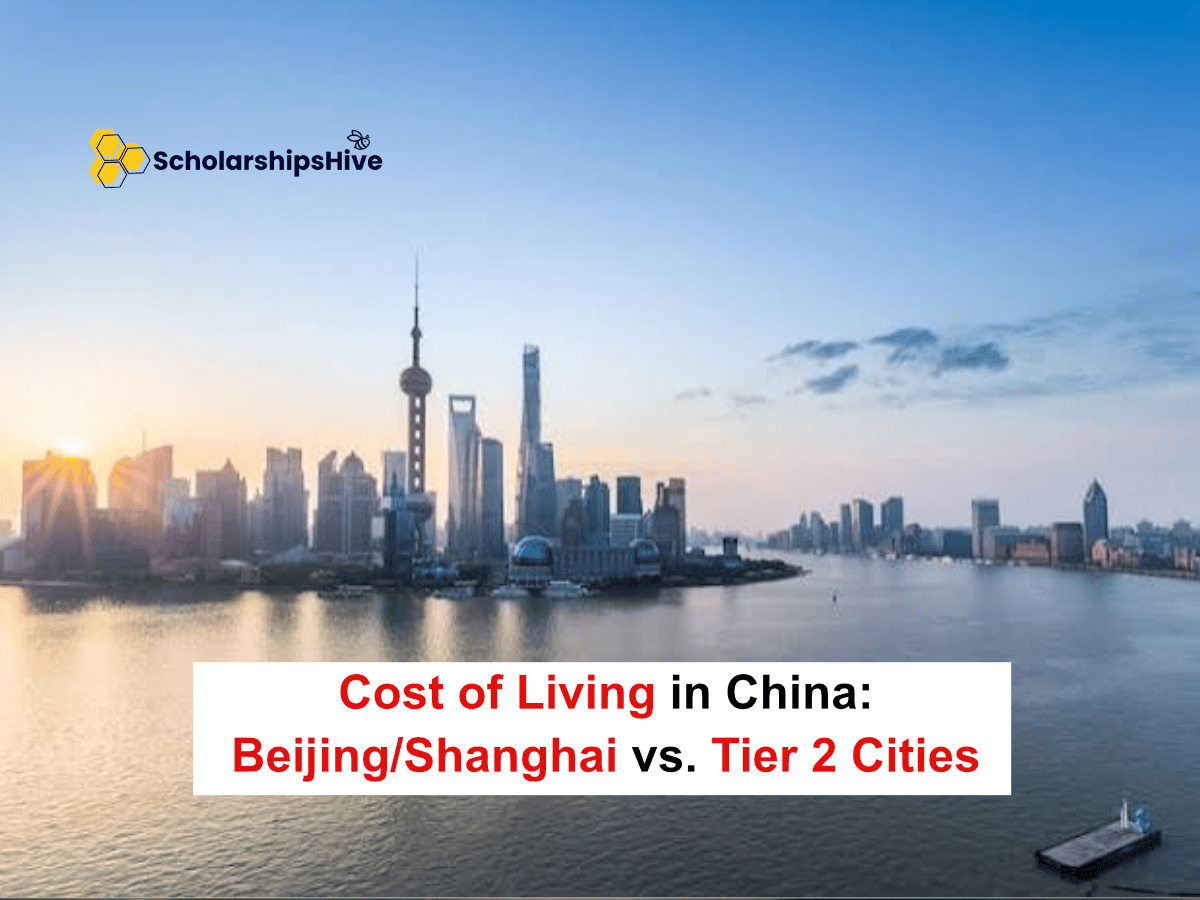
Choosing where to study in China is perhaps the most important financial decision you will make as an international student. While Beijing and Shanghai are global megacities with unmatched career opportunities and vibrant social scenes, they come with a significantly higher price tag. In contrast, Tier 2 cities—such as Wuhan, Chengdu, Xi’an, and Nanjing—offer a balanced lifestyle where your money can stretch significantly further.
If you are planning your budget for 2026, here is the comprehensive breakdown of what you can expect in different Chinese cities.
Understanding the “Tier” System
China classifies its cities into “Tiers” based on economic development, population, and infrastructure:
- Tier 1 Cities (Beijing, Shanghai, Guangzhou, Shenzhen): These are the economic, political, and financial hearts of China. Everything—from rent and dining to leisure—is priced at a premium.
- Tier 2 Cities (Wuhan, Chengdu, Xi’an, Nanjing, Kunming): These are major provincial capitals. They are highly developed, offer excellent world-class universities, and are home to a large international student population, but at a much lower cost of living compared to the capital hubs.
Check this: MOFCOM Scholarship: Master’s for Government Officials, China | Fully Funded
Comparative Monthly Budget (Estimates for 2026)
For a self-funded international student living a moderate, comfortable lifestyle, the difference in monthly expenses can be substantial.
| Expense Category | Tier 1 (Beijing/Shanghai) | Tier 2 (e.g., Wuhan/Chengdu) |
| Rent (Private) | 3,500 – 6,000+ CNY | 1,500 – 3,000 CNY |
| Food (Canteen/Local) | 1,000 – 1,500 CNY | 700 – 1,000 CNY |
| Transport | 200 – 300 CNY | 100 – 200 CNY |
| Social/Leisure | 1,000 – 2,000+ CNY | 400 – 800 CNY |
| Total Monthly | 5,700 – 9,800 CNY | 2,700 – 5,000 CNY |
Note: If you secure university dormitory housing (highly recommended), you can often slash the “Rent” category to nearly zero or a very low, subsidized rate.
Why Your Choice of City Matters
The “Stipend” Reality
If you are a scholarship student, you likely receive a monthly stipend (typically 2,500–3,500 CNY).
- In Tier 2 Cities: Your stipend is often enough to cover your daily needs with room to save for travel or personal electronics.
- In Tier 1 Cities: Your stipend will cover your basic survival, but you will have very little “fun money.” You may find yourself running out of funds before the end of the month if you choose to eat out frequently or shop.
Lifestyle Differences
- Beijing/Shanghai: You pay for the experience. The cost of a coffee, a movie, or a night out in these cities is comparable to major Western capitals. You are paying for proximity to headquarters, international networking, and world-class museums.
- Tier 2 Cities: These cities allow for a “local” lifestyle. Food in local markets and campus canteens is incredibly cheap, and public transportation is consistently affordable. You might trade the skyscraper views of Shanghai for the rich historical culture of Xi’an or the legendary cuisine of Chengdu.
You may like this: Tianjin University Engineering Scholarships: Chemical and Industrial Engineering Grants, China | Partial Funding
Strategic Pro-Tips for Stretching Your Yuan
Successful scholars in China often share a few “secret” habits that separate those who stress about money from those who save effectively:
- The Power of E-Commerce: Apps like Taobao, JD.com, and Pinduoduo are the pillars of the Chinese economy. Learn to use their image-search feature to find the exact same products sold by different vendors at significantly lower prices.
- Prioritize University Dorms: This is the single most effective way to cut costs. They are safe, utilities-inclusive, and allow you to live on campus, eliminating daily commute costs.
- Eat Like a Local: University canteens are heavily subsidized, clean, and offer a wide variety of food. They are the most budget-friendly option for every meal.
- Master Local Apps: Use Alipay and WeChat Pay for everything. Use Meituan or Ele.me for food delivery (often cheaper than eating at sit-down restaurants) and Didi for affordable transportation.
- Always Carry Your Student ID: You can get significant discounts on museum tickets, train travel, and even software subscriptions.
Check this out: Xiamen University Scholarships : Coastal Campus Programs and Student Support, China | Fully Funded
Official Scholarship Resources and Links
To lodge your official digital portfolio and track your 2026 placement, use these certified channels:
- China Scholarship Council (CSC) Official Portal: Your home base for all scholarship policies, university programs, and official application guidelines.
- CSC Student Login Gateway: Essential for tracking your admission status, scholarship details, and administrative updates once you are enrolled.
- HEC Scholarship Portal: The required platform for Pakistani students applying through the Type A (Government-nominated) program.
Join our WhatsApp Channel for the latest updates on international scholarships and deadlines.
Frequently Asked Questions (FAQs)
Is the cost of living really that different between cities?
Yes. While tuition fees are set by the university, daily living costs are driven by local market demand. Beijing and Shanghai have high property costs that trickle down to every other service, whereas inland cities maintain lower costs for goods and services.
Can I live comfortably on a 3,000 RMB stipend?
In a Tier 2 city, yes. You can afford a modest lifestyle, eat well, and explore the city. In a Tier 1 city, 3,000 RMB is the absolute minimum for basic survival, and you will likely need to supplement it with personal savings.
Are there hidden costs I should prepare for?
Initial costs are the biggest. You will need to pay for your visa, flights, and sometimes a security deposit for housing (if off-campus). Always have a buffer fund of at least 10,000 RMB for your first two months.
Final thoughts and advice From ScholarshipsHive
Choosing a city is about balancing your career goals with your financial reality. If your field requires high-level internships in multinational corporations, Beijing or Shanghai might be worth the extra expense. However, for most students, Tier 2 cities offer a higher quality of life, less stress regarding monthly budgets, and a more immersive Chinese experience. In 2026, do your research on the specific city of your university—you might find that a city like Chengdu or Wuhan offers everything you need at half the cost. Your academic journey is a marathon; choose a financial path that lets you reach the finish line without unnecessary burden.