📲 Join our WhatsApp for Daily Fully Funded Scholarship Alerts
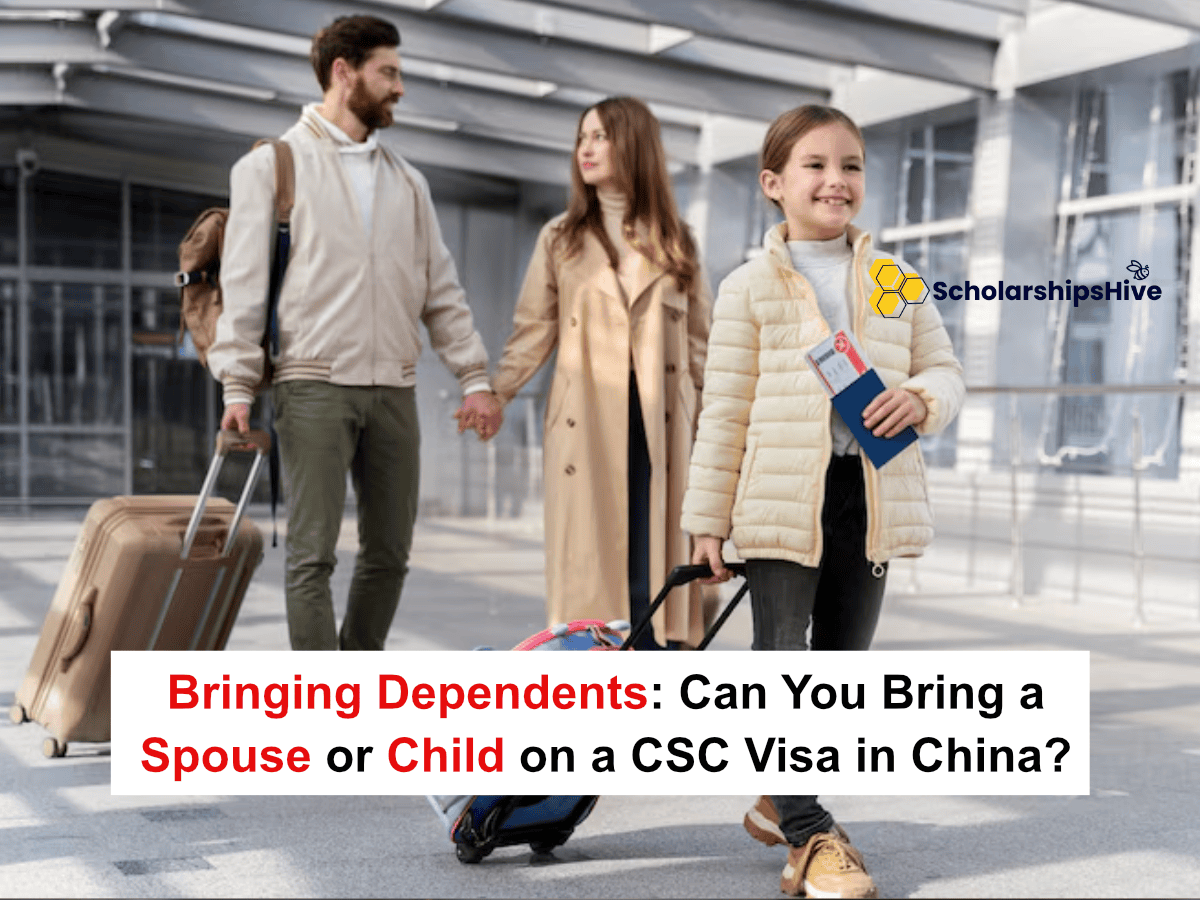
For many international students, the decision to pursue a degree in China involves more than just academic ambitions—it involves family. A common question for scholarship recipients is whether they can bring their spouse or children along for the journey.
The short answer is yes, international students holding an X1 (student) visa and a valid Residence Permit are generally eligible to bring their immediate family members to China. However, this process requires careful planning, documentation, and coordination with local authorities.
Here is the essential guide to navigating the dependent visa process in 2026.
Understanding the Family Visa (S Visa)
China issues specific visas for family members of foreigners residing in the country for work or study. These are known as S Visas. There are two primary categories you need to know:
- S1 Visa: Intended for family members who wish to stay in China for more than 180 days. This is the visa your spouse or children would need if they intend to live with you for the duration of your academic program. Upon entry, the S1 visa holder must convert it into a “Residence Permit for Family Reunion” within 30 days.
- S2 Visa: Intended for family members who are visiting for a short-term stay (180 days or less). This is often used for family members who want to visit during graduation ceremonies, holidays, or short academic breaks.
Who Qualifies as a Dependent?
Under Chinese immigration law, eligible family members are limited to:
- Spouse
- Parents and Parents-in-law
- Children under the age of 18
Note: Other relatives (like siblings or grandparents) are generally not eligible for the S1 visa under an international student’s sponsorship.
Check this: MOFCOM Scholarship: Master’s for Government Officials, China | Fully Funded
The Application Process: Step-by-Step
Bringing your family is not an automatic right; it is a formal application process. You should only initiate these steps after you have secured your own student Residence Permit in China.
Step 1: Gather Required Documentation
You will need to provide proof of your relationship and your financial capability to support them.
- Proof of Kinship: An original, notarized, and authenticated Marriage Certificate (for spouses) or Birth Certificate (for children). If these documents are not in English or Chinese, they must be translated and legally authenticated by the Chinese Embassy in your home country.
- Letter of Invitation: You, as the primary student, must provide a formal invitation letter. This letter should state your relationship, your status in China (including your passport and Residence Permit copies), and your commitment to covering their living expenses.
- Proof of Student Status: A letter from your university’s International Student Office (ISO) confirming your enrollment and current residence status.
Step 2: Visa Application
Your family members must apply for their S1 or S2 visa at the Chinese Embassy or Consulate in their home country. They will need to present your invitation letter and the notarized proof of relationship along with their own passports.
Step 3: Residence Permit Conversion (For S1 Holders)
Once your family members arrive in China on an S1 visa, they have 30 days to convert their visa into a formal Residence Permit for Family Reunion. This is handled at the local Public Security Bureau (PSB) Exit-Entry Administration office in your city.
You may like this: Tianjin University Engineering Scholarships: Chemical and Industrial Engineering Grants, China | Partial Funding
Important Considerations for 2026
While bringing your family is possible, it comes with practical challenges:
- Financial Burden: The CSC scholarship provides a stipend for the student only. It does not provide additional funds, housing, or insurance for dependents. You are legally required to prove that you have sufficient funds to support your family members in China.
- Housing: University dormitories are generally designed for single students. You will likely need to find and rent private off-campus accommodation, which can be significantly more expensive and requires registering your address with the local police.
- Education for Children: Finding an international or local school for your children can be complex and expensive. Research local school options in your specific city well before you arrive.
- Health Insurance: You must arrange private health insurance for your dependents, as the CSC-provided insurance typically covers only the scholarship holder.
Check this out: Xiamen University Scholarships : Coastal Campus Programs and Student Support, China | Fully Funded
Official Scholarship Resources and Links
To lodge your official digital portfolio and track your 2026 placement, use these certified channels:
- China Scholarship Council (CSC) Official Portal: Your home base for all scholarship policies, university programs, and official application guidelines.
- CSC Student Login Gateway: Essential for tracking your admission status, scholarship details, and administrative updates once you are enrolled.
- HEC Scholarship Portal: The required platform for Pakistani students applying through the Type A (Government-nominated) program.
Join our WhatsApp Channel for the latest updates on international scholarships and deadlines.
Frequently Asked Questions (FAQs)
Can my dependents work in China?
No. Family members holding an S1/S2 visa are not permitted to work in China. Engaging in any form of employment on this visa is a violation of Chinese immigration law and can lead to immediate deportation.
Should I bring my family at the same time I move?
It is often recommended to arrive first, settle into your university, find suitable off-campus housing, and understand the local PSB requirements before bringing your family. This helps avoid the stress of trying to find long-term housing while your family is waiting in temporary accommodation.
Can I bring my parents?
Yes, parents and parents-in-law are eligible under the “immediate family” category for an S1 visa.
Final thoughts and advice From ScholarshipsHive
Bringing your family to China can make your study experience much more rewarding, but it requires thorough preparation and financial readiness. Start the document authentication process (notarization of marriage/birth certificates) in your home country well in advance, as these processes can take time. Always communicate with your university’s International Student Office before making travel arrangements; they are the best resource for the specific procedures of your host city. In 2026, with careful planning and adherence to the legal requirements, your family can share in your academic journey abroad.