When you open a scholarship portal for the USA, UK, Germany, or Australia, one of the first questions you’ll encounter is: “What is your GPA?”
For many international students, this is a moment of panic. If your home university uses a 10-point CGPA, a percentage system, or a “Division” classification, you might feel like your hard-earned grades are getting “lost in translation.”
At Scholarships Hive, we believe that a 3.2 GPA in a rigorous engineering program can be just as valuable as a 4.0 in an easier field. This guide will teach you how to convert your local grades like a pro, meet international eligibility criteria, and even how to handle a “low” GPA in your application.
1. Understanding the Global Grading Systems
Before you start calculating, you must realize that there is no “universal” GPA. Every country—and sometimes every university—has its own language for success.
The US 4.0 Scale
Common in the USA, Canada, and parts of the Middle East. It ranges from 0.0 (Fail) to 4.0 (A/Excellent).1
- 3.5 – 4.0: Competitive for top-tier scholarships (Fulbright, Ivy Leagues).2
- 3.0 – 3.4: Good for most state universities and mid-range funding.
The UK Classification System
The UK doesn’t use GPA.3 They use “Honours” classifications:4
- First Class (1st): Usually 70%+. Equivalent to a 3.7–4.0 US GPA.
- Upper Second Class (2:1): 60–69%.5 This is the “Gold Standard” for Chevening and Commonwealth scholarships.
- Lower Second Class (2:2): 50–59%. Still eligible for many Master’s programs.
You may also like The Scholarship Documentation Masterclass: How to Prepare Winning Documents
The German “Bavarian” Formula
Germany uses a reverse scale where 1.0 is the best and 4.0 is the minimum pass.6 If you are applying for DAAD, you must know this formula.
2. How to Convert 10-Point CGPA to 4.0 GPA
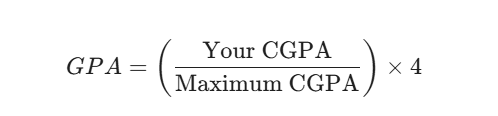
If your transcript is from a 10-point system (common in India, Pakistan, and Nepal), use this globally accepted formula for a quick estimation:
Example:
If your CGPA is 8.2 out of 10:
- Divide 8.2 by 10 = 0.827
- Multiply 0.82 by 4 = 3.28 GPA8
Scholarship Hive Tip: While this formula is great for your CV, always check if your target university requires a WES (World Education Services) evaluation.9 Some scholarships will not accept self-calculated GPAs.10
3. Converting Percentages to GPA
Many systems still rely on percentages (out of 100). To convert these, you can use the following general table used by international admissions offices:
| Percentage Range | US Grade | 4.0 GPA Equivalent |
| 90% – 100% | A+ / A | 4.0 |
| 80% – 89% | A- / B+ | 3.5 – 3.9 |
| 70% – 79% | B | 3.0 – 3.4 |
| 60% – 69% | C+ | 2.5 – 2.9 |
| 50% – 59% | C | 2.0 – 2.4 |
4. The German Calculation: The Bavarian Formula
Applying for a scholarship in Germany? The “Bavarian Formula” is the only one they trust. It looks complicated, but it’s very accurate.
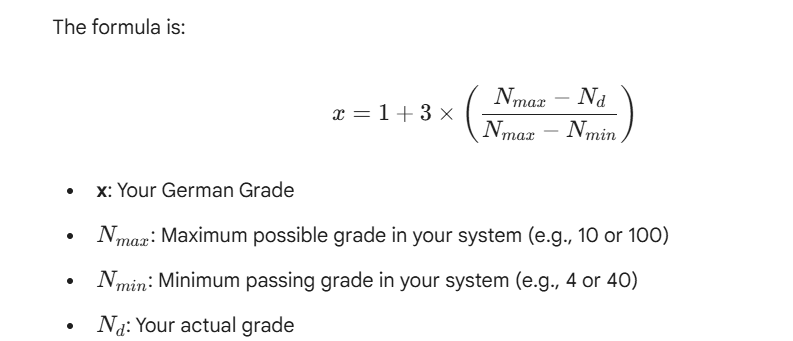
The Result: If your x is between 1.0 and 1.5, you are a top-tier candidate for German funding.
5. How to Explain a “Low” GPA (The “Comeback” Strategy)
One of the most frequent questions we get at Scholarships Hive is: “Can I get a scholarship with a 2.5 or 2.8 GPA?”
The answer is YES, but you have to be intentional. Do not hide your GPA; instead, provide context.
A. Use the “2-Sentence Rule” in your SoP
Don’t write a page of excuses. Use two sentences to explain the “Why” and the “Result.”
- The Context: “During my second year, I managed a family health crisis that required me to work 30 hours a week alongside my studies.”
- The Pivot: “Despite this, I maintained an upward trend in my final two years, scoring an A in all my core major subjects.”
B. Highlight the “Major” GPA
Sometimes your overall GPA is low because of elective subjects (like Art History or Physical Ed) that have nothing to do with your degree. In your CV, you can list your Major GPA separately to show your expertise in your actual field of study.
C. Focus on Extracurriculars and Research
If your grades aren’t perfect, your Letter of Recommendation (LoR) must be. A professor’s testimony about your research skills or leadership can often “outweigh” a lower GPA in the eyes of a holistic committee.
Check out Essential Documents Required for Student Visa Application: A Complete Checklist
6. Essential Checklist for GPA Submission
Before you submit your transcript, ensure you have:
- Official Grading Scale: Every transcript should have a “Key” on the back explaining the grades. If yours doesn’t, request an official “Grading Scale Letter” from your Registrar.
- English Translation: If your transcript is in Urdu, Arabic, or Spanish, it must be translated by a certified professional.
- No Rounding Up: If your GPA is 3.49, do not write 3.5. Scholarship committees view this as academic dishonesty.
Conclusion: Your Grades Don’t Define Your Destiny
While a high GPA opens doors, your Statement of Purpose and Letters of Recommendation are what get you through the room. Use this guide to present your grades accurately and professionally. Remember, the goal of the committee is to find a “potential leader,” not just a “grade-scoring robot.”
Start your calculations today, and if you need help, join our WhatsApp Channel where we share daily tips on winning fully funded opportunities!