📲 Join our WhatsApp for Daily Fully Funded Scholarship Alerts
You did it. You pushed through the visa interviews, the document legalizations, and the long-haul flights. You’ve officially landed in Italy! Whether you’re staring at the Duomo in Milan or the ancient ruins of Rome, take a deep breath. You’ve made it.
But here’s the reality check: while your visa allows you to enter the country, it doesn’t legally allow you to stay for the long term. In the eyes of the Italian government, your first week is a race against the clock. Italy has a strict “8-Day Rule.” Within eight working days of your arrival, you must initiate the process for your Residency Permit (Permesso di Soggiorno).
If you’re feeling overwhelmed by the thought of Italian post offices and police stations, don’t worry. I’ve been through this maze, and I’ve broken down the exact steps you need to take to stay legal, secure your SIM card, and start living like a local.
Step 1: Your “Codice Fiscale” (The Key to Your Italian Life)
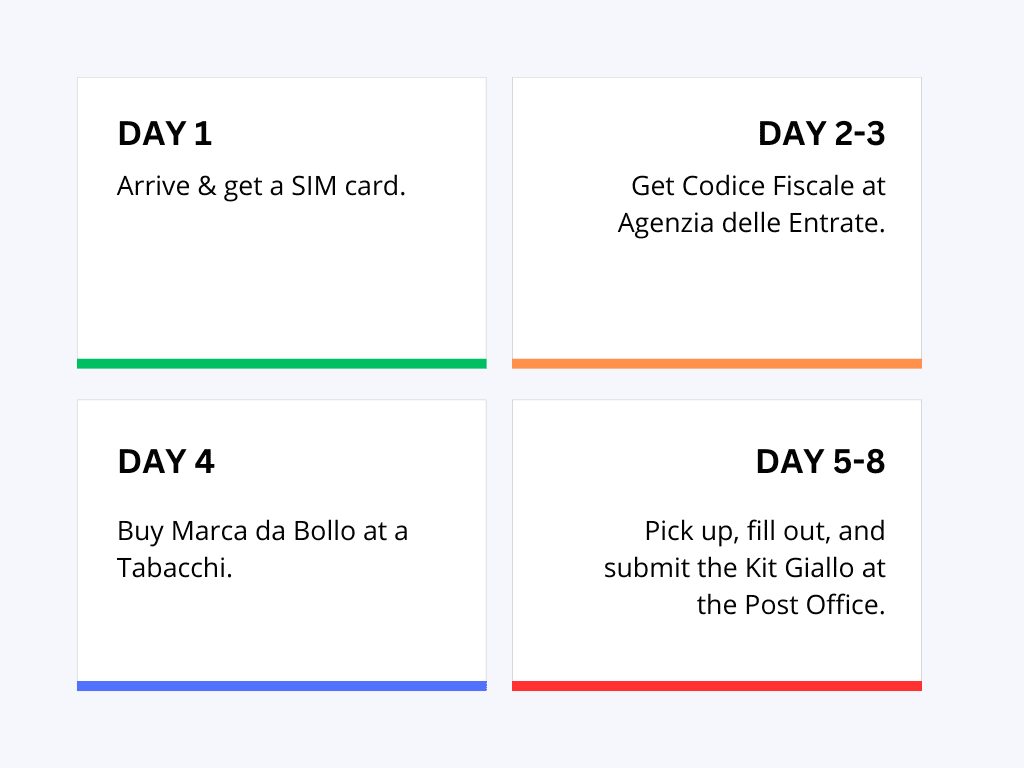
Before you can even think about the Post Office, you need your Codice Fiscale. Think of this as your Italian Social Security or Tax Number. It is a 16-character alphanumeric code that identifies you in every government database.
Why you need it immediately: You cannot rent an apartment, open a bank account, or even sign up for a cheap Iliad or Ho Mobile SIM card without it.
How to get it in 2026:
- Check Your Papers: In 2026, many students receive their Codice Fiscale automatically via the Universitaly Portal or attached to their Visa documents from the Consulate. If you have it, print three copies and skip to Step 2.
- The In-Person Visit: If you don’t have it, head to the nearest Agenzia delle Entrate. You typically don’t need an appointment for this, but I highly recommend arriving at 8:15 AM before the doors open.
- What to Bring: Your passport (original + 2 photocopies) and your university admission letter.
- The Form: Ask for Form AA4/8. You’ll fill it out with your personal details. If you don’t have a permanent address yet, you can often use your hostel or university dorm address temporarily.
Step 2: The Hunt for the “Marca da Bollo”
In Italy, official documents are only valid if they have a “government tax stamp” attached. This is the Marca da Bollo.
- The Hunt: Look for a shop with a large Blue and Black “T” sign (Tabacchi). Every neighborhood has one.
- The Cost: In 2026, the price is €16.00.
- Crucial Warning: Do not lose this sticker! It is as valuable as cash. Also, do not stick it on anything yet. You will glue it onto your residency application (Modulo 1) in front of the Post Office clerk later.
Step 3: The “Kit Giallo” (Your Residency Permit Application)
Now we enter the heart of Italian bureaucracy: the Permesso di Soggiorno. For stays longer than 90 days, this is mandatory.
- Where to go: Find a Poste Italiane that has a “Sportello Amico” logo at the entrance.
- The Request: Walk up to the counter and ask for the “Kit Giallo per il Permesso di Soggiorno” (the Yellow Kit). It is a large envelope with a yellow stripe, and it is free.
How to Fill Out “Modulo 1”
The kit contains several forms, but as a student, you generally only need to fill out Modulo 1.
- The Rules: Use Black Ink only. Write in ALL CAPS. If you make a mistake, don’t use white-out; get a new kit.
The “Cheat Sheet” for Attachments (Photocopies Only):
- Passport: Photocopy of the data page and the page with your Italian Visa.
- University Admission: Your Universitaly summary or enrollment letter.
- Proof of Funds: For 2026, you must show you have at least €7,101.12 for the year. This can be a bank statement or your DSU Scholarship letter. (Tip:When filling your residency kit, include your DSU Scholarship proof to avoid showing extra bank funds.)
- Health Insurance: A policy valid for Italy covering at least €30,000.
- Accommodation: A rental contract or a declaration of hospitality.
Step 4: Costs and the “Golden Receipt” (Ricevuta)
Once your kit is ready, go back to the Sportello Amico. The clerk will take your passport, scan your kit, and ask for payment.
The 2026 Fee Breakdown:
- €30.46 for the electronic permit card.
- €40.00 for the residence permit (for stays between 3 months and 1 year).
- €30.00 for the mailing service fee.
- Total: Expect to pay approximately €100.46 (plus your €16 stamp).
The “Ricevuta”: The clerk will hand you a receipt with a hologram. Treat this like your passport. In Italy, the Ricevuta is your legal proof of residency until your actual plastic card is ready (which can take months). It has a User ID and Password that allows you to track your status on the Portale Immigrazione website.
Step 5: The Questura Appointment (Fingerprinting)
When you submit your kit, the Post Office will automatically generate an appointment for you at the Questura (Police Headquarters).
- Check the Slip: The receipt will tell you the exact date and time you must go for your biometrics (fingerprinting).
- What to Bring: 4 identical passport photos (white background), the original documents you photocopied for the kit, and your precious Ricevuta.
P.s: When I first went to the Questura, I forgot my passport photos—don’t make that mistake!
Step 6: Bonus—Living Like a Local in Your First Week
Paperwork is exhausting. Once you’ve submitted your kit, take these three steps to make your life easier:
- SIM Cards: Don’t go to the big brands like TIM or Vodafone at first. Go to an Iliad kiosk or a PosteMobile counter. You can get 150GB–200GB of data for about €7.99–€9.99/month.
- Public Transport: Visit the local transport office (e.g., ATM in Milan, ATAC in Rome) with your Codice Fiscale. Ask for the “Abbonamento Studenti” (Student Pass). It usually costs around €22–€35 per month for unlimited travel.
- Grocery Strategy: Find your local Lidl, Eurospin, or Esselunga. Eating out in Italy is beautiful, but groceries are how you survive on a scholarship budget!
Frequently Asked Questions (FAQs)
1. What happens if I miss the 8-day deadline to apply for the Permesso di Soggiorno?
While Italian authorities are sometimes lenient if you miss it by a day or two due to weekends or holidays, a significant delay can lead to your stay being declared illegal. You could face problems during the fingerprinting appointment or even be asked to leave. Always try to get your “Ricevuta” within the first week.
2. Can I travel with only the Post Office receipt (Ricevuta)?
Yes, but with restrictions. You can travel between Italy and your home country on a direct flight (no layovers in other Schengen countries like Germany or France). You must carry your original passport, the Ricevuta, and your expired permit (if it’s a renewal).
3. Do I need an Italian bank account for the Permesso di Soggiorno?
Not necessarily. You can use a bank statement from your home country (translated) or a statement from an online bank like Revolut or Wise, as long as it clearly shows your name and the required funds for the 2026 academic year.
